
Natural Environment Teaching (NET) is a play-based ABA method that teaches skills during everyday activities rather than at a structured table. It uses the child’s natural interests, such as a favorite toy or snack, to create learning opportunities. NET works best for children ages 2 to 7.
If your child’s ABA program includes time on the floor, in the kitchen, or at the playground rather than only at a desk, you are already seeing Natural Environment Teaching in action. NET is the play-based counterpart to Discrete Trial Training (DTT), and almost every quality ABA program uses both methods together.
This guide explains what NET is, how it works in real life, the techniques your BCBA may use within it, and how it compares to other ABA approaches you may have heard about.
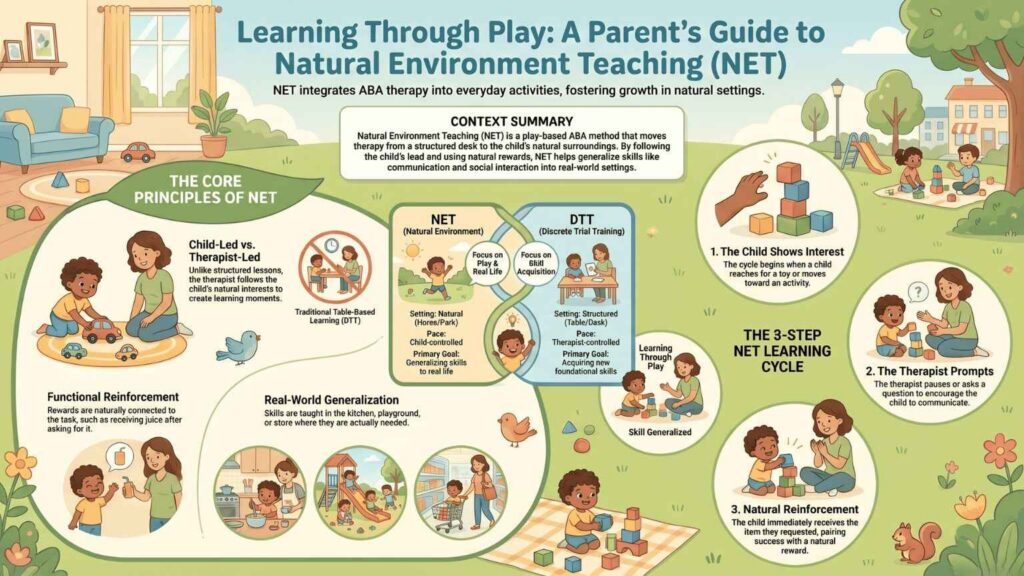
What is Natural Environment Teaching in ABA?
Natural Environment Teaching is an ABA method that delivers learning opportunities inside a child’s everyday activities and surroundings. Instead of bringing the child to a teaching table, the therapist brings the teaching to wherever the child already is, the living room floor, the bath, the swing set, the snack table.
NET is rooted in research from the 1970s by Drs. Betty Hart and Todd Risley, who showed that children learn language more naturally when adults respond to the child’s own interests rather than directing every interaction [1]. The method was later adapted specifically for children with autism by Dr. Gail McGee through the Walden Early Childhood Center at Emory University [2].
Three things define NET:
- Child-led, not therapist-led: The therapist follows what the child is already interested in and turns that interest into a teaching opportunity.
- Functional reinforcement: The reward is naturally connected to the task. If the child asks for juice, they get juice, not a sticker.
- Real-world settings: Skills are taught in the same environment where the child will actually need to use them: home, playground, store, school.
Like DTT, NET is one technique inside the broader Applied Behavior Analysis framework. It is not a separate therapy.
Wondering if play-based ABA would actually work for your child?
Fill in the form below to discuss how your child could start therapy quickly, without the stress:
How is NET different from Discrete Trial Training (DTT)?
DTT and NET are often described as opposites, but a strong ABA program uses both. The difference comes down to who leads and where the learning happens.
Feature | NET | DTT |
Setting | Wherever the child is: floor, kitchen, park | Structured area, usually a table |
Who leads | The child’s interests | The therapist’s lesson plan |
Pace | Child-controlled | Therapist-controlled |
Reinforcer | Naturally connected to the task | Often unrelated (token, snack, toy) |
Best for | Generalization, spontaneous communication, social skills | New skill acquisition, foundational targets |
Looks like | Play | Structured teaching |
A common pattern is to teach a new skill at the table using DTT (where repetition and prompts are easiest), then move the same skill into NET on the floor (where the child practices using it in real situations). This blend is what most modern programs call eclectic or naturalistic-behavioral teaching [3]. For a complete comparison of all four major ABA methods and which blend likely fits your child best, see our guide to Types of ABA Therapy Methods Explained.
How Does NET Work in Practice?
NET still follows the core ABA cycle of antecedent, behavior, and consequence but the antecedent comes from the child, not the therapist.
Here is how a typical NET teaching moment unfolds:
- The child shows interest in something: The child reaches for a toy car, walks toward the kitchen, or looks at the bubbles on the table.
- The therapist recognizes the teaching opportunity: Instead of just handing over the car, the therapist holds it up and waits.
- The therapist sets up a prompt: “What do you want?” or “Tell me – car or truck?”
- The child responds. The child says “car” (or signs, points, uses an AAC device, whatever communication system fits).
- The child gets the natural reinforcer: The car goes to the child immediately, paired with brief social praise.
- The therapist records the data: As with all ABA methods, every learning opportunity is tracked so progress is measurable.
The whole exchange takes 10 to 30 seconds and looks nothing like a lesson. To a watching parent, it just looks like the therapist is playing with the child. That is the point. NET is designed to feel natural so the child stays engaged and the skill transfers into real life [4].
What Does a NET Session Look Like at Home?
A typical in-home NET session lasts 1 to 3 hours and rotates through whatever activities the child enjoys. The therapist arrives with a few preferred items in mind but follows the child’s lead throughout the session.
Here is what a real 90-minute session might look like for a 3-year-old child working on requesting and social interaction:
- First 20 minutes — Floor play with cars: The child rolls cars across the rug. The therapist holds up two different cars at a time and waits for the child to request one (“red,” “fast one,” “more”). Each correct request earns the car immediately.
- Next 15 minutes — Snack time: The therapist sits with the child at a low table with snacks visible but slightly out of reach. The child practices saying “open,” “help,” or “I want crackers” to access each item.
- Next 20 minutes — Bubbles in the backyard: The therapist blows bubbles. The child practices saying “more,” pointing at the bubble wand, or making eye contact to request another round.
- Next 20 minutes — Pretend kitchen play: The child cooks with toy food. The therapist embeds turn-taking, color identification, and simple back-and-forth conversation into the play.
- Last 15 minutes — Parent training and data review: The therapist briefly shares what worked, gives parents one or two strategies to try during the week, and records the day’s data.
A center-based NET session looks similar but uses the center’s play stations, snack bar, and outdoor area instead of the home. NET delivered in your home is one of the strengths of in-home ABA therapy because the child practices in the exact environment where the skill needs to stick.
What Skills Can NET Teach My Child?
NET works best for skills that depend on motivation, social context, or spontaneous use. Skills commonly taught with NET include requesting (also called manding), expressive language during play, joint attention, turn-taking, social initiation, play skills, and adaptive routines such as handwashing or putting on shoes.
NET is less effective for skills that need many repetitions in a controlled setting to build, such as letter identification, number sequencing, or precise imitation of complex movements. Those skills are usually started in DTT and then carried into NET once the child has the basic response down [3].
A good way to think about it: DTT teaches the skill, NET makes the skill real.
Not sure which skills your child should work on first?
NET Techniques: Incidental Teaching, Mand-Modeling, and Time Delay
Inside the NET framework, your BCBA may use one or more specific techniques. The three most common are:
1. Incidental teaching
The original NET technique, developed by Hart and Risley in 1975, and adapted for autism by McGee in the 1990s [1][2]. The therapist arranges the environment so preferred items are visible but require the child to communicate to access them. When the child initiates by reaching, looking, or vocalizing, the therapist uses that moment to prompt a slightly more advanced response, then delivers the item as the reinforcer.
2. Mand-modeling
Used when a child does not spontaneously initiate. The therapist models the desired response (“Say ‘ball'”) and then prompts the child to imitate it before delivering the item. Over time, the model is faded and the child begins making requests independently.
3. Time delay
The therapist pauses expectantly when the child wants something, giving the child 3 to 5 seconds to initiate communication on their own before any prompt is offered. This builds independence and reduces prompt dependency.
Most NET programs use all three techniques, switching between them based on the child’s response at the moment. Your BCBA will choose the right mix during the ABA assessment and revise it as your child progresses.
At What Age Does NET Work Best?
NET is most effective in the early intervention years — roughly ages 2 to 7 — when children are still developing core language and play skills. The McGee Walden program was specifically designed for toddlers and preschoolers with autism, and follow-up research showed strong outcomes for children who started NET-based intervention before age 3 [2].
That said, NET continues to be useful at every age. Older children, teens, and even autistic adults benefit from NET when working on functional life skills such as job tasks, community outings, or self-advocacy. The setting changes, a job site instead of a playroom but the principle stays the same: teach the skill where it is going to be used.
If your child is under age 3 and you are considering ABA, early intervention using a NET-heavy approach is often the recommended starting point because young children typically resist long stretches of structured table work.
Would your child do better with a play-based approach? Let's find out.
Frequently asked questions about NET
Is NET as evidence-based as DTT?
Yes. Naturalistic ABA methods, including NET and incidental teaching, are supported by decades of peer-reviewed research and are recognized by the American Academy of Pediatrics as evidence-based components of autism intervention [5]. The 2015 consensus paper on Naturalistic Developmental Behavioral Interventions (NDBI) classified NET-style methods as a research-supported category of treatment [3].
Can NET happen during regular family activities like meals or bath time?
Yes and it should. Some of the best NET teaching opportunities are during routine activities your family already does every day. A skilled BCBA will teach you how to embed NET strategies into mealtime, bath time, dressing, and bedtime. This is one of the most valuable parts of the parent training component of ABA therapy.
Do NET sessions feel different to my child than DTT sessions?
Almost always, yes. NET feels like play, while DTT feels like structured learning. Many children who initially resist table work happily engage in NET because the activities are based on what they already enjoy. This is also why most modern programs lead with NET for younger children and add DTT gradually.
Will my child still need DTT if they respond well to NET?
Most likely yes. NET excels at teaching when motivation already exists, but some foundational skills, such as accurate letter sounds, math facts, or precise imitation, benefit from the repetition and predictability that DTT provides. Your BCBA will recommend a ratio based on your child’s specific needs.
Is NET covered by insurance?
Yes. NET is part of standard ABA therapy and is included in coverage from major carriers such as Aetna, Cigna, UnitedHealthcare, Anthem BCBS, and state Medicaid programs in eligible states. See our ABA therapy insurance guide for New York for details on verifying your benefits.
Talk to a BCBA about whether NET is right for your child
Most children benefit from a blend of NET and DTT, but the right ratio depends on your child’s age, current skills, and goals. The only reliable way to know is a proper assessment by a Board Certified Behavior Analyst. Our team has supported families across New York, New Jersey, Connecticut, Georgia, and North Carolina since 2015 and would be glad to answer your questions.
References
[1] Hart, B., & Risley, T. R. (1975). “Incidental teaching of language in the preschool.” Journal of Applied Behavior Analysis, 8(4), 411–420.
https://pmc.ncbi.nlm.nih.gov/articles/PMC1311874/
[2] McGee, G. G., Morrier, M. J., & Daly, T. (1999). “An incidental teaching approach to early intervention for toddlers with autism.” Journal of the Association for Persons with Severe Handicaps, 24(3), 133–146. https://journals.sagepub.com/doi/10.2511/rpsd.24.3.133
[3] Schreibman, L., Dawson, G., Stahmer, A. C., Landa, R., Rogers, S. J., McGee, G. G., et al. (2015). “Naturalistic Developmental Behavioral Interventions: Empirically Validated Treatments for Autism Spectrum Disorder.” Journal of Autism and Developmental Disorders, 45(8), 2411–2428. https://pubmed.ncbi.nlm.nih.gov/25737021/
[4] Indiana Resource Center for Autism, Indiana University Bloomington. “Naturalistic Teaching Strategies.”
https://iidc.indiana.edu/irca/
[5] Hyman, S. L., Levy, S. E., Myers, S. M., & AAP Council on Children with Disabilities. (2020). “Identification, Evaluation, and Management of Children With Autism Spectrum Disorder.” Pediatrics, 145(1).
https://publications.aap.org/pediatrics/article/145/1/e20193447/36917/
[6] McGee, G. G., Krantz, P. J., & McClannahan, L. E. (1985). “The facilitative effects of incidental teaching on preposition use by autistic children.” Journal of Applied Behavior Analysis, 18(1), 17–31. https://pubmed.ncbi.nlm.nih.gov/3997695/
[7] Behavior Analyst Certification Board (BACB). “About Behavior Analysis.” https://www.bacb.com/about-behavior-analysis/