
When a child with autism turns 3, one of the most important transitions in their early life happens quietly in a school district conference room: their Individualized Education Program, their first IEP is written. For families navigating this for the first time, the meeting can feel overwhelming. You are asked to approve goals for a 3-year-old that will shape their next 12 months of school support. Most parents do not know what to ask for. This guide changes that. It covers the 5 priority goal areas for autistic toddlers ages 3–5, gives you real measurable goal examples, and tells you exactly what to say at your child’s IEP meeting. [1]
Why Age 3 Is a Critical IEP Moment
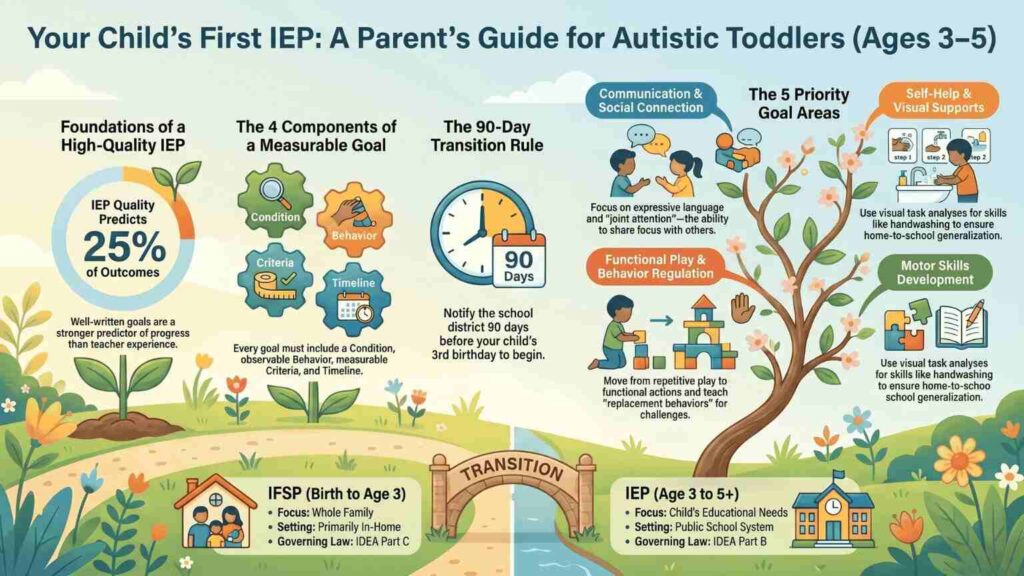
Before age 3, children with autism who receive early intervention services have an IFSP “Individualized Family Service Plan” under Part C of IDEA. [2] The IFSP focuses on the whole family and is delivered primarily in the home. On the child’s third birthday, that plan transitions to a Part B IEP, governed by a different section of IDEA and delivered through the public school system.
This shift from IFSP to IEP is not automatic, it requires an evaluation, an eligibility determination by the school, and an IEP meeting. Under federal law, the IEP must be written and in place by the child’s third birthday. [3] A critical detail parents often miss: the school district must be notified at least 90 days before the third birthday if the child is currently in Part C services, so this process can begin in time.
Why does this timing matter for goals? Because the brain at ages 3 to 5 is in its single most plastic period, its highest capacity for learning and reorganization. Research consistently shows that ABA interventions initiated before age 5, and specifically between 18 and 36 months, produce the strongest long-term gains in language, cognition, and adaptive behavior. [4] The goals written at this first IEP set the foundation for everything that follows.
Read More: ABA Therapy for Toddlers: Why Starting Before Age 3
Starting an IEP and Want ABA Goals Aligned from Day One? ABS BCBAs Attend IEP Meetings.
Fill in the form below to discuss how your child could start therapy quickly, without the stress:
What Makes a Good IEP Goal for a 3–5 Year Old with Autism?
Under IDEA, every IEP goal must be measurable. [1] For toddlers and preschoolers, this matters even more because vague goals lead to unclear progress monitoring and make it harder for both the school team and families to know if interventions are actually working. Research published in PMC found that IEP quality accounted for one quarter of the variance in child outcomes for young children with autism, meaning how well goals are written directly predicts how much progress children make. [5]
Every strong toddler IEP goal should include all four of these components:
Component | What It Means | Example Language |
Condition | Under what circumstances will the skill occur? | “Given a verbal prompt from an adult…” or “During free play…” |
Behavior | What specific, observable skill will the child demonstrate? | “…will request a preferred item using a 2-word phrase…” |
Criteria | How well and how consistently must the child perform? | “…with 80% accuracy across 3 consecutive sessions…” |
Timeline | When will the goal be measured or achieved? | “…by the end of the IEP year (within 12 months)” |
A vague goal like ‘improve communication skills‘ cannot be tracked, celebrated, or used to change the program when things aren’t working. A good goal specifies exactly what the child will do, when, and at what level of accuracy.
Did You Know?
A published study of children with autism in early childhood programs found that IEP quality accounted for approximately 25% of the variance in child outcomes, more than teacher experience or classroom characteristics. Well-written, specific, measurable goals are not bureaucratic paperwork. They are the strongest predictor of how much progress your child makes that year. [5]
The 5 Priority Goal Areas for Autistic Toddlers Ages 3–5
IDEA requires preschool IEPs to address all areas where a child’s disability affects their ability to participate in age-appropriate activities. [3] For most autistic 3–5 year olds, these five domains carry the highest priority. The examples below are starting points every goal must be individualized to your child’s current assessment data.
1. Communication – Expressive & Receptive Language
Communication is almost always the highest-priority domain for autistic toddlers. Research confirms that early, intensive language intervention during the preschool years produces the largest and most durable gains across all other developmental outcomes. [4] Both expressive language (what the child says or communicates) and receptive language (what the child understands) need explicit goals.
Example goal: “Given a motivating item during structured activities, [child’s name] will spontaneously request the item using a 2-word phrase (e.g., ‘more juice,’ ‘want ball’) in 4 out of 5 opportunities across 3 consecutive sessions.” Why it matters: This goal is measurable, tied to natural motivation, and creates a direct pathway to communication independence. |
Example goal: “When given a 1-step verbal direction without gestures in a structured setting, [child’s name] will follow the direction correctly in 4 out of 5 trials as measured by RBT data collection.” Why it matters: Following instructions is a foundational academic-readiness and safety skill for all preschool environments. |
Ask for: Both an expressive and a receptive language goal. If your child is minimally verbal, ask specifically about AAC (Augmentative and Alternative Communication) picture exchange, speech-generating devices, or sign support. The IEP must include this if the evaluation data supports it. [6]
2. Social Communication & Joint Attention
Joint attention, the ability to share focus with another person on an object or activity is one of the earliest and most important social communication skills. Deficits in joint attention in young autistic children are strongly associated with later language and social outcomes. [7] Preschool IEPs for autistic toddlers must address these skills if they are areas of delay.
Example goal: “During play activities, [child’s name] will initiate joint attention by pointing to or showing an object of interest to a familiar adult in 3 out of 5 opportunities, without prompting, across 4 consecutive sessions.” Why it matters: Pointing to share not just to request, is a qualitatively different skill that underpins social communication development. |
Ask for: A goal that specifically targets initiating joint attention (not just responding to it). Schools often only target the easier ‘responding to’ version. Initiating is the harder and more socially meaningful skill.
3. Play Skills – Functional and Symbolic
Play is how toddlers learn almost everything. For autistic children ages 3–5, play skills are often significantly delayed, many remain at a sensorimotor or repetitive level while peers engage in functional and symbolic play. Research on play-based interventions for autistic children ages 2–8 shows significant gains in both social communication and peer interaction when play goals are included in IEPs. [7]
Example goal: “During a 10-minute structured play activity, [child’s name] will engage in 2 or more functionally appropriate actions with a toy (e.g., rolling a car, feeding a doll) for 3 out of 4 observed play sessions as measured by teacher observation.” Why it matters: Functional play precedes symbolic play. Goals here create the foundation for imaginative play with peers. |
Ask for: A separate, specific play goal, not ‘social play’ lumped together with peer interaction. And ask whether the goal will be targeted in natural play settings, not only at a therapy table.
4. Behavioral Regulation & Transition Tolerance
Challenging behaviors in autistic toddlers most often serve a communication function, the child is expressing a need they cannot yet communicate in words. [5] When a school writes a behavior goal for a 3-year-old, it must be paired with a replacement behavior, a new appropriate way to express the same need. Goals that only target reducing a behavior without teaching a functional replacement are not best practice and are unlikely to produce lasting change.
Example goal: “When presented with a non-preferred demand, [child’s name] will hand a visual break card to the adult (instead of dropping to the floor or crying) in 4 out of 5 opportunities across 3 consecutive school days.” Why it matters: This goal teaches the same function (escape) in an appropriate, communicative way. Tracking it against baseline data confirms whether the intervention is actually working. |
Ask for: If behavior is a concern, request that the IEP include a Behavior Intervention Plan (BIP) based on a Functional Behavior Assessment (FBA). A BIP without an FBA is built on guesswork. The FBA must identify why the behavior occurs before any plan is designed. [1]
5. Self-Help & Adaptive Living Skills
Preschool-aged autistic children often need explicit instruction in daily living skills that typically developing peers acquire without teaching handwashing, toileting, dressing, mealtime routines. These skills are foundational for preschool participation and for independence. IDEA Part B preschool IEPs must address how the disability affects participation in appropriate activities for the child’s age and self-care is central to that. [3]
Example goal: “Given a 5-step visual task analysis posted in the bathroom, [child’s name] will complete all 5 handwashing steps independently (without verbal prompting) in 4 out of 5 consecutive school bathroom visits.” Why it matters: Visual task analyses are an evidence-based support that generalizes this skill across school and home environments simultaneously. |
Ask for: Self-help goals that use visual support from day one because skills taught with visuals generalize more reliably to home and community settings than skills taught with verbal prompting alone.
Read More: IEP vs 504 Plan for Autism: Which Does Your Child Actually Need?
What to Ask at Your Child's First IEP Meeting
You are an equal member of your child’s IEP team by law. [1] Here is the language to use:
Questions Every Parent of a 3–5 Year Old with Autism Should Ask at the IEP Meeting
1. “Can you show me the assessment data that supports each goal you’ve written?”
Goals must connect to evaluation findings, not be generic fillers.
2. “How will we measure progress on each goal, and how often will I receive data?”
IDEA requires progress reporting at least as often as report cards are sent to general ed students.
3. “Is there an AAC evaluation included if my child has limited verbal communication?”
Schools must evaluate and address communication needs in all modalities.
4. “Will there be a Functional Behavior Assessment if my child has challenging behaviors?”
A BIP without an FBA is not evidence-based and is unlikely to work.
5. “How do these IEP goals align with what my child is working on in ABA therapy?”
Coordinated goals produce far better outcomes than siloed ones.
6. “Can ABA therapy be included as a related service in this IEP?”
This is your legal right to request; the team must consider it.
How ABA Therapy and IEP Goals Work Together for Toddlers
ABA therapy and a well-written IEP are not parallel systems, they should be the same system, working toward the same goals in different settings. When a BCBA and an IEP team are aligned, the skills an autistic toddler learns in ABA sessions are the exact same skills the preschool teacher is working on every morning. That consistency is what drives generalization and generalization is the goal.
At Achievement Behavior Services, our BCBAs regularly attend IEP meetings alongside families in New York, New Jersey, Connecticut, Georgia, and North Carolina. We help parents understand what to request, how goals should be written to align with ABA programming, and how to ensure the school’s plan and the ABA program reinforce each other rather than pulling in different directions.
ABS BCBAs Work Directly with Preschool Teams to Align IEP Goals and ABA Programs - Ages 2–21.
Frequently Asked Questions
Q: What IEP goals should a 3 year old with autism have?
For a 3-year-old with autism, the most important IEP goal areas are: expressive and receptive communication, joint attention, functional play skills, behavioral regulation with replacement behaviors, and self-help/adaptive skills. [1] Every goal must be measurable written with specific criteria, conditions, and timelines. A good preschool IEP typically includes 4 to 8 goals targeting the child’s areas of greatest developmental need, as identified through a formal evaluation.
Q: When does the IEP start for a child with autism?
For children who were in Part C early intervention before age 3, the IEP must be written and in place by the child’s third birthday. [3] The school district must be notified at least 90 days before the third birthday if the child is currently receiving Part C services. If your child receives their autism diagnosis after age 3, the IEP process can begin at any time, requesting a school evaluation in writing as soon as possible.
Q: What is the difference between an IFSP and an IEP for a toddler with autism?
An IFSP (Individualized Family Service Plan) covers services from birth to age 3 under Part C of IDEA. It is family-centered and typically delivered in the home. [2] An IEP (Individualized Education Program) begins at age 3 under Part B of IDEA and is delivered through the public school system. The IEP focuses specifically on the child’s educational needs rather than the whole family’s, and is legally binding on the school district.
Q: How can I get more specific IEP goals for my 3 year old with autism?
Before the meeting, request a copy of all evaluation reports and review the assessment data yourself. Ask the team to show you the specific data point that supports each proposed goal. [5] You can also bring written ‘goals for consideration’ to the meeting based on your own observations of your child’s daily functioning. What skills would most improve their daily life and participation in preschool? You can request changes to any goal before signing the IEP. If you are unsure, a BCBA or special education advocate can attend the meeting with you.
Q: Can ABA therapy goals be included in an autism IEP for a 3 year old?
Yes. ABA can be written into a preschool IEP as a related service, meaning the school may be required to fund or coordinate it when a BCBA’s assessment determines it is educationally necessary. [1] Additionally, the behavioral goals and teaching methods in your child’s ABA program should be explicitly aligned with the IEP goals so that school staff and ABA therapists are teaching the same skills using compatible methods. When both systems reinforce the same targets, children make significantly faster progress.
References
[1] U.S. Department of Education, Office of Special Education Programs. Individuals with Disabilities Education Act (IDEA) — Part B.
https://sites.ed.gov/idea/
[2] U.S. Department of Education, OSEP. IDEA Part C: Early Intervention Program for Infants and Toddlers.
https://sites.ed.gov/idea/regs/c
[3] Early Childhood Technical Assistance Center (ECTA). Part B, Section 619 of IDEA — Preschool Special Education.
https://ectacenter.org/sec619/sec619.asp
[4] Supekar K, et al. The Impact of Early Intensive Behavioral and Developmental Interventions on Key Developmental Outcomes in Young Children With Autism Spectrum Disorder: A Narrative Review. PMC12514992. 2025.
https://pmc.ncbi.nlm.nih.gov/articles/PMC12514992/
[5] Ruble LA, McGrew JH, Dalrymple N, Jung LA. Teacher and Child Predictors of Achieving IEP Goals of Children with Autism. J Autism Dev Disord. 2013;43(12):2748–2763. PMC3825843.
https://pmc.ncbi.nlm.nih.gov/articles/PMC3825843/
[6] Ruble LA, McGrew JH, Toland MD. Examining the Quality of IEPs for Young Children with Autism. J Autism Dev Disord. 2012;42(5):986–997. PMC3116234.
https://pmc.ncbi.nlm.nih.gov/articles/PMC3116234/
[7] Barber AB, et al. Play-based interventions to support social and communication development in autistic children aged 2–8 years: A scoping review. PMC9620698. 2022.
https://pmc.ncbi.nlm.nih.gov/articles/PMC9620698/
[8] Early Childhood Technical Assistance Center, Center for IDEA Early Childhood Data Systems. IDEA Child Outcomes Highlights for 2023–2024 (FFY 2023).
https://ectacenter.org/eco/pages/childoutcomeshighlights.asp
[9] Shaw KA, et al. Prevalence and Early Identification of ASD — ADDM Network, 2022. MMWR Surveillance Summaries. 2025;74(SS-2). CDC.
https://www.cdc.gov/mmwr/volumes/74/ss/pdfs/ss7402a1-H.pdf
[10] Rakap S, et al. Enhancing IEP Goal Development for Preschoolers with Autism: A Preliminary Study on ChatGPT Integration. J Autism Dev Disord. 2026;56(4):1682–1687.
https://pubmed.ncbi.nlm.nih.gov/38625490/