
Both an IEP and a 504 plan support children with disabilities in school but they are not the same thing, and for a child with autism, choosing the wrong one can leave real services off the table. The key difference: an IEP provides specialized instruction and services, while a 504 plan provides accommodations only.
Most autistic children qualify for and benefit significantly more from an IEP. [1] In the 2022–23 school year, autism represented 13% of all students receiving special education services under IDEA, up from 7.8% a decade earlier. [3] This guide breaks down every difference so you can advocate confidently at your next school meeting.
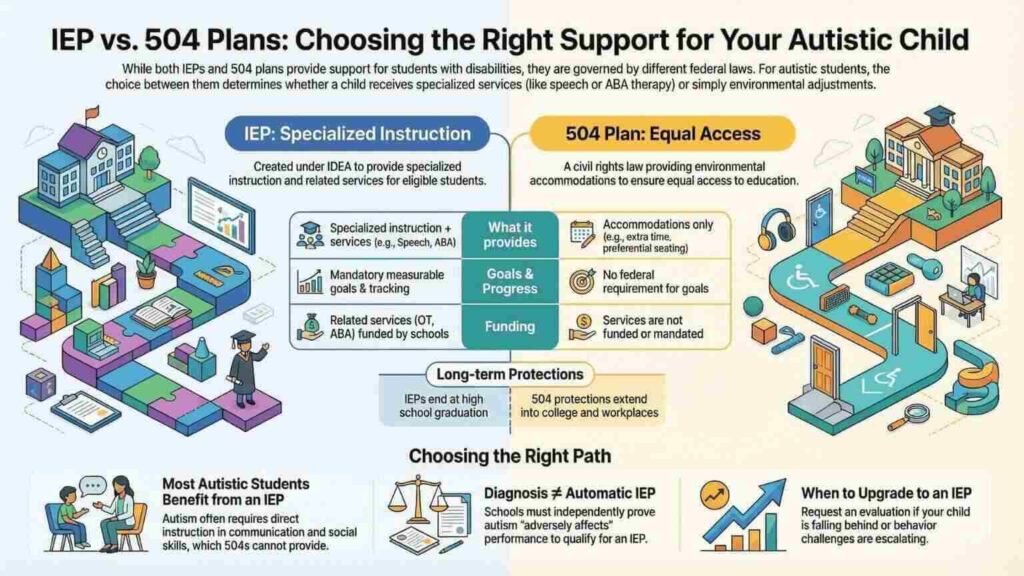
The Two Federal Laws Behind These Plans
Before diving into specifics, the single most important thing to understand is that these two plans come from completely different federal laws and those laws determine everything about what each plan can and cannot provide.
- IEP: created under IDEA (Individuals with Disabilities Education Act): a special education law that guarantees eligible children a Free Appropriate Public Education with specialized instruction. [1]
- 504 Plan: created under Section 504 of the Rehabilitation Act of 1973: a federal civil rights law that prohibits discrimination against people with disabilities and requires schools to provide accommodations for equal access. [2]
The practical implication: an IEP can change what your child is taught and how they are taught. A 504 plan can only change the conditions under which your child accesses the existing curriculum. For most children with autism who often need direct instruction in communication, social skills, and behavior regulation this distinction is critical.
Read More: What Is an IEP for Autism? A Simple Guide for Parents
Unsure Which Plan Your Child Needs? A BCBA Can Attend the IEP Meeting With You.
Fill in the form below to discuss how your child could start therapy quickly, without the stress:
The Two Federal Laws Behind These Plans
Before diving into specifics, the single most important thing to understand is that these two plans come from completely different federal laws and those laws determine everything about what each plan can and cannot provide.
- IEP: created under IDEA (Individuals with Disabilities Education Act): a special education law that guarantees eligible children a Free Appropriate Public Education with specialized instruction. [1]
- 504 Plan: created under Section 504 of the Rehabilitation Act of 1973: a federal civil rights law that prohibits discrimination against people with disabilities and requires schools to provide accommodations for equal access. [2]
The practical implication: an IEP can change what your child is taught and how they are taught. A 504 plan can only change the conditions under which your child accesses the existing curriculum. For most children with autism who often need direct instruction in communication, social skills, and behavior regulation this distinction is critical.
Read More: What Is an IEP for Autism? A Simple Guide for Parents
IEP vs 504 Plan: Complete Side-by-Side Comparison
This table covers every key difference between the two plans so you have a complete reference before your next school meeting:
Feature | IEP (IDEA) | 504 Plan |
Federal law | IDEA (Individuals with Disabilities Education Act) | Section 504 of the Rehabilitation Act of 1973 |
Type of law | Special education law | Civil rights law |
Disability definition | Must have one of 13 IDEA disability categories AND need special education | Any physical or mental impairment that substantially limits a major life activity broader definition |
Does autism qualify? | Yes, autism is one of IDEA’s 13 named categories | Yes, if autism substantially limits learning or another major life activity |
What it provides | Specialized instruction + accommodations + related services | Accommodations only, no specialized instruction |
Includes annual goals? | Yes, measurable academic and functional goals required | No, goals are not required |
Progress monitoring? | Required, formal progress reporting to parents | Not required, no federal mandate |
IEP/504 meeting team | Mandated: gen ed teacher, spec ed teacher, district rep, evaluation specialist, parents | No mandated attendee list, usually smaller, less formal |
Review frequency | At least annually + 3-year re-evaluation | No set schedule, recommended annually, 3-year re-eval suggested |
Related services funded? | Yes, speech, OT, ABA, counseling can be written in | No, services are not funded or mandated under 504 |
Legal enforceability | Legally binding, school must deliver what is written | Civil rights protection, school cannot discriminate, but enforcement is less structured |
Extending to college? | No, ends at age 22 or high school graduation | Protections extend, students can self-disclose to college disability offices |
Cost to family | Free, FAPE guarantee under IDEA | Free, but schools may be less proactive in offering 504s |
Note: All information is based on federal law requirements. Individual states may have additional regulations. This is educational information, not legal advice.
What an IEP Provides for an Autistic Child
An Individualized Education Program is the more powerful of the two tools and for children with autism, it is usually the appropriate one. To qualify, your child must meet a 3-part eligibility test under IDEA [1]:
- They have a qualifying disability: autism is one of IDEA’s 13 named disability categories, so the first part is typically straightforward for children with an ASD diagnosis
- The disability adversely affects educational performance: this includes academics, behavior, social skills, communication and functional skills, not just grades
- They need specialized instruction: accommodations alone are not enough, the child requires teaching that is different in method, intensity, or structure from general education
If all three conditions are met, the school is legally required to create an IEP. Once in place, the IEP is a legally binding document the school must deliver everything written in it. Goals must be measurable, progress must be reported to you regularly, and the plan must be reviewed at least once every 12 months. [1]
For autistic children specifically, an IEP can include:
- Speech-language therapy: targeting expressive language, pragmatics, and conversation skills
- Occupational therapy: addressing sensory processing, fine motor skills, and daily living independence
- ABA therapy as a related service: behavior intervention plans, skill acquisition programming, and BCBA consultation can all be written directly into an IEP
- Social skills instruction: direct teaching of peer interaction, turn-taking, and reading social cues
- Modified curriculum: alternate assessments, simplified content, or grade-level modifications where needed
- 1:1 paraprofessional support: a dedicated aide for classroom, transitions, or specific activities
Read More: ABA vs OT: What’s the Difference and Does Your Child Need Both?
ABA Therapy Can Be Written Into Your Child's IEP as a Related Service - Find Out How.
What a 504 Plan Provides for an Autistic Child
A 504 plan uses a broader definition of disability than IDEA. Any physical or mental impairment that substantially limits a major life activity including learning, concentrating, reading, or communicating can qualify. [2] This means some children with autism who do not qualify for an IEP (or whose needs are less intensive) may be eligible for a 504 plan instead.
A 504 plan does not provide specialized instruction or fund services. What it does provide is a set of accommodations changes to the learning environment that remove barriers so a student can access the same curriculum as their peers. Common autism-specific 504 accommodations include:
Area of Need | 504 Accommodation Examples |
Sensory processing | Access to a sensory corner, noise-canceling headphones, fidget tools, flexible seating, reduced visual clutter |
Attention and focus | Preferential seating near the teacher, movement breaks, reduced-distraction test environment |
Communication | Extra wait time for verbal responses, visual schedule, picture-based instructions, use of a communication device |
Organization and transitions | Written checklists, advance notice of schedule changes, visual timer, structured transition routines |
Testing and assessment | Extended time on tests, separate room for exams, oral responses allowed instead of written |
Behavior and emotional regulation | Access to quiet space for breaks, designated calming strategies, pre-agreed de-escalation plan |
Did You Know?
Even though autism is listed as one of IDEA’s 13 qualifying disability categories, a medical diagnosis of ASD does not automatically result in an IEP. The school team independently determines whether the disability adversely affects educational performance and whether specialized instruction is needed. Research found that more than 36% of children with ASD did not receive an autism eligibility classification in special education meaning they may have been underserved or placed under the wrong category. [4]
IEP or 504 for Autism: Which Is Right for Your Child?
This is the question most parents are actually asking. The answer depends on how autism is showing up in your specific child’s school experience, not just on the diagnosis itself. Here is a practical decision guide:
Your child likely needs an IEP if… | Your child may be okay with a 504 plan if… |
They have significant delays in communication, language, or social interaction | They are keeping up academically with peers and meeting grade-level standards |
They require direct instruction in skills like requesting, turn-taking, or self-regulation | They primarily need environmental adjustments like extra time or quiet space |
Challenging behaviors (aggression, self-injury, elopement) disrupt learning or safety | Their autism affects school access but not their ability to learn from the general curriculum |
They need related services: speech therapy, OT, or ABA written as a school service | A 504 was recently implemented and is working they are making meaningful progress |
They are not making meaningful progress with accommodations alone | They have high-functioning autism with primarily sensory or anxiety-based barriers |
Their autism requires modified curriculum, alternate assessment, or 1:1 support | They have recently received a diagnosis and the team needs more time to assess needs |
An important note for parents: because autism typically affects multiple developmental domains simultaneously, most autistic students qualify for and benefit most from an IEP even those who perform well academically. [5] High grades do not mean a child does not need specialized support for communication, regulation, or social learning. Schools sometimes underestimate the energy it takes for an autistic child to get through a school day.
Real Scenarios: Seeing the Difference in Practice
IEP – Scenario A: Maya, Age 6
Situation: Maya has an autism diagnosis and communicates using single words and picture exchange. She struggles with transitions, has frequent meltdowns, and is significantly below grade level in reading and math. She receives no services currently.
Outcome: Maya qualifies for an IEP. Her autism adversely affects communication, behavior, and academic performance, and accommodations alone cannot address those needs. Her IEP includes speech therapy, ABA-based behavior support, social skills instruction, and modified academic goals. A BCBA attends her IEP meeting to ensure behavioral goals are measurable and evidence-based.
504 Plan – Scenario B: Jordan, Age 10
Situation: Jordan has a high-functioning autism diagnosis and is performing at or above grade level in all subjects. He struggles with anxiety during tests, has sensory sensitivities to fluorescent lights and loud noises, and needs more time to process verbal instructions.
Outcome: Jordan’s needs can be addressed through a 504 plan. He does not need specialized instruction, he understands the curriculum but he does need specific accommodations: testing in a quiet room, extended time, noise-canceling headphones, and preferential seating away from ceiling lights. He would be re-evaluated if his academic performance begins to decline.
Did You Know?
A 2024 policy analysis found that 1 in 8 schools reported having no students with a 504 plan suggesting this support tool remains widely underused and that many families who qualify are never offered it. Meanwhile, 7.5 million children received special education services under IDEA in 2022-23, an all-time high. Both plans are underutilized relative to need. [3]
Can a Child Move Between an IEP and a 504 Plan?
Yes and it happens in both directions. The plan a child has should always reflect their current level of need, not the plan they had last year.
- IEP → 504 Plan: This happens when a child makes significant progress, no longer needs specialized instruction, but still benefits from accommodations. It is a sign of growth, not a demotion. The 504 plan preserves support while removing services the child no longer requires.
- 504 Plan → IEP: This happens when a child on a 504 plan is not making adequate progress, begins falling behind, or requires more intensive support. Parents can request a full evaluation for IEP eligibility at any time in writing.
- Simultaneous: A child cannot hold both an IEP and a 504 plan at the same time. If they have an IEP, any accommodations that would be in a 504 are simply included in the IEP instead. The IEP is always the more comprehensive document.
What Happens After High School? IEP vs 504 in College
This is one of the most overlooked and practically important differences between the two plans. Understanding it now can help you plan ahead.
- IEP ends: an IEP expires when a student graduates from high school or turns 22 (whichever comes first). Colleges are not required to continue IEP services, though students can request disability accommodations through the college’s disability services office. [1]
- 504 protections extend beyond high school: Section 504 applies to any institution receiving federal funding, which includes virtually all colleges and universities, and most workplaces. Students must self-disclose to their college’s disability office and provide documentation. The high school 504 plan serves as evidence. [2]
Practical implication: if your child is approaching high school, make sure every accommodation they rely on is formally documented before they exit the system whether in the IEP or a 504 plan. That documentation becomes their lifelong evidence for continued support.
How ABA Therapy Connects to Your Child's IEP
One of the most powerful things parents in New York, New Jersey, Connecticut, Georgia, and North Carolina can do is ensure their child’s ABA therapy goals are directly aligned with or written into their IEP. The U.S. Supreme Court’s 2017 decision in Endrew F. v. Douglas County established that an IEP must be ‘reasonably calculated to enable a child to make progress appropriate in light of the child’s circumstances’ it must be ‘appropriately ambitious.’ [6] ABA is one of the most evidence-based frameworks for achieving measurable, ambitious goals in communication, behavior, and adaptive skills.
At Achievement Behavior Services (ABS), our BCBAs regularly attend IEP meetings alongside families, collaborate with school teams, and help parents understand what to request and how to frame their child’s needs. ABA therapy can be included in an IEP in several ways:
- As a related service: the school may be required to fund or coordinate ABA support when it is clinically necessary and included in the IEP
- As behavior support: a BCBA can write the Behavior Intervention Plan (BIP) referenced in the IEP and provide training to school staff
- As a supplementary service: ABA goals delivered privately by ABS can be explicitly aligned with IEP goals so that school and therapy are reinforcing the same skills simultaneously
Signs Your Child’s 504 Plan Is Not Enough: Consider Requesting an IEP Evaluation
- Falling behind academically: despite accommodations being in place
- Behavioral challenges escalating: aggression, self-injury, or refusal disrupting the classroom
- Communication needs not being met: your child still cannot express needs reliably
- Progress is plateauing: months pass with no measurable skill growth
- Social isolation worsening: your child has no peer connections and is not receiving social skills instruction
- School expressing concern: teachers raising red flags that your child is struggling more than peers
- If any of these apply: request an IEP evaluation in writing. You do not need the school’s permission, this is your legal right under IDEA.
ABS Serves Families Across NY, NJ, CT, GA & NC
ABS BCBAs Attend IEP Meetings, Write BIPs, and Align ABA Goals with Your Child’s School Plan — Across NY, NJ, CT, GA & NC:
- New York – In-home and center-based ABA therapy
- New Jersey – ASD evaluations and individualized ABA programs
- Connecticut – Evidence-based autism support for families
- Georgia – Personalized ABA therapy for lasting results
- North Carolina – Supporting your child’s development journey
- Douglasville, GA – Family-centered autism care
Frequently Asked Questions
Q: What is the main difference between an IEP and a 504 plan for autism?
The core difference is what each plan provides. An IEP provides specialized instruction, related services (such as speech therapy, OT, and ABA), measurable goals, and formal progress monitoring all legally mandated under IDEA. [1] A 504 plan provides accommodations only changes to the environment or test conditions with no specialized instruction and no required progress tracking. For most autistic children, an IEP provides significantly more comprehensive support.
Q: Does having an autism diagnosis automatically qualify my child for an IEP?
Not automatically. Autism is one of IDEA’s 13 qualifying disability categories, which makes the first part of the 3-part eligibility test easier but the school team must still independently determine that autism adversely affects educational performance and that the child needs specialized instruction. [4] A medical diagnosis alone is not enough. Request a comprehensive school evaluation in writing to get that determination.
Q: Can my autistic child have both an IEP and a 504 plan?
No, a child cannot hold both simultaneously. If a child qualifies for an IEP, any accommodations that would be in a 504 are simply incorporated into the IEP. The IEP is the more comprehensive document and always supersedes a 504 plan. A child can move from an IEP to a 504 if they no longer need specialized instruction but still benefit from accommodations. [1]
Q: Which is better for a child with high-functioning autism IEP or 504?
It depends on the child’s actual needs in school, not just their diagnosis or academic performance. [5] Children with high-functioning autism may perform well academically while still needing direct instruction in social communication, emotional regulation, or adaptive behavior in which case an IEP is appropriate. If their only barriers are environmental (sensory sensitivities, test anxiety, time management) and they are keeping up with grade-level content, a 504 plan may be sufficient. A comprehensive evaluation is the only way to know for sure.
Q: Can ABA therapy be included in an IEP?
Yes. ABA therapy can be written into an IEP as a related service, which means the school may be required to fund or coordinate it when the BCBA’s assessment determines it is clinically necessary for the child to access their education. [7] BCBAs can also write the child’s Behavior Intervention Plan (BIP), which is a formal component of the IEP, and can provide ongoing training to school staff to ensure consistency across environments.
Q: What accommodations can be in a 504 plan for autism?
Common 504 accommodations for autistic students include: extended time on tests, separate testing room, preferential seating, access to sensory tools (fidgets, noise-canceling headphones), advance notice of schedule changes, visual schedules, movement breaks, reduced homework load, and access to a quiet space for self-regulation. [2] Unlike an IEP, these accommodations remove barriers to learning but do not change what or how the child is taught, they only change the conditions under which the child learns.
References
[1] U.S. Department of Education, Office of Special Education Programs. Individuals with Disabilities Education Act (IDEA).
https://sites.ed.gov/idea/
[2] U.S. Department of Education, Office for Civil Rights. Section 504 Frequently Asked Questions.
https://www.ed.gov/laws-and-policy/civil-rights-laws/disability-discrimination/frequently-asked-questions-section-504-free-appropriate-public-education-fape
[3] National Center for Education Statistics (NCES). Students with Disabilities. Condition of Education 2024. U.S. Department of Education, IES. https://nces.ed.gov/programs/coe/indicator/cgg/students-with-disabilities
[4] Ruble LA, McGrew JH, Toland MD. Examining the Quality of IEPs for Young Children with Autism. Journal of Autism and Developmental Disorders. 2012;42(5):986–997. PMC3116234. https://pmc.ncbi.nlm.nih.gov/articles/PMC3116234/
[5] Life Skills Advocate. Clear Differences Between IEP vs 504 Plans. 2025. https://lifeskillsadvocate.com/blog/iep-vs-504/ cites IDEA eligibility standard for autism in school settings
[6] Supreme Court of the United States. Endrew F. v. Douglas County School District. 580 U.S. 386 (2017).
https://www.supremecourt.gov/opinions/16pdf/15-827_0pm1.pdf
[7] American Psychological Association (APA). Applied Behavior Analysis. APA Policy Statement. https://www.apa.org/about/policy/applied-behavior-analysis
[8] Anderson KA, McDonald TA, et al. Individualized Education Programs and Transition Planning for Adolescents with Autism. JAMA Pediatrics. 2024. PMC10911052. https://pmc.ncbi.nlm.nih.gov/articles/PMC10911052/
[9] National Education Association (NEA). Differences Between a 504 Plan and an IEP. https://www.nea.org/professional-excellence/student-engagement/tools-tips/differences-between-504-plan-and-individualized-education-program-iep
[10] Shaw KA, et al. Prevalence and Early Identification of ASD — ADDM Network, 2022. MMWR Surveillance Summaries. 2025;74(SS-2):1–22. https://www.cdc.gov/mmwr/volumes/74/ss/pdfs/ss7402a1-H.pdf