

Yes, ABA therapy works but what the research shows is more nuanced than a simple yes. Peer-reviewed evidence consistently finds significant improvements in communication, adaptive behavior, and daily living skills for children with autism who receive ABA, with stronger outcomes linked to earlier start, higher intensity, and longer duration [1][2].
If you’re a parent considering ABA therapy for your child, the most important question you’re asking isn’t “what is ABA”, it’s “will it actually help my child?” This guide answers that question honestly, using the most current research available and drawing on our clinical experience at Achievement Behavior Services since 2015.
For a complete explanation of what ABA therapy is and how it works, see our Applied Behavior Analysis parent guide. This post focuses specifically on the evidence for why it works.
What the Research Actually Shows About ABA Effectiveness?
ABA therapy has more than four decades of peer-reviewed research behind it, more than almost any other autism intervention. But research does not mean uniformity, and the honest picture is more complex than a simple endorsement.
What The Strongest Evidence Shows?
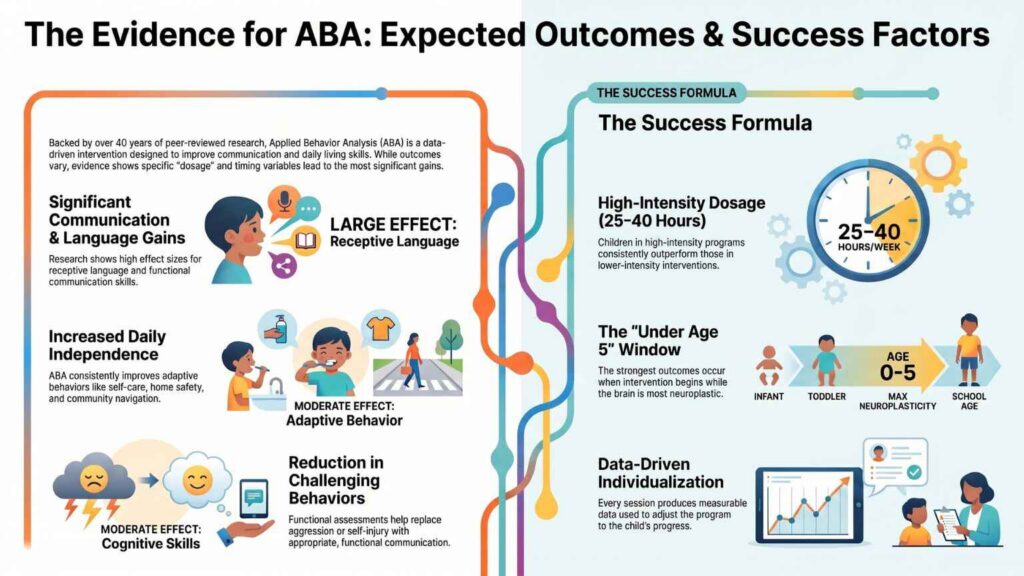
A 2025 meta-analysis published in the Review Journal of Autism and Developmental Disorders examined ABA-based interventions across multiple outcome domains and found large effect sizes for receptive language skills and moderate effect sizes for adaptive behavior and cognitive skills [1]. The study found that children who received higher treatment doses and longer program durations showed the greatest improvements in adaptive behavior.
A 2024 review by the Council of Autism Service Providers (CASP), considered one of the field’s most rigorous evaluations, confirmed that comprehensive, intensive ABA-based interventions are evidence-based practices for young children with autism, with stronger positive outcomes consistently linked to greater intensity and duration [2].
A broader umbrella review using TRICARE’s definition of reliable evidence concluded that ABA-based interventions meet the standard of evidence-based practice under both controlled trial and meta-analytic frameworks, and are endorsed as such by the American Academy of Pediatrics and the American Psychological Association [3].
What Research is More Mixed On?
A 2025 mixed-methods systematic review of 25 studies found significant improvements in adaptive behavior, daily living skills, and language compared to treatment as usual but also noted that evidence is inconsistent across studies and that some outcomes, including core autism symptom severity, have less conclusive evidence [4].
This nuance is important for parents. ABA is not a single program that works the same way for every child. Outcomes vary based on:
- The child’s age at the start of intervention
- The intensity and duration of the program
- The quality and consistency of BCBA supervision
- The degree of parent involvement and home carryover
- The specific skills being targeted
From our experience at ABS: When parents ask us whether ABA will work for their child, we tell them the same thing we’re telling you here. The research is strong but it is an average across many children in many different programs. The question for your child is not “does ABA work in general?” but “is this specific program, at this intensity, with these BCBAs, right for my child’s specific needs?” That question is answered through a comprehensive assessment, not through a general evidence review.
Wondering what ABA outcomes could look like for your child specifically?
Fill in the form below to discuss how your child could start therapy quickly, without the stress:
What Outcomes Can Parents Realistically Expect From ABA?
Based on the research base and our clinical experience, here is what ABA therapy consistently produces and at what intensity:
1. Communication and Language Skills
ABA produces some of its strongest outcomes in communication. Research consistently shows significant improvements in both receptive language (understanding and following directions) and expressive language (producing words, phrases, and sentences) for children with autism who receive ABA [1][5].
For children who are pre-verbal at the start of therapy, intensive early intervention using ABA-based approaches, particularly Verbal Behavior programming with mand training, is one of the few interventions shown to help children develop functional communication [5]. For children with emerging language, ABA programs using Natural Environment Teaching and Pivotal Response Treatment consistently increase the spontaneity and complexity of communication.
The Verbal Behavior framework specifically targets four different language functions — requesting (mand), labeling (tact), repeating (echoic), and conversing (intraverbal) — so gains in one area transfer to real-world communication use. For a full explanation of how VB-based ABA teaches language, see our Verbal Behavior approach guide.
Adaptive Behavior and Daily Living Skills
Adaptive behavior, the ability to perform practical everyday tasks independently, shows consistent improvement in ABA research. Skills in this domain include self-care routines (dressing, handwashing, toileting), home safety skills, and community navigation.
The 2025 systematic review found significant effects on adaptive behavior (SMD = 0.34) and daily living skills (SMD = 0.39) compared to treatment as usual [4]. For families whose primary goal is their child’s long-term independence, adaptive behavior is often the most meaningful outcome domain and ABA has a strong evidence base here.
Social Skills and Peer Interaction
ABA programs that include structured social skills components, particularly group-based social skills training combined with individual ABA, show consistent improvements in peer interaction, joint attention, and social initiation [3].
It is worth noting that social outcomes show more variability across studies than communication outcomes. The quality of the social skills programming, the peer context available to the child, and the involvement of school teams all affect how much social gains transfer into everyday settings.
Our Social Skills Groups at ABS combine structured ABA-based social skills curricula with real peer interaction in a group setting, addressing both the learning and the generalization that individual sessions alone cannot provide.
Challenging Behavior Reduction
Functional Behavior Assessment (FBA) and behavior intervention planning within ABA programs are among the most evidence-based approaches to reducing challenging behaviors in children with autism, including aggression, self-injury, tantrums, and elopement. ABA addresses these behaviors by identifying their function (what the behavior is getting for the child) and teaching replacement behaviors that meet the same need more appropriately [3].
Families often see the most immediate impact of ABA in this domain. Reducing daily challenging behavior allows children to be more available for learning and allows families to function more normally.
Why Intensity and Early Start Matter So Much?
The research on ABA is unusually clear on two factors that predict outcomes more consistently than almost anything else: intensity and age of onset.
Intensity
Studies repeatedly show that children receiving 25 to 40 hours per week of comprehensive ABA outperform children receiving less intensive programs on measures of communication, adaptive behavior, and cognitive functioning [2][3]. Lower-intensity programs (10 to 25 hours) can produce positive outcomes, but the effect sizes are smaller.
This does not mean every child needs 40 hours per week. A focused ABA program targeting specific skill areas may be the right fit for some children, particularly older children with fewer core deficits. See our guide on focused versus comprehensive ABA for a detailed breakdown of which approach fits which child profile.
Age of Onset
The strongest outcomes in ABA research consistently come from children who begin intervention before age 5. The American Academy of Pediatrics’ clinical guidelines specifically recognize early intensive behavioral intervention as the evidence-based standard for young children with autism [3].
This is why early intervention is one of the most important decisions a family can make after an autism diagnosis. Every additional month of delay in starting ABA is a month in which a critical developmental window narrows. The brain is most neuroplastic, most able to reorganize and build new pathways, in the first five years of life.
If your child is under 5 and has received an autism diagnosis or is showing early signs, starting the ABA intake process now is the single highest-return action you can take.
Is your child in the early intervention window right now?
Why ABA Is Different From Other Autism Interventions
Several autism interventions exist, speech therapy, occupational therapy, play therapy, the Floortime approach, TEACCH, and others. Parents often wonder how ABA compares.
The distinguishing feature of ABA is not that it is the only effective intervention. It is that ABA is the most systematically evidence-based. Every target skill in an ABA program is defined in measurable, observable terms. Every session produces data. Programs are adjusted based on that data by a BCBA, not on intuition or schedule.
This data-driven accountability is what allows ABA to achieve consistent, measurable outcomes rather than subjective improvements that are hard to verify. It also allows programs to be individualized in a precise way, not just personalized in language, but genuinely differentiated by the child’s actual data.
ABA is also not exclusive of other interventions. Many ABS families have children receiving both ABA and speech therapy, both ABA and occupational therapy. The approaches address different aspects of development and are most powerful when coordinated. ABA BCBAs and speech therapists frequently collaborate on communication goals, with ABA providing the behavioral framework and speech therapy providing the linguistic and articulation expertise.
How ABS Delivers Evidence-Based ABA for NYC and Tri-State Families
The research on ABA outcomes gives averages across many programs. What those averages don’t capture is the difference in outcome quality between a boutique BCBA-owned agency and a large national corporation.
The factors that research identifies as driving better outcomes, BCBA supervision quality, program individualization, early start, parent involvement, data integrity, are all areas where smaller, clinician-led agencies consistently outperform high-volume corporate providers.
At Achievement Behavior Services, every program is:
- Designed by a named, credentialed BCBA who knows your child’s case specifically
- Based on a comprehensive assessment, VB-MAPP or ABLLS-R, that maps the program to your child’s actual current skills, not a standard template. See our ABA assessments guide for what this involves
- Reviewed and adjusted regularly based on real session data
- Delivered in the setting where your child needs to use the skills, in-home across NY, NJ, CT, GA, NC, or at our Malverne center
- Supported by parent training so progress generalizes into the hours when the therapist is not present
We use the four major ABA teaching methods DTT, NET, PRT, and VB blended based on what each child’s data tells us works best. See our complete ABA methods guide for how we choose the right blend.
Ready to find out what ABA could do for your child?
Frequently Asked Questions
At what age is ABA most effective?
Research consistently shows the strongest outcomes for children who begin ABA before age 5, when neuroplasticity is highest. However, ABA produces meaningful gains at older ages as well, the targets and methods shift, but the evidence base is solid across childhood and into adolescence. For very young children, see our early intervention guide.
How many hours per week does ABA therapy require?
Comprehensive ABA programs run 25 to 40 hours per week and have the strongest evidence base for significant outcomes. Focused ABA programs run 10 to 25 hours and are appropriate for children with narrower, specific goals. Your BCBA will recommend the right intensity based on your child’s comprehensive assessment. See our focused vs comprehensive ABA guide for the decision framework.
How long does ABA therapy last?
Duration varies widely by child. Some children reach their program goals within one to two years. Others benefit from ABA across many years as goals evolve from foundational communication skills to academic readiness to community independence. Progress reviews are conducted regularly to assess whether the program continues to be appropriate.
Can ABA therapy hurt a child?
Modern, ethical ABA uses only positive reinforcement and is completely free of punishment procedures. The concerns some parents have heard about ABA relate to older, 1980s-era programs that have since been replaced. Contemporary ABA is play-based, child-led where appropriate, and designed to be a positive experience. If you’ve heard specific concerns, ask your BCBA to explain their approach directly.
Does ABA address the whole child, or just behaviors?
Good ABA addresses communication, social skills, academic readiness, adaptive living, and challenging behavior, not just behaviors in isolation. The best programs are designed around meaningful life outcomes: can this child ask for what they need, play with peers, follow a routine, and participate in family life? For a full picture of what ABA programs cover, see our ABA services overview.
Is ABA covered by insurance?
Yes. ABA therapy is covered by most major insurance carriers including Aetna, Cigna, UnitedHealthcare, Anthem BCBS, and state Medicaid programs. See our ABA insurance guide for New York for carrier-specific detail, and contact our intake team for insurance verification.
Ready to Talk About What ABA Could Do for Your Child?
The research is clear that ABA works but the right program for your child depends on their specific profile, age, goals, and learning style. Our BCBAs at Achievement Behavior Services have been designing individualized ABA programs for families across New York, New Jersey, Connecticut, Georgia, and North Carolina since 2015.
Sources:
[1] Eckes, A., Wilde, N., & Stacey, P. C. (2025). A Meta-Analysis of Applied Behavior Analysis-Based Interventions to Improve Communication, Adaptive, and Cognitive Skills in Children on the Autism Spectrum. Review Journal of Autism and Developmental Disorders. https://link.springer.com/article/10.1007/s40489-025-00506-0
[2] Council of Autism Service Providers (CASP). (2024/2025). “Evidence About ABA Treatment for Young Children with Autism.” CASP White Paper. https://asatonline.org/research-treatment/book-reviews/review-of-evidence-about-aba-treatment-for-young-children/
[3] National Academies of Sciences, Engineering, and Medicine / NCBI Bookshelf. (2025). “Evidence Base for Applied Behavior Analysis — The Comprehensive Autism Care Demonstration.” https://www.ncbi.nlm.nih.gov/books/NBK619281/
[4] Murray, A. L., et al. (2025). “Effectiveness and experiences of early intensive behavioral and naturalistic developmental behavior interventions for autism spectrum disorders: a mixed-methods systematic review and meta-analysis.” Child and Adolescent Psychiatry and Mental Health. https://www.ncbi.nlm.nih.gov/pmc/articles/PMC12849440/
[5] Sundberg, M. L., & Michael, J. (2001). “The Benefits of Skinner’s Analysis of Verbal Behavior for Children with Autism.” Behavior Modification, 25(5), 698–724.
https://pubmed.ncbi.nlm.nih.gov/11573336/
[6] Hyman, S. L., Levy, S. E., Myers, S. M., & AAP Council on Children with Disabilities. (2020). Identification, Evaluation, and Management of Children With Autism Spectrum Disorder. Pediatrics, 145(1).
https://publications.aap.org/pediatrics/article/145/1/e20193447/36917/Identification-Evaluation-and-Management-of