

Your child’s first ABA therapy session focuses on connection, not therapy. The therapist spends the session “pairing”, joining your child’s play and becoming a source of good things, before asking anything of them. First sessions typically last 1 to 3 hours and involve no demands.
If you’re preparing for your child’s first ABA session, you are probably feeling two things at once: hope that this will help, and worry about how your child will handle it. Both are normal. In our experience at Achievement Behavior Services, nearly every parent walks into the first session with the same unspoken question, will my child be okay?
This guide answers that question honestly. It walks through exactly what happens in the first session, what your role is, and how to prepare your child, the first stage of what happens in ABA therapy from intake through graduation.
What Happens in The First ABA Therapy Session?
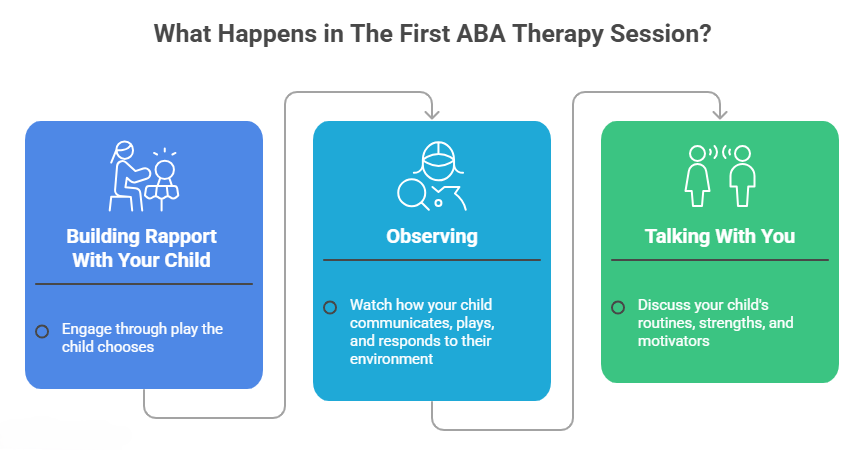
The first ABA session is deliberately low-demand. Your child will not be asked to sit at a table, complete drills, or perform tasks. Instead, the therapist, usually a Registered Behavior Technician (RBT) working under the supervision of a Board Certified Behavior Analyst (BCBA), spends the session doing three things [1]:
- Building rapport with your child through play the child chooses
- Observing how your child communicates, plays, and responds to their environment
- Talking with you about your child’s routines, strengths, motivators, and what a good day looks like
Some providers combine the first session with the formal assessment. Others separate them. At ABS, we keep the first session focused on connection and handle formal assessment separately, because a child who is anxious or unfamiliar with the therapist will not show their real skills.
The session may be shorter, sillier, and more relaxed than you expect. That is by design, not a sign that nothing is happening.
Haven't scheduled your child's first session yet?
Tell us about your child and our BCBA team will reach out to you. We’ll verify your insurance, answer your questions, and if it’s a fit, get a first session on the calendar.
What is "Pairing" and Why Does The First Session Focus On It?
Pairing is the process of a therapist associating themselves with things your child already enjoys, so the child comes to see the therapist as a source of good experiences rather than a source of demands [2].
In practice, pairing looks like this: if your child loves trains, the therapist sits on the floor and builds tracks alongside them. They narrate what your child is doing. They hand over the pieces your child reaches for. They celebrate when the train goes around the loop. They ask for nothing in return.
This is not therapists being nice for the sake of it. Pairing is a specific, research-supported procedure. A 2024 study published in Behavioral Interventions trained early interventionists in pairing skills and found that pre-session pairing reduced children’s interfering behaviors during subsequent teaching sessions [2]. Earlier research by Shillingsburg and colleagues found that rapport-building procedures increased social approach behavior and decreased social avoidance in children with autism during structured teaching [3].
The logic is straightforward. A child who associates a therapist with fun will approach them. A child who associates a therapist with demands will avoid them. Everything that comes later in ABA, teaching communication, reducing challenging behavior, building daily living skills, depends on the child being willing to engage with the person teaching them.
From our experience at ABS: Parents sometimes tell us after the first session, “They just played the whole time, when does the therapy start?” We understand the reaction. But the first session is the therapy. A child who trusts their therapist learns faster in every session that follows. Skipping pairing to get to “real work” faster almost always costs more time than it saves. The families who see the strongest early progress are usually the ones whose child felt safe first.
Will My Child Be Scared or Upset?
Some children are curious and engage immediately. Others are hesitant, cling to a parent, or ignore the therapist entirely. Some cry. All of these responses are normal, and none of them mean therapy is failing.
A skilled therapist expects a range of reactions and adjusts accordingly. If your child is overwhelmed, the therapist backs off, gives space, and lets your child set the pace. Modern ABA practice increasingly emphasizes assent, watching for signs that your child is willing and comfortable participating, and honoring “no thanks” cues rather than pushing through them.
What a first session should never look like:
- Your child being physically forced to participate
- Demands continuing after clear distress
- The therapist ignoring your child’s cues to escalate compliance
- Your child being left to cry without support
If you observe any of these, raise it with the BCBA immediately. Contemporary, ethical ABA uses positive reinforcement and does not use punishment procedures. A first session that feels coercive is a red flag about the provider, not a normal part of the process.
Want your child's first session to look like this?
What is My Role As a Parent in The First Session?
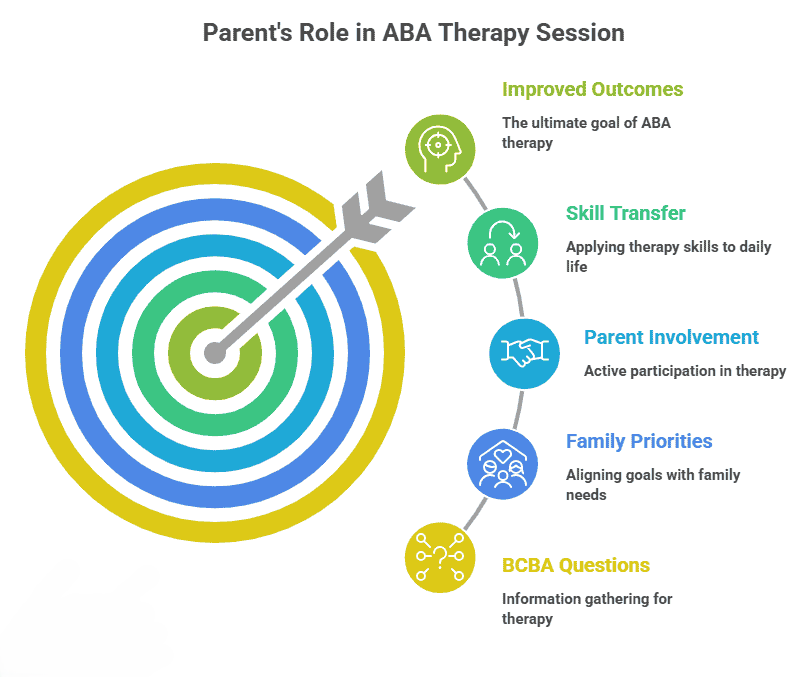
You are part of the team from day one. Most parents are surprised by how involved they become.
In the first session, expect the BCBA to ask you questions like:
- What does your child love? What are their strongest motivators?
- What does a typical day look like mealtimes, transitions, bedtime?
- What are your child’s sensory needs and sensitivities?
- What behaviors are hardest for your family right now?
- What would success look like to you in six months?
That last question matters more than parents expect. ABA goals should reflect your family’s priorities, not just clinical targets. A program that teaches your child to label 50 objects but does not help them get through a grocery store trip has missed the point.
You may also be asked to observe, and later to participate. Some providers begin caregiver coaching in the first session, the BCBA models a strategy, then steps back so you can try it with real-time feedback. Research consistently shows that parent involvement in ABA improves outcomes and helps skills transfer from the therapy setting into daily life [4].
How Long Does The First ABA Session Last?
The first session typically lasts 1 to 3 hours, depending on your child’s age, attention span, and tolerance for a new person.
Younger children and children who are easily overwhelmed often do better with a shorter first session, sometimes 45 to 60 minutes. There is no clinical benefit to pushing a distressed child through a three-hour first visit. A therapist who ends early because your child has had enough is making a good clinical decision, not cutting corners.
Ongoing sessions are longer. Comprehensive ABA programs typically run 25 to 40 hours per week, and focused programs run 10 to 25 hours per week, delivered across multiple sessions. For a full breakdown of how program intensity is decided, see our guide on focused versus comprehensive ABA.
How Should I Prepare My Child For Their First Session?
Preparation reduces anxiety for most children. A few strategies that work well:
- Talk about it in advance, positively. Frame it as a new person coming to play, not as an appointment or an evaluation. Avoid words that carry medical weight for your child.
- Use a visual schedule. A simple picture sequence showing what happens, therapist arrives, play, snack, therapist leaves, helps children who rely on predictability.
- Have comfort items available. A favorite toy, blanket, or snack helps a child regulate in a new situation.
- Prepare the space if the session is in your home. Choose a quiet area, clear obvious hazards, turn off the television, and put away toys you would rather not have in play.
- Do not over-prepare. Rehearsing the session for a week beforehand can build anxiety rather than reduce it. One or two calm mentions is usually enough.
You do not need to prepare your child to perform. The first session has no pass or fail.
What Happens After The First Session?
By the end of the first session, you should typically receive:
- A brief debrief: what the therapist observed about your child’s strengths, interests, and communication style
- Initial impressions of where the program might start
- One or two practical strategies you can try at home this week
- A plan for next steps: when the formal assessment happens, and how progress will be tracked
After the visit, the BCBA reviews their observations and assessment data and designs your child’s individualized treatment plan. This involves selecting goals, choosing teaching methods, and setting up the data system that will measure progress. The team then works on scheduling and, where required, insurance authorization.
The assessment tools your BCBA uses such as the VB-MAPP or ABLLS-R map your child’s current skills across communication, social interaction, and daily living. For more on what these assessments involve, see our guide to types of ABA assessments.
Once the program begins, sessions blend structured teaching with play-based learning using methods such as Discrete Trial Training (DTT), Natural Environment Teaching (NET), and Pivotal Response Treatment. For a complete comparison of how these methods work together, see our guide to types of ABA therapy methods.
Ready to get your child's first session on the calendar?
Frequently Asked Questions About The First ABA Session
Can I stay in the room during the first session?
Yes. Parents are welcome and usually encouraged to be present, especially for younger children. Your presence helps your child feel safe and lets you see the strategies the therapist uses so you can reinforce them later.
Where does the first session take place?
It depends on your program. In-home ABA sessions happen in your living room, playroom, or wherever your child is most comfortable. Center-based sessions happen at the clinic. Both are valid, the setting should match your child’s needs and your family’s logistics.
What if my child has a meltdown during the first session?
That is not a failure, and it is not unusual. Experienced therapists are trained to respond calmly, reduce demands, and help your child regulate. It also gives the BCBA useful information about what triggers distress and what helps your child recover.
Will the therapist start teaching skills right away?
Usually not in the first session. Demands are introduced gradually over the following sessions once rapport is established. A common pattern is: day one is pairing only, day two adds one or two easy requests, and demands build slowly from there.
Does my child need an autism diagnosis before the first session?
Most insurance carriers require a formal diagnosis before authorizing ABA services. If your child has not yet been evaluated, ABS offers ASD evaluations in New York and New Jersey.
How soon after the first session does regular therapy start?
At ABS, most families begin their regular schedule within 1 to 2 weeks of the first session, once the assessment is complete and insurance authorization is in place. See our ABA insurance guide for New York for details on the authorization process.
Talk To a BCBA Before Your Child's First Session
If you have questions about what your child’s first session will look like or you are still deciding whether ABA is right for your family, we would be glad to talk. Our BCBAs have guided hundreds of families through their first session across New York, New Jersey, Connecticut, Georgia, and North Carolina since 2015.
If your child is under 5, starting sooner matters. See our early intervention ABA Program for why the first years produce the strongest outcomes.
Sources
[1] Behavior Analyst Certification Board (BACB). “About Behavior Analysis: BCBA and RBT roles.”
https://www.bacb.com/about-behavior-analysis/
[2] Ensor, C., Feeley, K., & Jones, E. (2024). “Evaluation of a rapport-building intervention for early interventionists working with children on the autism spectrum.” Behavioral Interventions, 39(1).
https://onlinelibrary.wiley.com/doi/10.1002/bin.1983
[3] Shillingsburg, M. A., Bowen, C. N., & Shapiro, S. K. (2014). “Increasing social approach and decreasing social avoidance in children with autism spectrum disorder during discrete trial training.” Research in Autism Spectrum Disorders, 8(11), 1443–1453.
https://www.sciencedirect.com/science/article/pii/S1750946714001731
[4] Strauss, K., Vicari, S., Valeri, G., D’Elia, L., Arima, S., & Fava, L. (2012). “Parent inclusion in early intensive behavioral intervention: The influence of parental stress, parent treatment fidelity and child outcome.” Psychotherapy and Psychosomatics, 81(3), 166–168.
https://pubmed.ncbi.nlm.nih.gov/22188793/
[5] Association for Science in Autism Treatment (ASAT). “Building Rapport using Strategies to Promote Pairing.”
https://asatonline.org/research-treatment/clinical-corner/building-rapport/
[6] LeBlanc, L. A., Taylor, B. A., & Marchese, N. V. (2020). “The Training Experiences of Behavior Analysts: Compassionate Care and Therapeutic Relationships with Caregivers.” Behavior Analysis in Practice, 13(2), 387–393.
https://pmc.ncbi.nlm.nih.gov/articles/PMC7314888/
[7] Hyman, S. L., Levy, S. E., Myers, S. M., & AAP Council on Children with Disabilities. (2020). “Identification, Evaluation, and Management of Children With Autism Spectrum Disorder.” Pediatrics, 145(1).
https://publications.aap.org/pediatrics/article/145/1/e20193447/36917/Identification-Evaluation-and-Management-of