

Choosing an ABA provider in New York City means evaluating BCBA credentials, insurance acceptance, borough coverage, waitlist length, and whether the program is in-home, center-based, or both. NYC families also navigate a layered service system, Early Intervention for under-3s, CPSE for preschoolers, and private insurance-funded ABA for school-age children.
New York City has one of the highest concentrations of ABA providers in the country. That’s both a gift and a problem. More options should mean better care but it also means more opportunity for families to get lost in a system that doesn’t explain itself clearly.
This guide is written specifically for NYC parents. It covers how the local service system works, what to look for in any ABA provider, what red flags to walk away from, and how Achievement Behavior Services serves families across the five boroughs and Long Island.
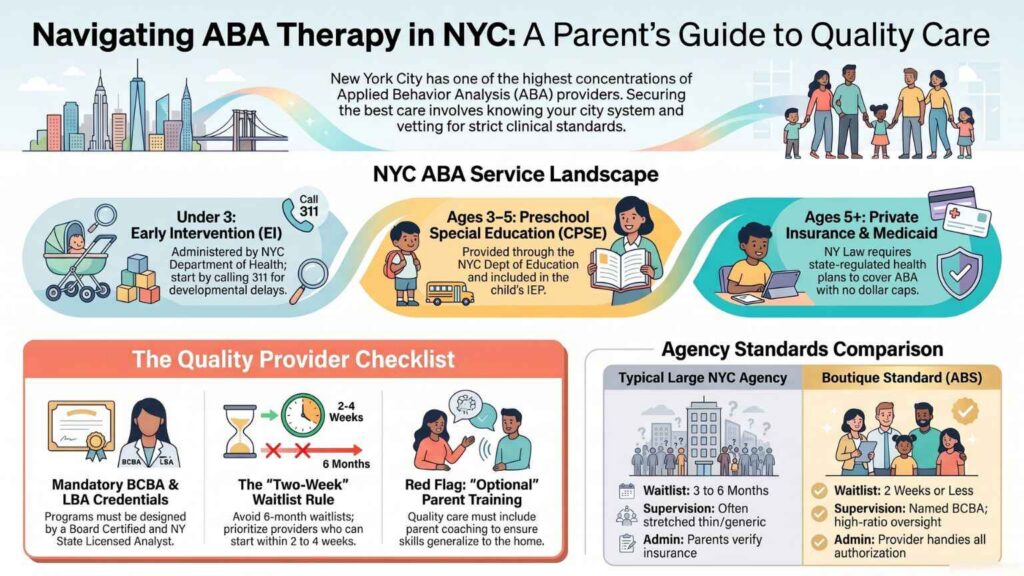
How the NYC ABA System Actually Works (Before You Even Choose a Provider)
Before evaluating individual providers, NYC parents need to understand which system their child qualifies for because the answer determines who pays for therapy and what kind of provider you need.
Children under 3: NYC Early Intervention Program
If your child is under 3 and shows developmental delays, ABA therapy may be available through New York City’s Early Intervention (EI) Program, administered by the NYC Department of Health and Mental Hygiene. To start the process, call 311 and ask for Early Intervention, or contact the NYC EI program directly.
Important: ABS is a private insurance-based ABA provider, not a state-enrolled EI provider. If your child is under 3 and does not yet have private insurance coverage, the EI system is your starting point. If your child has private insurance or Medicaid and is under 3, ABS can provide services. See our Early Intervention ABA service for details.
Children ages 3 to 5: NYC CPSE
Children aged 3 to 5 who need behavioral support may qualify for services through the NYC Department of Education’s Committee on Preschool Special Education (CPSE). ABA services may be included in your child’s IEP through this channel.
Again, ABS provides private insurance-based ABA, which runs alongside CPSE services in many families. Some families receive school-based support through CPSE while also enrolling in private ABA with ABS for additional hours.
Children 5 and up: Private Insurance or Medicaid-Funded ABA
For school-age children, ABA therapy is typically funded through private health insurance or Medicaid. New York State law requires all state-regulated health plans to cover ABA therapy for children with an autism diagnosis, with no annual or lifetime dollar caps [1]. Medicaid covers ABA for children under 21 who qualify.
This is where ABS operates. We work with most major insurance plans and verify benefits before your first appointment.
Looking for ABA therapy in NYC with no waitlist?
Tell us about your child and our intake team will reach out to verify your insurance and discuss next steps. Most families start within 2 weeks.
10 Things to Look for When Choosing an ABA Provider in NYC
1. BCBA Supervision: Who Actually Designs Your Child’s Program?
The single most important credential to verify is whether a Board Certified Behavior Analyst (BCBA) designs and regularly supervises your child’s program. In New York State, BCBAs must also hold a Licensed Behavior Analyst (LBA) license to practice [2].
The BCBA designs the treatment plan, conducts assessments, sets goals, and supervises the Registered Behavior Technicians (RBTs) who deliver direct therapy. If a provider can’t tell you which BCBA is assigned to your child, that is a red flag.
At Achievement Behavior Care , every child’s program is designed by a credentialed BCBA and reviewed monthly. Our BCBAs hold both BCBA and NY LBA credentials.
2. Ratio of BCBA Supervision to Direct Therapy Hours
Ask every provider: “How many hours per week will my child’s BCBA directly observe and supervise their program?”
The BACB’s guidelines require that BCBAs supervise a meaningful percentage of their supervisees’ work. However, some large ABA agencies stretch BCBA supervision thin across dozens of clients. The result: your child’s program isn’t being regularly adjusted based on data.
A boutique agency with fewer clients per BCBA provides more responsive program oversight. At ABS, our BCBA-to-client ratios are designed to allow genuine program management, not just checkbox supervision.
3. Personalized Programs vs. Cookie-Cutter Approaches
Quality ABA starts with a comprehensive ABA assessment, typically a VB-MAPP, ABLLS-R, or similar tool, that maps your child’s current skills across communication, social interaction, and adaptive behavior. The program goals emerge from that assessment, not from a standard template.
Ask any provider: “How do you assess my child before starting, and how does the assessment directly shape the program?”
If the answer is vague, the program will likely be generic. See our ABA assessment guide for what a thorough intake assessment looks like.
4. In-Home, Center-Based, or Both
NYC families have different needs depending on their borough, their work schedule, their child’s age, and their child’s learning profile.
In-home ABA: is delivered at your home or in community settings. It’s especially effective for generalization, teaching skills where the child actually needs to use them. It also eliminates the need to transport a young child to a center.
Center-based ABA: provides a structured therapeutic environment with more resources, peer interaction opportunities, and specialized equipment. It suits children who benefit from clear separation of home and therapy environments, and children who are ready for group-based social skills work.
ABS offers both. Our Malverne ABA center in Nassau County serves Long Island and Queens families, and our in-home teams serve all five boroughs including Queens, Brooklyn, and Staten Island.
From our experience at ABS: Many families start with in-home ABA because it’s easiest to arrange and most comfortable for younger children. As a child progresses and social goals become central, we often transition toward a hybrid of in-home sessions plus center-based social skills groups. We discuss this transition as part of our initial planning conversation with every family.
5. Waitlist Length: What NYC Parents Often Don’t Ask About
Waitlists are one of the least-discussed factors in ABA provider selection and one of the most important in New York City, where demand consistently exceeds supply.
Ask every provider two questions:
- “What is your current waitlist for new clients?”
- “If I enroll today, when would my child realistically start therapy?”
Some larger NYC ABA agencies have waitlists of 3 to 6 months or longer. For a young child in the early intervention window, a 6-month waitlist is not an administrative inconvenience, it’s 6 months of a critical developmental period.
ABS has no waitlist. Most families start within 2 weeks of insurance verification.
6. Insurance Verification: Who Does the Work?
ABA therapy in NYC is expensive without insurance. A comprehensive program of 25 to 40 hours per week can cost $3,000 to $6,000 or more per month at private-pay rates. Most families rely on insurance to cover the majority of this cost.
The difference between providers is who handles the insurance process. Some agencies hand the verification work back to families, an exhausting task for parents already managing a child with autism. Quality providers handle benefit verification themselves, including prior authorization, as a part of intake.
ABS handles insurance verification, prior authorization, and billing for every family. If your insurance requires prior authorization for ABA services (most do), we manage that process on your behalf. See our ABA insurance guide for New York for details on which carriers we work with.
7. Parent Training: Are You Part of the Program?
Research consistently shows that parent participation in ABA therapy significantly improves long-term outcomes [3]. A quality provider doesn’t just deliver therapy — they teach you how to continue therapeutic techniques during the hours when the therapist is not present.
Ask any provider: “How do you involve parents, and what does parent training look like in your program?”
Red flag: if parent training is described as an add-on, optional, or available only at certain package levels, that is a sign the provider views it as secondary. It isn’t. Skill generalization at home is where real progress compounds.
At ABS, parent training is embedded in every program. Your BCBA conducts regular parent coaching sessions and provides strategies you can use during daily routines, mealtimes, bath time, transitions, and bedtime.
8. Data Collection and Progress Reporting
ABA therapy is a data-driven discipline. Every session should produce data on your child’s targets, and that data should regularly inform program adjustments by the supervising BCBA. If a provider cannot clearly explain how they collect data, store it, and use it to modify programs, that is a significant quality concern.
Ask: “Can I see a sample data sheet? How often does my child’s BCBA review data and adjust the program?”
A program that doesn’t adapt based on data is not practicing quality ABA. It is going through motions.
9. Cultural and Linguistic Sensitivity
New York City is one of the most linguistically and culturally diverse cities in the world. An ABA provider serving NYC families must be prepared to work with families whose home language is not English and whose cultural background shapes how they understand disability, therapy, and intervention.
Ask any provider: “Do you have therapists who speak [language]? How does your team approach cultural differences in how families engage with therapy?”
A provider that cannot answer this question may not be prepared to serve your family well.
10. Communication Standards: How Responsive Is the Team?
Once your child starts ABA, you will have questions, concerns, and updates throughout the week. The quality of a provider’s communication directly affects your ability to support your child’s progress at home.
Before enrolling, send the provider an email with a few questions and time how long it takes to get a substantive response. A provider who takes 3 days to respond to a pre-enrollment inquiry will likely take longer to respond once your child is enrolled.
ABS’s standard response time for family inquiries is within 24 hours on business days. Our intake team is available by phone, email, and Slack for current families.
Red Flags to Walk Away From
Not all ABA providers in NYC meet the same standard. Here are specific warning signs that should cause you to keep looking:
Red Flag 1: No dedicated BCBA named for your child. If the provider cannot tell you the name and credentials of the BCBA who will design your child’s program before you enroll, the supervision structure is unclear. Walk away.
Red Flag 2: Guarantees of specific outcomes. No ethical ABA provider promises that your child will speak in full sentences by a certain date, stop all challenging behaviors in 30 days, or hit any other specific milestone on a timeline. ABA produces measurable progress but outcomes vary by child. Any guarantee of specific results is a clinical red flag.
Red Flag 3: Waitlists measured in months, presented as normal. A 6-month waitlist in a city with your child’s developmental window at stake is not acceptable. Push back. Other options exist.
Red Flag 4: Insurance “handled later.” If a provider starts therapy before fully verifying your insurance benefits and obtaining prior authorization, you risk receiving a large unexpected bill. Verify before you commit.
Red Flag 5: No parent training component. A provider who delivers therapy to your child for 20 hours per week without teaching you how to support that work in the remaining 148 hours is not providing complete care.
Red Flag 6: Vague answers about data and progress. If you cannot get a clear answer about how data is collected and how it is used to adjust the program, the program is not genuinely data-driven.
Red Flag 7: RBTs operating without regular BCBA observation. RBTs are trained and capable practitioners but they must operate under active BCBA supervision. If a provider’s BCBAs are rarely present for direct observation, the supervision is nominal, not real.
Checked the boxes and still not sure which provider to trust?
Why NYC and Long Island Families Choose ABS
Achievement Behavior Services is a boutique, BCBA-owned ABA agency serving families across New York City, Long Island, and the tri-state area since 2015. Here is specifically how we compare on the criteria that matter most to NYC families:
|
Factor |
What NYC Parents Need |
What ABS Provides |
|
BCBA supervision |
Named BCBA for every child |
Dedicated BCBA per client, LBA-licensed |
|
Waitlist |
As short as possible |
No waitlist, start within 2 weeks |
|
Insurance |
Handled by provider |
We verify, authorize, and bill |
|
Setting |
Flexibility |
In-home across all 5 boroughs + center in Malverne |
|
Parent training |
Embedded in program |
Included in every ABA program |
|
BCBA-to-client ratio |
Genuine supervision |
Boutique ratios, no overloading |
|
Cultural sensitivity |
NYC-level diversity awareness |
Multilingual intake and care coordination |
|
Communication |
Fast and reliable |
24-hour response standard |
We are not the largest ABA agency in New York. We are deliberately boutique because boutique means your child has a named BCBA who knows their case, responds to your messages, and adjusts the program based on actual data, not administrative convenience.
Frequently Asked Questions
Does ABS serve all five NYC boroughs?
Yes. Our in-home ABA team serves Queens, Brooklyn, Staten Island, the Bronx, and Manhattan, as well as Long Island (Nassau and Suffolk Counties). For families in Queens or Long Island, our Malverne center is also accessible as a center-based option. See our New York in-home ABA page for coverage details.
Does ABS accept NYC Medicaid for ABA therapy?
ABS is a private insurance-based provider. We accept most major private insurance plans and Medicaid Managed Care Plans. Contact our intake team to confirm whether your specific plan is accepted before beginning the enrollment process.
Does my child need an autism diagnosis to start ABA with ABS?
Most insurance carriers require a formal autism diagnosis from a licensed psychologist, neurologist, or developmental pediatrician before authorizing ABA therapy. If your child has not yet been evaluated, ABS offers ASD evaluations in New York and New Jersey. Getting a formal diagnosis first is usually the fastest path to starting ABA through insurance.
How long does the intake process take?
From initial inquiry to first therapy session, the typical ABS intake timeline is 2 to 4 weeks. This includes insurance verification, prior authorization, BCBA assessment, and program planning. This is faster than the NYC market average of 6 to 12 weeks for many large agencies.
What is the difference between in-home ABA in NYC and the Malverne center?
In-home ABA is delivered in your home, school, or community, ideal for young children, generalization goals, and families with transportation limitations. Our Malverne center is a structured clinical environment in Nassau County suited to older children ready for peer-based social skills programming or families who prefer the separation of home and therapy. Many ABS families use both over time.
How is ABS different from large national ABA companies operating in NYC?
Large national ABA corporations prioritize scale. Boutique agencies like ABS prioritize clinical quality. The practical difference: at a large agency, your child may cycle through multiple BCBAs as staff turns over, receive supervision on paper rather than in practice, and experience program drift as case loads grow. At ABS, every client has a consistent, named BCBA and benefits from the direct clinical leadership of agency founders who are active BCBAs, not administrators.
Ready to Find Out If ABS Is Right for Your Family?
Choosing an ABA provider for your child is one of the most important decisions you’ll make. We believe the best way to make that decision is with a real conversation, not just a brochure.
Our intake team will answer your questions, review your insurance coverage, and schedule a BCBA assessment with no obligation. Most families who speak with us get their first session scheduled within 2 weeks.
Ready to find out if ABS serves your area and accepts your insurance?
Sources:
[1] New York State Department of Financial Services. “Autism Spectrum Disorder Insurance Requirements.”
https://www.dfs.ny.gov/industry_guidance/circular_letters/cl2014_06
[2] New York State Education Department, Office of the Professions. “Licensed Behavior Analyst.” https://www.op.nysed.gov/licensed-behavior-analysts
[3] Strauss, K., Vicari, S., Valeri, G., D’Elia, L., Arima, S., & Fava, L. (2012). “Parent inclusion in early intensive behavioral intervention: The influence of parental stress, parent treatment fidelity and child outcome.” Psychotherapy and Psychosomatics, 81(3), 166–168. https://pubmed.ncbi.nlm.nih.gov/22188793/
[4] Hyman, S. L., Levy, S. E., Myers, S. M., & AAP Council on Children with Disabilities. (2020). “Identification, Evaluation, and Management of Children With Autism Spectrum Disorder.” Pediatrics, 145(1).
https://publications.aap.org/pediatrics/article/145/1/e20193447/36917/Identification-Evaluation-and-Management-of