
Every parent of a child with autism has witnessed the heartbreak of watching their child struggle to communicate basic needs. The screaming, hitting, or meltdowns aren’t defiance, they’re desperate attempts to be heard when words won’t come. Functional Communication Training (FCT) in ABA therapy offers a proven pathway to replace these challenging behaviors with actual communication, transforming frustration into connection.
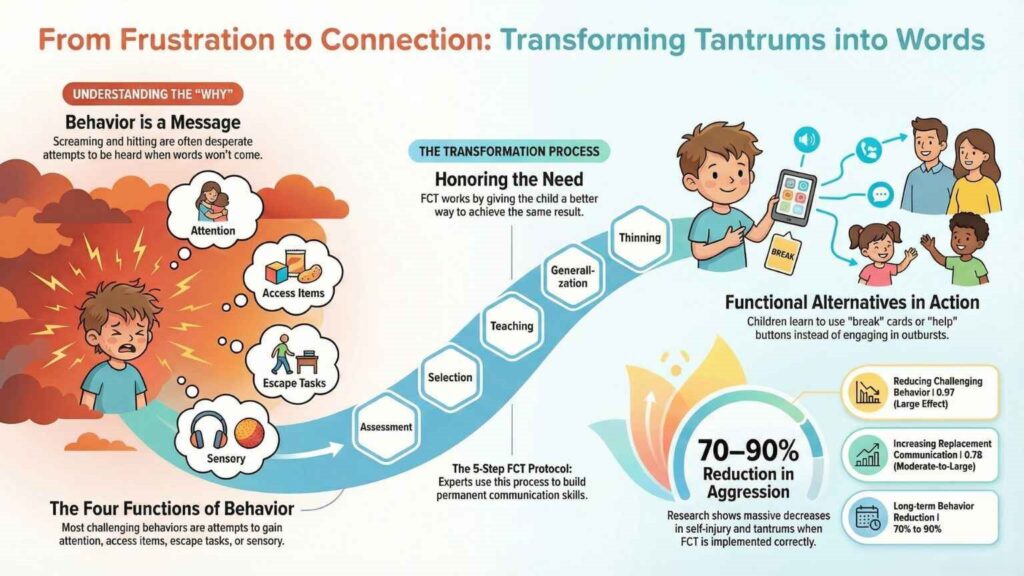
What Is Functional Communication Training ABA?
Functional Communication Training is an evidence-based intervention within Applied Behavior Analysis that teaches children meaningful ways to express their needs, wants, and feelings. [1] Rather than simply stopping problem behaviors, FCT addresses their root cause by providing children with effective communication tools they currently lack.
Think of it this way: When your child throws toys to escape a difficult task, they’re communicating “this is too hard” or “I need a break” they just don’t have the words or skills to say it appropriately. FCT teaches them exactly how to communicate those same needs using methods that work for them, whether that’s speaking, signing, pointing to pictures, or using a communication device.
Research consistently shows FCT produces large effects for reducing challenging behavior (effect size 0.97) and moderate-to-large effects for increasing replacement communication (effect size 0.78). [2]
Did You Know?
Recent meta-analysis research examining 79 children with autism found that FCT effectively reduced challenging behaviors across home, school, and clinical settings. When children learn to communicate their needs appropriately, problem behaviors decrease dramatically because the function (getting needs met) is now achieved through communication instead. [2]
Why Challenging Behaviors Are Actually Communication Attempts
Before diving into how FCT works, understanding why children engage in challenging behaviors changes everything. Children with autism often face significant communication barriers. When communication fails repeatedly, children learn that certain behaviors reliably get results.
Common Functions of Challenging Behavior
- Escape or Avoidance: Child hits when asked to do homework. The function is escaping the non-preferred task.
- Attention-Seeking: Child throws toys when parent talks on the phone. The function is gaining parent attention.
- Access to Tangibles: Child screams in the toy aisle. The function is accessing desired toys.
- Sensory Stimulation: Child engages in repetitive behaviors. The function is creating specific sensory input.
Once you identify what your child is trying to communicate through their behavior, you can teach them appropriate ways to communicate that same message.
Ready to Transform Communication in Your Home?
Fill in the form below to discuss how your child could start therapy quickly, without the stress:
The Five-Step FCT Process
Implementing functional communication training follows a systematic approach developed through decades of research.
Step 1: Functional Behavior Assessment
Your BCBA conducts a Functional Behavior Assessment (FBA) to determine exactly why challenging behaviors occur through direct observation, ABC data collection, interviews with caregivers, and functional analysis when appropriate. The FBA reveals the function maintaining problem behavior.
Step 2: Select Appropriate Communication Response
Next, your behavior analyst identifies a communication method that serves the same function as the problem behavior and matches your child’s current abilities. Options include vocal speech, sign language, Picture Exchange Communication System (PECS), speech-generating devices, or simple gestures.
The key is selecting something easier than the problem behavior. If screaming gets immediate attention but using a communication card is ignored, the child will continue screaming.
Step 3: Teach the Communication Response
Teaching happens in structured sessions where your BCBA creates opportunities for the behavior to occur naturally, prompts the communication before problem behavior emerges, immediately reinforces any communication attempt, and gradually fades prompts as the child learns.
Step 4: Generalize Across Settings and People
Communication skills must work everywhere. Your BCBA develops strategies including training multiple family members, practicing in different locations, using the system throughout the day, and coordinating with teachers for school implementation. Research shows that involving parents and teachers as implementers significantly improves maintenance and generalization. [3]
Step 5: Thin Reinforcement Schedule
Once skills are established, your BCBA gradually adjusts expectations by introducing brief delays, requiring more complex communication, teaching tolerance for “wait” responses, and varying reinforcement schedules to build persistence.
Did You Know?
Studies show that when FCT is implemented by trained caregivers in natural settings, children demonstrate significant reductions in problem behaviors while maintaining communication gains over time. The key success factor is consistent implementation across all settings and people. [3]
Real-World Examples of FCT in Action
Example 1: Escaping Non-Preferred Tasks
- Before FCT: Five-year-old Maya hits her RBT every time academics are presented.
- FCT Intervention: Maya learns to exchange a “break” picture card when work becomes overwhelming. RBT immediately provides 2-minute break whenever Maya uses the card.
- Results: Within three weeks, hitting decreases 85%. Maya independently requests breaks 10-15 times per session and completes more academic tasks than ever before.
Example 2: Gaining Adult Attention
- Before FCT: Seven-year-old James screams and destroys toys when his mother is on phone calls.
- FCT Intervention: James learns to tap mom’s shoulder and say “Excuse me” or hand her an “I need you” card.
- Results: Property destruction stops within the first week. Screaming decreases to near-zero within two months.
Example 3: Accessing Desired Items
- Before FCT: Three-year-old nonverbal Aiden throws intense tantrums in stores when he sees toys he wants.
- FCT Intervention: Aiden learns to use a speech-generating device with the “I want” button.
- Results: Tantrums decrease 70% in the first month. Parents can now take him to stores and outings previously impossible.
Understanding how to cope with disruptive behavior through functional communication helps families address challenging situations proactively.
Read More: Understanding Hand Flapping in Autism: What Parents Should Know
See Real Results With Professional FCT Support
Supporting FCT Success at Home
Parents play crucial roles in FCT success. Here’s how to maximize your child’s progress:
- Honor Every Communication Attempt: In the early stages, respond immediately to any communication effort, even imperfect attempts.
- Create Opportunities for Communication: Don’t anticipate needs so efficiently that your child doesn’t need to communicate. Place preferred items in sight but out of reach.
- Maintain Consistency Across Family Members: Everyone must respond the same way to communication attempts. Have family meetings to review the system.
- Use Visual Supports: Post visual reminders of communication systems where needed. Create PECS books for different settings.
- Celebrate Progress: Recognize improvements even when perfection isn’t reached. Your child is learning an entirely new skill system.
- Practice During Calm Moments: Don’t only work on communication during crises. Practice during relaxed times when your child can learn without frustration.
Learning about the role of parents in ABA therapy empowers you to support communication development effectively at home.
FCT for Different Communication Levels
Functional Communication Training adapts to children across the entire spectrum of communication abilities:
- For Nonverbal Children: Picture Exchange Communication Systems (PECS), speech-generating devices or apps, simple gestures like pointing, and sign language approximations.
- For Minimally Verbal Children: Expanding single-word requests to phrases, teaching specific communication for different functions, and building vocabulary for diverse needs.
- For Verbal Children Who Don’t Use Speech Functionally: Teaching when and how to use existing verbal skills purposefully to communicate needs, request help appropriately, and express feelings clearly.
Long-Term Benefits of FCT
Investing in functional communication training creates ripple effects throughout your child’s development:
- Reduced Challenging Behaviors: Research shows 70-90% reductions in aggression, self-injury, and tantrums when FCT is implemented correctly. [1]
- Improved Social Relationships: Appropriate communication helps peers and adults respond more positively.
- Increased Independence: Children who can express needs gain autonomy over their environment.
- Enhanced Learning Opportunities: Behavioral disruptions decrease, allowing more instructional time.
- Better Family Quality of Life: Families report decreased stress and ability to participate in community outings.
Transform Your Child's Communication Today
Getting Started With FCT at Achievement Behavior Services
If your child struggles with challenging behaviors rooted in communication difficulties, functional communication training might transform your family’s daily life. At Achievement Behavior Services, our Board Certified Behavior Analysts specialize in comprehensive FCT implementation.
Our Approach Includes:
- Thorough functional behavior assessments identifying exact functions of behaviors
- Individualized communication systems matching your child’s unique abilities
- Training for family members to implement strategies at home
- Coordination with schools for consistent implementation
- Ongoing data collection monitoring progress
- Support throughout generalization and maintenance phases
We serve families across New York, New Jersey, Connecticut, Georgia, And North Carolina through both center-based and in-home services. Don’t let communication barriers limit your child’s potential. The sooner FCT begins, the faster your child learns effective ways to be heard, understood, and empowered.
References
- Tiger, J.H., Hanley, G.P., & Bruzek, J. (2008). Functional Communication Training: A Review and Practical Guide. Behavior Analysis in Practice, 1(1), 16-23. https://pmc.ncbi.nlm.nih.gov/articles/PMC2846575/
- Kim, S.Y., Park, J., & Blair, K.S.C. (2025). A Meta-Analysis of Functional Communication Training for Young Children with ASD and Challenging Behavior in Natural Settings. Behavioral Sciences, 15(12), 1688.
https://www.mdpi.com/2076-328X/15/12/1688 - Luo, Y., LaRue, R.H., & Brown, J.L. (2025). A Mega-Review of Functional Communication Training for Students with Disabilities in Educational Settings. Journal of Behavioral Education.
https://link.springer.com/article/10.1007/s10864-025-09598-4 - Ferris, E.L., Howard, A.R., Baker, E., Craig, A.R., & Roane, H.S. (2025). Chaining Differential Reinforcement of Compliance and Functional Communication Training. Behavioral Sciences, 15(7), 891.
https://pmc.ncbi.nlm.nih.gov/articles/PMC12292196/