
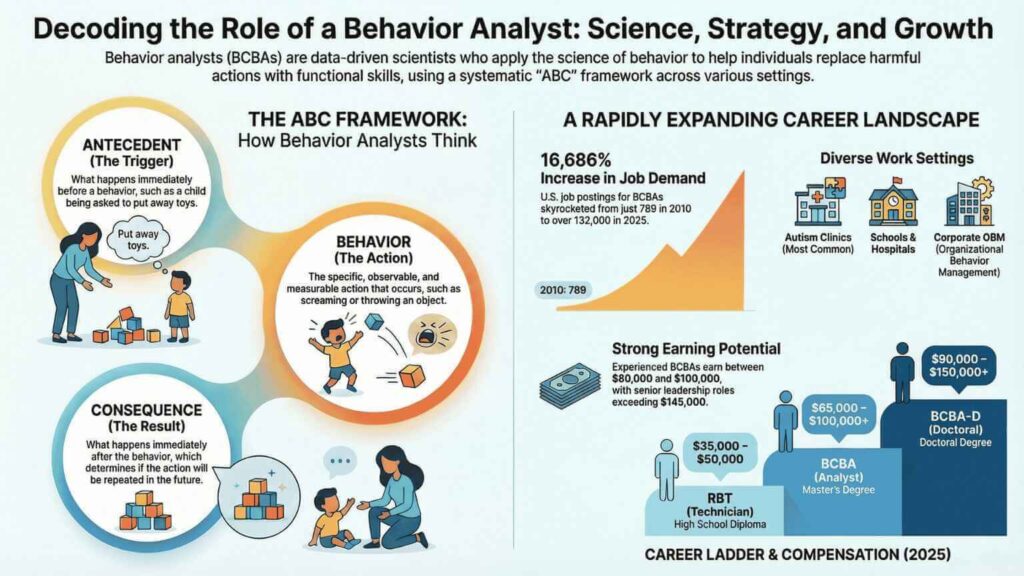
Behavior analysts are professionals who apply the science of Applied Behavior Analysis (ABA) to understand why people behave the way they do and to create evidence-based plans that replace harmful or limiting behaviors with meaningful, functional ones. Most work with children with autism, but the field spans schools, hospitals, corporations, and beyond. In 2025, the Behavior Analyst Certification Board (BACB) recorded 132,307 job postings requesting BCBA certification — a 28% increase from the prior year, and a staggering rise from just 789 postings in 2010. [1] Whether you are a parent wondering who will work with your child, or a professional considering this career, this guide covers everything.
What Is a Behavior Analyst?
A behavior analyst is a trained and certified professional who uses the principles of Applied Behavior Analysis to observe, measure, and modify behavior. The gold-standard credential is the Board Certified Behavior Analyst (BCBA), a master’s or doctoral-level practitioner certified by the independent Behavior Analyst Certification Board (BACB). [2] Behavior analysts are not therapists in the traditional clinical sense. They are data-driven scientists who design individual intervention programs, supervise their implementation, and measure outcomes with precision.
The title is broader than most people realize. While autism and developmental disabilities represent the largest area of practice, behavior analysts also work in schools, hospitals, organizational management, sports performance, animal training, and public health. What they all share is a single framework: the systematic study of how behavior relates to the environment.
Looking for a BCBA for Your Child? ABS Serves Families Across NY, NJ, CT, GA & NC.
Fill in the form below to discuss how your child could start therapy quickly, without the stress:
The ABC Framework: How Behavior Analysts Think
Every behavior analyst thinks through a common lens called the ABC model: Antecedent, Behavior, Consequence. This is the foundational framework for everything they do. Understanding this model helps parents and families understand exactly how a BCBA approaches their child’s challenges.
|
ABC Component |
Definition |
Real-World Example |
|
A — Antecedent |
What happens immediately BEFORE the behavior. The trigger or setting. |
A child is asked to put away their toys (the demand is the antecedent) |
|
B — Behavior |
The specific, observable action that occurs. Measurable and defined precisely. |
The child throws the toys and screams |
|
C — Consequence |
What happens immediately AFTER the behavior. This determines if it will happen again. |
The demand is removed — the child escapes the task (negative reinforcement) |
By analyzing the A-B-C chain, a behavior analyst can identify the function of a behavior, the reason it keeps happening. The four most common functions are: attention, escape/avoidance, access to something desired, and automatic sensory reinforcement. [3] Once the function is understood, the BCBA builds an intervention that addresses the root cause rather than suppressing surface symptoms.
Read More: Essential Tips for Behavior Technicians in ABA Therapy
What Do Behavior Analysts Do Day-to-Day?
The daily work of a BCBA spans clinical assessment, program design, supervision, coaching, and data review. Here is what a typical day in practice actually involves:
- Conducting Functional Behavior Assessments (FBAs): structured observation and data collection to identify the triggers, patterns, and functions behind challenging behaviors before any intervention is designed
- Designing Behavior Intervention Plans (BIPs): individualized written plans specifying what to do before a behavior occurs (antecedent strategies), how to respond when it does (consequence strategies), and how to teach a replacement behavior
- Writing and updating Skill Acquisition Programs: step-by-step teaching programs targeting communication, social skills, daily living, academic readiness, and emotional regulation
- Supervising Registered Behavior Technicians (RBTs): observing, coaching, and providing performance feedback to the direct-care staff who implement programs session to session
- Training parents and caregivers: teaching families to apply the same strategies at home so that skills generalize beyond therapy sessions into daily life
- Collecting and analyzing data: reviewing session-by-session data graphs to evaluate whether programs are working, then adjusting intensity, prompting strategies, or reinforcement schedules accordingly
- Collaborating with school and medical teams: attending IEP meetings, consulting with teachers and speech therapists, and aligning goals across all of a child’s support environments
Core Techniques Behavior Analysts Use
BCBAs draw on a toolkit of evidence-based techniques, selected and combined based on the child’s age, profile, and specific goals. Here are the most widely used:
|
Technique |
What It Is |
Best Used For |
|
Discrete Trial Training (DTT) |
Highly structured, one-on-one teaching that breaks skills into small components and practices each with immediate reinforcement |
Teaching early language, imitation, and foundational cognitive skills |
|
Natural Environment Training (NET) |
Communication and skill goals are embedded in the child’s natural play and daily routines, following the child’s lead |
Toddlers and young children; skill generalization to real life |
|
Functional Behavior Assessment (FBA) |
Systematic observation and data collection to identify the cause of a challenging behavior before designing any intervention |
Before creating any BIP; required prior to behavior reduction programs |
|
Behavior Skills Training (BST) |
A structured method of teaching new skills through instruction, modeling, rehearsal, and feedback |
Training parents, RBTs, and school staff on ABA strategies |
|
Teaching an appropriate communication behavior to replace a challenging one that serves the same function |
Reducing tantrums, aggression, and self-injury driven by communication gaps |
|
|
Token Economy |
A reinforcement system where points or tokens are earned for target behaviors and exchanged for a preferred reward |
Building motivation, compliance, and school readiness skills |
Did You Know?
In 2010, there were just 789 U.S. job postings requesting BCBA certification. By 2025, that number had reached 132,307 a 28% increase from 2024 alone, according to the BACB’s annual demand report. New Jersey ranked in the top 5 states for BCBA demand in 2025. The field is growing faster than almost any other in the helping professions. [1]
Where Do Behavior Analysts Work? (All Settings)
One of the most misunderstood facts about this profession is its range. Behavior analysts are not limited to autism clinics. The science of ABA is applicable anywhere human behavior matters which is everywhere. Here is the full landscape of work settings:
|
Work Setting |
What Behavior Analysts Do There |
Client Population |
|
In-home ABA (private) |
Deliver individualized ABA programs in the family’s home; coach parents in real time |
Children with autism, ages 18 months through school age |
|
ABA clinics / centers |
Run structured programs, group sessions, social skills training; supervise RBT teams |
Children and teens with ASD and developmental disabilities |
|
Public & private schools |
Conduct FBAs, write BIPs, support IEP teams, train teachers on behavioral strategies |
Students with ASD, ADHD, emotional disturbance, intellectual disabilities |
|
Hospitals & healthcare |
Manage behavioral challenges in patients with brain injuries, dementia, or chronic illness |
Adults and children with medical and neurological diagnoses |
|
Residential facilities |
Create behavior programs for adults with developmental disabilities in group homes |
Adults with ASD, ID, and co-occurring behavioral health conditions |
|
Organizational Behavior Mgmt (OBM) |
Apply ABA principles to improve workplace safety, productivity, and staff performance |
Corporate employees, manufacturing workers, healthcare staff |
|
Research & universities |
Study behavioral interventions, train future BCBAs, publish in peer-reviewed journals |
Graduate students and research participants |
The 4 Credential Levels in Behavior Analysis
The field has a clearly defined career ladder. Each level has different education requirements, scope of practice, and supervision requirements. Here is exactly what separates them:
|
Credential |
Education Required |
Role & Scope |
Supervised By |
|
RBT (Registered Behavior Technician) |
High school diploma + 40 training hours |
Implements programs designed by a BCBA; provides direct therapy under close supervision |
BCBA or BCaBA |
|
BCaBA (Board Certified Assistant Behavior Analyst) |
Bachelor’s degree in ABA or related field |
Assists in assessment and program design; can supervise RBTs but must be overseen by a BCBA |
BCBA |
|
BCBA (Board Certified Behavior Analyst) |
Master’s degree + supervised fieldwork hours + BCBA exam |
Independently conducts FBAs, designs BIPs, supervises RBTs and BCaBAs, trains families |
Independent practice (license required in most states) |
|
BCBA-D (Doctoral Level) |
Doctoral degree + BCBA requirements |
Same as BCBA plus research, university teaching, and high-level consultation |
Independent practice |
As of 2024, there were over 59,000 active BCBAs in the United States, with demand continuing to significantly outpace supply in most states. [2]
Read More: BCBA vs RBT: Responsibilities, Salary, and Career Path
Ready to Build a Career in Behavior Analysis? ABS Is Hiring BCBAs Across 5 States.
How to Become a BCBA in 2026: Step by Step
Becoming a Board Certified Behavior Analyst is a rigorous but clearly mapped process. Most people complete it in 6 to 8 years total from the start of undergraduate study. Here is every step:
- Earn a bachelor’s degree. A degree in psychology, education, or a related field is the standard starting point. This takes 4 years and does not need to be in ABA specifically.
- Complete a master’s degree in ABA. You must earn a graduate degree from a BACB-verified course sequence. Programs take 2 to 3 years. ABAI-verified programs meet all BACB coursework requirements. [2]
- Accumulate supervised fieldwork hours. Candidates must complete either 2,000 hours of Concentrated Supervised Fieldwork or 1,500 hours of Focused Supervised Fieldwork under an actively certified BCBA. [2]
- Pass the BCBA examination. The exam is administered by Pearson VUE and covers all core areas of ABA. As of 2024, the first-time pass rate was approximately 56%, making adequate preparation essential. [4]
- Obtain state licensure. Most U.S. states including New York, New Jersey, Connecticut, Georgia, and North Carolina now require BCBAs to hold a state license in addition to BACB certification. Requirements vary by state.
- Maintain certification with CEUs. BCBAs must complete 32 continuing education units (CEUs) every two years to maintain their BACB certification, including ethics training. [2]
Read Complete Guide Here: How to Become a BCBA in 2026
What Does a Behavior Analyst Earn?
Salaries for behavior analysts vary widely based on credential level, setting, state, and years of experience. The table below reflects 2025 figures from multiple compensation sources alongside official BLS projections:
|
Credential / Experience Level |
Typical Annual Salary Range |
Notes |
|
RBT (entry-level) |
$35,000 – $50,000 |
Varies significantly by employer, region, and hours |
|
BCaBA |
$55,000 – $70,000 |
Typically employed under a supervising BCBA |
|
BCBA (0–3 years experience) |
$65,000 – $80,000 |
Mid-range for early-career BCBAs in clinical settings |
|
BCBA (3–7 years experience) |
$80,000 – $100,000 |
Rises with supervision caseload and program management |
|
BCBA (senior / leadership) |
$100,000 – $145,000+ |
Clinical directors, regional managers, private practice |
|
BCBA-D (doctoral) |
$90,000 – $150,000+ |
Research, university, high-level consultation roles |
The BLS projects 17% job growth in behavior-analysis-related roles from 2024 to 2034, generating approximately 48,300 annual job openings well above the average growth rate for all U.S. occupations. [5] For BCBA-credentialed professionals specifically, demand continues to significantly outpace the supply of new graduates entering the field.
Read More: BCBA Salary in New York: 2026 Averages, Ranges, and Factors to Know
Did You Know?
According to the BACB’s 2026 US Employment Demand report, California, New Jersey, Texas, Massachusetts, and North Carolina accounted for 38% of all BCBA job postings nationally in 2025. [1]
Why Behavior Analysts Choose to Work at Achievement Behavior Services
Not all ABA employers are the same. At Achievement Behavior Services (ABS), BCBAs work in a BCBA-owned, boutique agency which means clinical decisions are made by clinicians, not investors. ABS was founded in 2015 and serves families across New York, New Jersey, Connecticut, Georgia, and North Carolina, with center-based locations in Malverne, NY and Douglasville, GA.
What sets ABS apart as an employer for behavior analysts:
- Low caseloads: BCBAs at ABS manage meaningful, focused caseloads rather than the unsustainably high numbers common at large corporate ABA providers
- Collaborative clinical culture: direct access to BCBA leadership and a team that values clinical quality over volume metrics
- Professional development: ABS provides access to CEU programming and ongoing supervision to support career growth and certification maintenance
- In-home and center-based experience: BCBAs gain experience across multiple service delivery models, building a more versatile clinical skill set
- States with top BCBA demand: both New Jersey and North Carolina rank in the national top 5 for BCBA job postings, meaning ABS’s locations are where the field is growing fastest
Join a BCBA-Owned Agency Where Clinical Excellence Comes First.
Frequently Asked Questions
Q: What exactly does a behavior analyst do every day?
On a typical day, a behavior analyst conducts functional assessments, reviews session data from their RBT team, updates behavior intervention plans, coaches parents and caregivers on home implementation, and collaborates with school or medical professionals. [3] The balance shifts depending on setting in-home BCBAs spend more time on parent training, while clinic-based BCBAs spend more time on direct supervision and group programming. The constant across all settings is data: every decision is driven by objective measurement.
Q: What is the difference between a BCBA and a behavior therapist?
A BCBA is the supervisor and program designer they assess, create the plan, and oversee everything. A behavior therapist (typically an RBT) implements the programs the BCBA designs during direct sessions. [2] An RBT cannot independently assess clients, write treatment plans, or supervise others. This distinction matters for families: the BCBA is the clinical brain of the program; the RBT is the consistent hands-on presence with your child.
Q: What qualifications does a behavior analyst need?
A Board Certified Behavior Analyst must hold a master’s degree in ABA or a related field, complete 1,500 to 2,000 supervised fieldwork hours, and pass the BCBA certification examination administered by the BACB. [2] In most U.S. states including NY, NJ, CT, GA, and NC a state license is also required. Certification must be maintained with 32 continuing education units every two years.
Q: Can a behavior analyst work outside of autism treatment?
Yes, significantly so. While autism treatment represents the largest employment sector, behavior analysts also work in public schools supporting students with a range of disabilities, hospitals and healthcare settings, residential programs for adults with intellectual disabilities, and corporate environments under Organizational Behavior Management (OBM). [6] The ABC framework and ABA principles apply wherever behavior and environment interact.
Q: How long does it take to become a behavior analyst?
Most people complete the pathway to BCBA certification in 6 to 8 years: 4 years for a bachelor’s degree, 2 to 3 years for a master’s program, and the supervised fieldwork hours accumulated during or after graduate study. The BCBA exam comes at the end of that process. Some accelerated programs allow candidates to complete the master’s and fieldwork concurrently, shortening the total timeline. [2]
Q: Is behavior analysis a good career in 2026?
By nearly every measure, yes. The BLS projects 17% growth in behavior-analysis-related roles from 2024 to 2034 more than double the average for all occupations. [5] BACB data shows 132,307 U.S. job postings requesting BCBA certification in 2025, up 28% from the prior year. [1] Salaries for experienced BCBAs commonly exceed $90,000, with senior and private practice roles surpassing $130,000. The combination of strong demand, meaningful work, and clear career advancement makes it one of the most stable career paths in behavioral health.
References
[1] Behavior Analyst Certification Board (BACB). US Employment Demand for Behavior Analysts: 2010–2025. Published January 2026. https://www.bacb.com/wp-content/uploads/2025/02/Lightcast2026_260127-2-a.pdf
[2] Behavior Analyst Certification Board (BACB). BCBA Handbook and Certification Requirements. 2025.
https://www.bacb.com/bcba/
[3] Cooper JO, Heron TE, Heward WL. Applied Behavior Analysis (3rd ed.). Pearson, 2020. Referenced in: Association for Behavior Analysis International (ABAI).
https://www.abainternational.org/aba.aspx
[4] Behavior Analyst Certification Board (BACB). BCBA Examination Pass Rates and Score Data. 2024.
https://www.bacb.com/wp-content/uploads/2025/05/BCBA-2024-Pass-Rates-Combined-251222-a.pdf
[5] U.S. Bureau of Labor Statistics. Occupational Outlook Handbook: Substance Abuse, Behavioral Disorder, and Mental Health Counselors (SOC 21-1018). May 2024. https://www.bls.gov/ooh/community-and-social-service/substance-abuse-behavioral-disorder-and-mental-health-counselors.htm
[6] Association of Professional Behavior Analysts (APBA). What Is Behavior Analysis? https://www.apbahome.net/about-behavior-analysis
[7] American Psychological Association (APA). Applied Behavior Analysis. APA Policy Statement. https://www.apa.org/about/policy/applied-behavior-analysis
[8] National Autism Center. National Standards Project, Phase 2. Findings and Conclusions: Addressing the Need for Evidence-Based Practice Guidelines for Autism Spectrum Disorder. 2015. https://nationalautismcenter.org/national-standards/phase-2-2015/
[9] Shaw KA, et al. Prevalence and Early Identification of Autism Spectrum Disorder — ADDM Network, 2022. MMWR Surveillance Summaries. 2025;74(SS-2):1–22. CDC. https://www.cdc.gov/mmwr/volumes/74/ss/pdfs/ss7402a1-H.pdf