
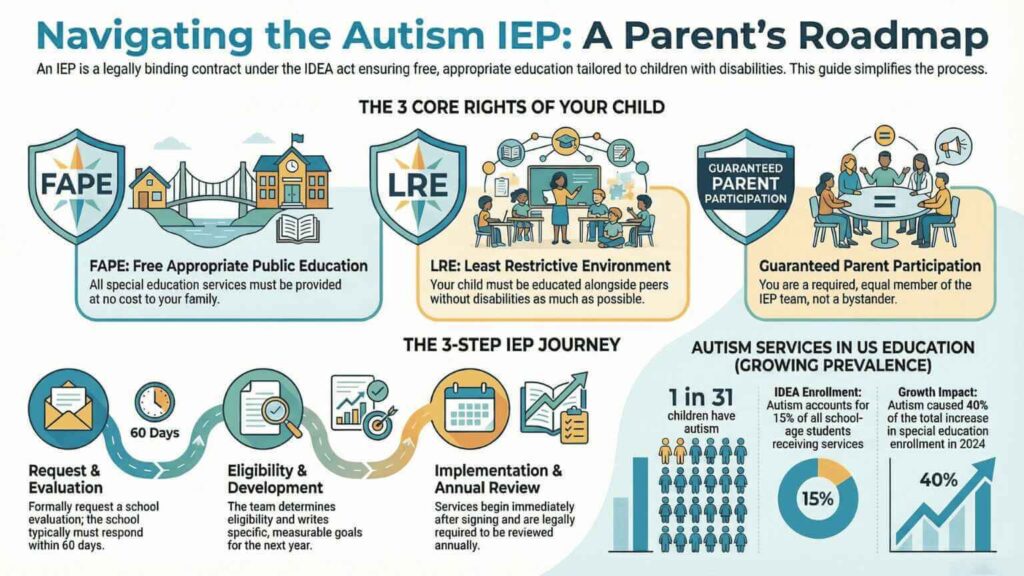
An IEP (Individualized Education Program) is a legally binding document that the school must create for your child if they qualify for special education services under federal law. For children with autism, this plan spells out exactly what support, goals, and services the school is required to provide. As of 2022, 1 in 31 children in the U.S. have autism, and autism is now the fastest-growing category in the entire special education system. [1][2] Understanding your child’s IEP is one of the most powerful things you can do as a parent.
What Does IEP Stand For?
IEP stands for Individualized Education Program. It is a written plan created under the Individuals with Disabilities Education Act (IDEA), the federal law that guarantees all eligible children with disabilities access to a free and appropriate public education. [3] ‘Individualized’ is the key word. No two IEPs are the same. The plan is built entirely around your child’s specific strengths, challenges, and needs.
An IEP is not just a list of goals, it is a legal contract. Once a school signs an IEP, they are legally required to deliver everything written in it. If they do not, parents have the right to dispute the decision and request changes through IDEA’s procedural safeguards.
Wondering How ABA Therapy Supports Your Child's IEP Goals? We Can Help.
Fill in the form below to discuss how your child could start therapy quickly, without the stress:
What Rights Does IDEA Give Your Autistic Child?
The Individuals with Disabilities Education Act creates five core rights for every child who qualifies for an IEP. Here is what each one means in plain language:
Your Child’s Right | What It Means in Practice |
FAPE – Free Appropriate Public Education | All special education services must be provided at no cost to your family |
LRE – Least Restrictive Environment | Your child must be educated alongside peers without disabilities as much as possible |
Parent Participation | You are a required, equal member of the IEP team not just a bystander |
Annual Review | The IEP is reviewed and updated at least every 12 months as your child grows |
Procedural Safeguards | You have the right to dispute, appeal, or request changes to any part of the IEP |
Why Do Children with Autism Need an IEP?
Autism affects each child differently. One child may struggle with spoken communication while another has advanced vocabulary but cannot regulate emotions in a classroom setting. A standard school environment is not designed to address these individual differences without a formal, written plan. [4] The IEP bridges that gap and makes support legally mandatory and measurable rather than left to the goodwill of individual teachers.
An IEP for an autistic child typically addresses these core areas of need:
- Communication: building expressive language, requesting skills, and conversation abilities
- Social skills: learning to initiate interaction, take turns, and read social cues
- Behavior and self-regulation: managing frustration, transitions, and sensory overwhelm
- Academic skills: reading, math, and writing goals tailored to the child’s level
- Daily living skills: independence with routines like dressing, eating, and organization
- Sensory needs: accommodations for sensory sensitivities that impact learning
Did You Know?
In 2024, autism accounted for nearly 15 percent of all school-age students receiving services under IDEA and was responsible for 40 percent of the total increase in special education enrollment that year. The number of children receiving autism-related IEP services has grown sharply every year for over a decade. [2]
What Is Inside an Autism IEP? The 6 Key Components
Every IEP contains specific required sections under IDEA. Here is what each one means and why it matters for your child:
IEP Component | What It Contains | Why It Matters |
Present Levels (PLAAFP) | Current performance across communication, academic, social, and functional areas | Sets the starting line all goals must connect to this section |
Annual Goals | Specific, measurable targets for the child to reach within 12 months | The heart of the IEP what the school is actually working toward |
Special Education Services | Hours, type, and frequency of instruction, therapy, or support | Determines how much direct help your child receives |
Accommodations & Modifications | Changes to the environment, testing, or curriculum to reduce barriers | Can include extra time, quiet testing rooms, visual schedules, and more |
Related Services | Speech therapy, occupational therapy, ABA support, counseling, and transportation | Services beyond teaching that support the child’s overall development |
Progress Reporting | How and when the school will report your child’s progress toward each goal | Keeps parents informed and holds the school accountable |
ABA Therapy Can Be Written Into Your Child's IEP as a Related Service - Find Out How.
Who Is on the IEP Team for Autism?
The IEP team is the group of people who create, review, and update your child’s plan together. Federal law specifies who must be included. As the parent, you are a required member and your voice carries equal weight to the school’s. [3]
The core IEP team typically includes:
- The parent or legal guardian: you know your child better than anyone in that room
- General education teacher: provides perspective on how your child functions in the classroom
- Special education teacher: leads the academic and behavioral support components of the IEP
- School district representative: has authority to commit school resources and services
- Someone who can interpret evaluation results: explains what assessment data means in plain language
- Speech-language pathologist: if communication is a goal area, which it often is in autism IEPs
- The child: invited to participate when appropriate, especially as they get older
- BCBA or behavior specialist: when behavioral goals or ABA services are part of the plan
How Does the IEP Process Work? Step by Step
For families navigating this for the first time, the IEP process can feel overwhelming. Here is how it works from start to finish, in plain English:
- Request an evaluation: You or the school can formally request a developmental and educational evaluation. The school must respond within 60 days in most states. You do not need a medical diagnosis to request one, only a concern that your child may need special education support.
- Review the evaluation results: A team of specialists assesses your child across multiple areas. You will receive a written report. You have the right to request an independent evaluation at the school’s expense if you disagree with the results.
- Determine eligibility: The IEP team meets to decide whether your child qualifies for services under IDEA. For autism, eligibility requires that the disability adversely affects the child’s educational performance. [3]
- Develop the IEP: The team meets to write the IEP together. Goals are set, services are agreed upon, and the plan is finalized. This meeting typically lasts 1 to 2 hours. You can bring a support person or advocate.
- Implement the plan: The school begins delivering services as soon as the IEP is signed. The plan goes into effect immediately there is no waiting period once you consent.
- Review and update annually: The IEP is reviewed at least once a year. You can also request a meeting at any time if you believe your child’s needs have changed or the plan is not working.
Did You Know?
A large U.S. longitudinal study found that 92 percent of adolescents with autism who were followed through high school had an active IEP and most included specific plans for postsecondary education and employment. IEPs are not just for young children. They evolve with your child all the way through school. [6]
How ABA Therapy Supports Your Child's IEP Goals
One of the most important things parents in New York, New Jersey, Connecticut, Georgia, and North Carolina can do is connect their child’s ABA therapy directly to their IEP. ABA is one of the most evidence-based interventions for autism, and a BCBA can work alongside the school team to ensure that therapy goals and IEP goals are aligned and reinforce each other. [7]
At Achievement Behavior Services (ABS), our BCBAs are experienced in attending IEP meetings, collaborating with school teams, and building ABA programs that directly support what is written in a child’s IEP. Skills practiced in therapy communication, following directions, emotional regulation are the same skills the school is working toward. When both sides work together, children make faster, more lasting progress.
ABA therapy can also be included in the IEP itself as a related service meaning the school may be required to fund or coordinate ABA support as part of your child’s free appropriate public education. Talking to a BCBA before or during the IEP process can help you understand what to request and how to advocate for the right level of support.
ABS Serves Families Across NY, NJ, CT, GA & NC - Start the IEP + ABA Conversation Today.
ABS Offers In-Home and Teletherapy-Compatible ABA for Speech – Available Across NY, NJ, CT, GA & NC.:
- New York – In-home and center-based ABA therapy
- New Jersey – ASD evaluations and individualized ABA programs
- Connecticut – Evidence-based autism support for families
- Georgia – Personalized ABA therapy for lasting results
- North Carolina – Supporting your child’s development journey
- Douglasville, GA – Family-centered autism care
Frequently Asked Questions
Q: What does IEP stand for in autism?
IEP stands for Individualized Education Program. It is a legally binding written plan created under federal law (IDEA) for children with disabilities, including autism, who qualify for special education services. It outlines the child’s current abilities, annual goals, the services the school will provide, and the accommodations that must be in place. [3]
Q: Does my child automatically get an IEP if they have an autism diagnosis?
Not automatically but having an autism diagnosis is a very strong indicator of eligibility. To qualify for an IEP, the school must determine that autism adversely affects educational performance and that the child needs specialized instruction. In practice, the large majority of school-age children with autism qualify. [4] If your child has a diagnosis, request a school evaluation in writing as soon as possible.
Q: What is the difference between an IEP and a 504 plan?
An IEP provides specialized instruction and a full range of related services under IDEA. A 504 plan provides accommodations only, it does not include direct special education instruction. Children with autism who need significant teaching support, communication therapy, or behavioral intervention almost always need an IEP rather than a 504 plan. A 504 is better suited for children who can access the general curriculum with minor adjustments.
Q: Can I add ABA therapy to my child’s IEP?
Yes. ABA therapy can be written into an IEP as a related service meaning the school district may be required to provide or fund it as part of your child’s free appropriate public education. [7] Working with a qualified BCBA before your IEP meeting can help you understand what to request and how to frame your child’s needs so that ABA support is included in the final plan.
Q: How often is the IEP reviewed?
Under IDEA, an IEP must be reviewed and updated at least once every 12 months. [3] However, you can request an IEP meeting at any time you do not need to wait for the annual review. If your child is not making progress, a new placement has been proposed, or their needs have changed significantly, request a meeting in writing right away.
Q: What should I bring to an IEP meeting?
Come prepared with any recent therapy reports, medical evaluations, or teacher observations about your child. Write down your goals and concerns before the meeting. Bring a trusted person to support a partner, family member, or advocate. You are allowed to record the meeting in most states with advance notice. Most importantly: remember that you are an equal member of the IEP team, not a visitor.
References
[1] Shaw KA, Williams S, Patrick ME, et al. Prevalence and Early Identification of Autism Spectrum Disorder Among Children Aged 4 and 8 Years — ADDM Network, 16 Sites, United States, 2022. MMWR Surveillance Summaries. 2025;74(SS-2):1–22. CDC.
https://www.cdc.gov/mmwr/volumes/74/ss/pdfs/ss7402a1-H.pdf
[2] The Advocacy Institute. Number of IDEA-Eligible Students Increases 3 Percent in 2024 — Autism Accounts for 40% of Total Increase. 2024.
https://www.advocacyinstitute.org/blog/
[3] U.S. Department of Education, Office of Special Education Programs. Individuals with Disabilities Education Act (IDEA).
https://www.ed.gov/laws-and-policy/individuals-disabilities/idea
[4] Ruble LA, McGrew JH, Toland MD. Examining the Quality of IEPs for Young Children with Autism. Journal of Autism and Developmental Disorders. 2012;42(5):986–997. PMC: https://pmc.ncbi.nlm.nih.gov/articles/PMC3116234/
[5] Ruble LA, McGrew JH, Dalrymple N, Jung LA. Examining the Quality of IEPs for Young Children with Autism. J Autism Dev Disord. 2010;40(7):899–911. PMC: https://pmc.ncbi.nlm.nih.gov/articles/PMC3116234/
[6] Anderson KA, McDonald TA, Edbauer RK, et al. Individualized Education Programs and Transition Planning for Adolescents with Autism. JAMA Pediatrics. 2024. PMC: https://pmc.ncbi.nlm.nih.gov/articles/PMC10911052/
[7] Eldevik S, Hastings RP, Hughes JC, et al. Using Participant Data to Extend the Evidence Base for Intensive Behavioral Intervention for Children with Autism. American Journal on Intellectual and Developmental Disabilities. 2010;115(5):381–405. PMC: https://pmc.ncbi.nlm.nih.gov/articles/PMC10422951/
[8] National Center for Education Statistics (NCES). Students with Disabilities. Condition of Education 2024. U.S. Department of Education, IES. https://nces.ed.gov/programs/coe/indicator/cgg/students-with-disabilities
[9] Promoting Progress / OSEP. Autism IDEA Disability Category Tip Sheet. 2025. https://promotingprogress.org/sites/default/files/2025-02/autism-tips.pdf
[10] National Institute on Deafness and Other Communication Disorders (NIDCD). Autism Spectrum Disorder: Communication Problems in Children. Updated 2023. https://www.nidcd.nih.gov/health/autism-spectrum-disorder-communication-problems-children