Why Stimulus Control is Important in Autism Therapy
For children with autism, recognizing and responding to cues doesn’t always come naturally. Stimulus control helps bridge this gap. A 2023 meta-analysis found that ABA-based interventions produced moderate to large gains in intellectual functioning (SMD = 0.51) and adaptive behavior (SMD = 0.37)[2].
- Encourages learning: Children learn how to connect instructions with actions.
- Builds independence: Kids practice skills they can use at home, school, or in the community.
- Reduces confusion: Clear cues reduce frustration and improve communication.
- Promotes positive behavior: Children learn when certain behaviors are appropriate, which reduces problem behaviors.
Our therapists at ABS often use everyday routines to teach children how to connect instructions with actions.
Did You Know?
Children who receive early, intensive ABA therapy (20–40 hours per week) show significant improvements in communication, learning, and daily living skills. [3]
Common Examples of Stimulus Control in Everyday Life
Stimulus control is not unique to autism therapy it’s something we all experience:
- Stopping at a red light (stimulus = red light, response = stop).
- Washing hands after hearing, “Time for lunch!”
- Saying “hello” when someone greets you.
In ABA, these same everyday principles are applied in a structured way to help children with autism build lasting skills. Over 50% of skill mastery in children receiving ABA is directly linked to treatment intensity and duration.[4]
How Therapists Teach Stimulus Control in ABA
ABA therapists use proven strategies to build stimulus control. Some common methods include:
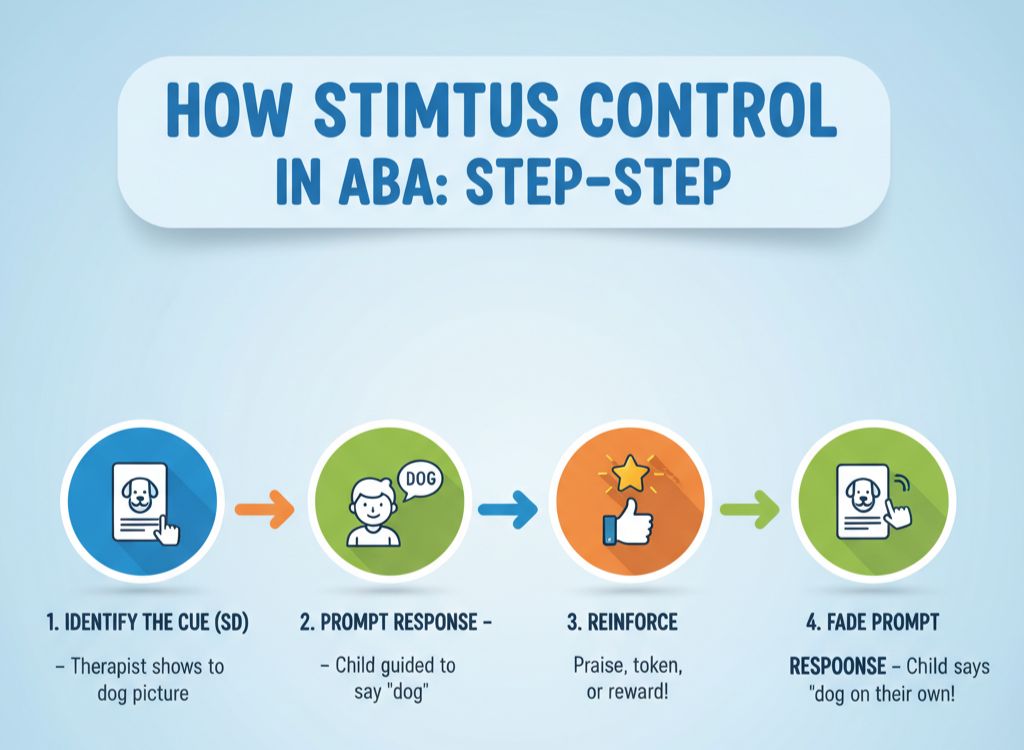
1. Discriminative Stimulus (SD)
- An instruction or cue that signals the child what to do.
- Example: When a therapist says, “Clap your hands,” that’s the SD.
2. Prompting
- Therapists may give hints or guidance if the child doesn’t respond correctly at first.
- Prompts can be verbal, physical, or visual.
3. Fading Prompts
- Over time, prompts are reduced so the child learns to respond independently to the SD.
4. Reinforcement
- Correct responses are rewarded with praise, tokens, or other reinforcers, making the child more likely to repeat the behavior.
Want your child’s skills to last? Our BCBAs create structured plans that include Parent Training to ensure consistency at home. Find expert, local support in: Albany, NY, West Hempstead, NY, Mountainside, NJ, and Eatontown, NJ.
Read More: Focused vs Comprehensive ABA Therapy: Which Is Right for Your Child?
How Parents Can Support Stimulus Control at Home
Parents play a big role in strengthening skills learned in ABA sessions. Here’s how you can help:
- Be consistent: Use the same cues that the therapist uses to avoid confusion.
- Practice daily routines: Embed learned skills into everyday life, like bedtime routines or mealtime.
- Provide reinforcement: Offer praise or small rewards when your child responds correctly.
- Communicate with therapists: Ask your child’s ABA team about the cues and strategies they’re using so you can mirror them at home.
Studies show that parent-led ABA significantly reduces disruptive behaviors and increases communication skills.[5] Our team at Achievement Behavior Services works closely with parents, sharing cues and reinforcement strategies so learning continues beyond the therapy room.
Need help generalizing skills to all environments? Our In-Home ABA model ensures your child practices stimulus control in their natural setting, your home! We are actively serving families in Columbus, GA, Raleigh, NC, Warner Robins, GA, and Durham, NC. View All Services.
Did You Know?
Research shows that consistent parent involvement in ABA therapy leads to better long-term outcomes, as children generalize skills more effectively at home.[6]
Common Challenges and How to Overcome Them
- Over-reliance on prompts: Sometimes children wait for extra help before responding. Solution: gradually fade prompts.
- Difficulty generalizing: A child may follow cues in therapy but not at home. Solution: practice skills in different environments.
- Frustration with unclear cues: Make instructions simple, clear, and consistent.
A 2025 study confirmed that ABA interventions yield large improvements in language skills and moderate gains in adaptive and cognitive skills—especially when treatment is sustained longer.[7]
Key Takeaway for Parents
Stimulus control is a cornerstone of ABA therapy, helping children with autism understand when and how to respond to everyday cues. By working together with therapists, parents can reinforce these skills at home, building independence and confidence in their child.
Remember, every child learns at their own pace but with patience, consistency, and collaboration, stimulus control can open doors to meaningful growth.
Start building lasting independence today. We offer personalized In-Home ABA and structured Center Based ABA nationwide. Find local support in Connecticut, Utah, and New Jersey. View All ABS Locations.
References:
- Eldevik, S., Hastings, R. P., Hughes, J. C., Jahr, E., Eikeseth, S., & Cross, S. (2009). Meta-analysis of early intensive behavioral intervention for children with autism. Journal of Clinical Child & Adolescent Psychology, 38(3), 439–450. https://www.tandfonline.com/doi/abs/10.1080/15374410902851739
- Peters-Scheffer, N., Didden, R., Korzilius, H., & Sturmey, P. (2011). A meta-analytic study on the effectiveness of comprehensive ABA-based early intervention programs for children with autism spectrum disorders. Research in Autism Spectrum Disorders, 5(1), 60–69. https://www.sciencedirect.com/science/article/pii/S1750946710000498?via%3Dihub
- Virués-Ortega, J. (2010). Applied behavior analytic intervention for autism in early childhood: Meta-analysis, meta-regression and dose–response meta-analysis of multiple outcomes. Clinical Psychology Review, 30(4), 387–399. https://www.sciencedirect.com/science/article/abs/pii/S0272735810000218?via%3Dihub
- Sandbank, M., Bottema-Beutel, K., Crowley, S., Cassidy, M., Dunham, K., Feldman, J. I., … & Woynaroski, T. (2020). Project AIM: Meta-analysis of interventions for young children with autism. Journal of Autism and Developmental Disorders, 50(9), 2953–2979. https://pubs.asha.org/doi/abs/10.1044/2020_JSLHR-19-00167
- Reichow, B., & Wolery, M. (2009). Comprehensive synthesis of early intensive behavioral interventions for young children with autism based on the UCLA Young Autism Project model. Journal of Autism and Developmental Disorders, 39(1), 23–41. https://link.springer.com/article/10.1007/s10803-008-0596-0