
Social skills for children form the foundation of successful relationships, academic achievement, and lifelong well-being. These essential abilities help kids navigate friendships, communicate effectively, resolve conflicts, and thrive in school and community settings. Understanding how to support your child’s social development empowers you to provide the guidance they need during critical growth years.
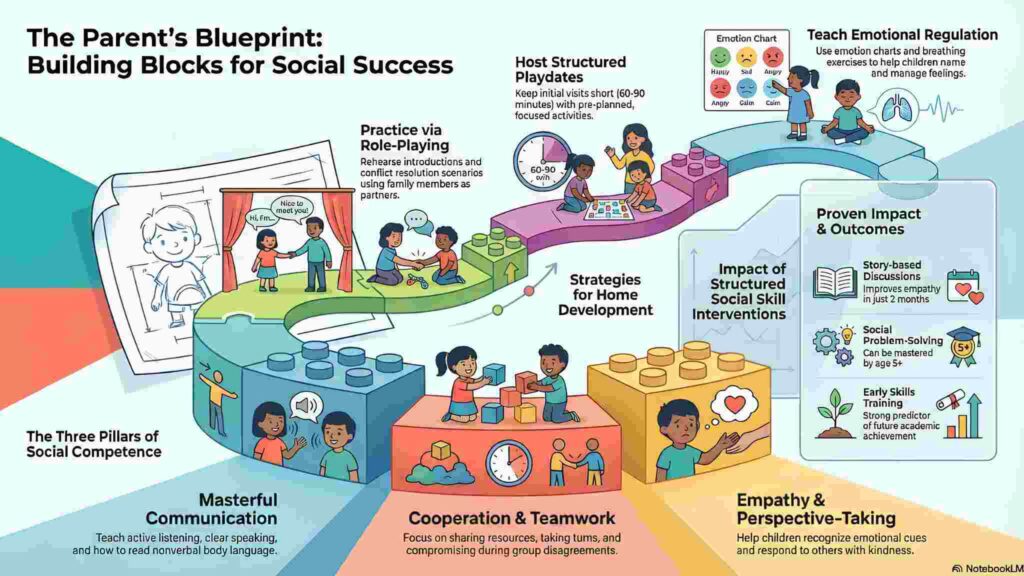
Why Social Skills Matter for Your Child's Success
Research demonstrates that social skills are strong predictors of academic success and overall life satisfaction.[1] Children who participate in social and emotional learning programs show significant improvements not only in social competence but also in academic achievement, emotional regulation, and problem-solving abilities.
Social skills enable children to make friends, collaborate with peers, cooperate in group settings, build harmonious relationships, and reduce conflicts with others. These competencies extend far beyond childhood, they shape career success, relationship quality, and mental health throughout adulthood.
For children with autism spectrum disorder, developing social skills presents unique challenges that require specialized support. The good news is that with appropriate intervention and practice, all children can improve their social competence significantly.
Talk to a Caring ABA Specialist About Your Child
Fill in the form below to discuss how your child could start therapy quickly, without the stress:
Did You Know?
Children as young as five years old can overcome both simple and complex interpersonal problems with the right opportunities and support. Social problem-solving abilities grow substantially with consistent practice and guidance from caring adults.[2]
Core Social Skills Every Child Needs
Communication Skills
Effective communication forms the cornerstone of all social interactions. Children need to develop both verbal and nonverbal communication abilities:
Verbal Communication:
- Starting and maintaining conversations with peers and adults
- Speaking clearly and at appropriate volumes for different settings
- Asking questions to show interest in others
- Expressing thoughts, feelings, and needs appropriately
- Taking turns during conversations without interrupting
- Using polite language like “please,” “thank you,” and “excuse me”
Nonverbal Communication:
- Making appropriate eye contact during conversations
- Reading facial expressions and body language
- Using gestures that match spoken words
- Maintaining appropriate personal space
- Recognizing tone of voice and emotional cues
- Understanding that how we say things matters as much as what we say
Research shows that up to 10% of children have nonverbal learning deficits that can cause behavioral, emotional, and social issues.[3] Teaching children to focus on body language, facial expressions, posture, and gestures helps them become more effective communicators.
Cooperation and Teamwork
Learning to work with others prepares children for school projects, sports teams, and eventually workplace collaboration:
- Sharing resources and taking turns with toys, materials, or attention
- Contributing ideas while respecting others’ suggestions
- Following group rules and accepting assigned roles
- Compromising when disagreements arise
- Supporting teammates and celebrating group successes
- Accepting help from others and offering assistance when needed
Empathy and Perspective-Taking
Understanding others’ feelings and viewpoints helps children build deep, meaningful relationships:
- Recognizing emotional cues in others’ faces and voices
- Imagining how others feel in different situations
- Responding with kindness when someone is upset or hurt
- Celebrating others’ successes without jealousy
- Understanding that people may have different opinions and preferences
- Adjusting behavior based on others’ emotional states
Studies show that seven-year-old children who participated in story-based discussions about emotions twice weekly performed better on empathy and “theory of mind” tests after just two months. These abilities to analyze and understand others’ thoughts and feelings are crucial for social success.
Structured Social Skills Groups for Children with Autism
Practical Activities to Build Social Skills at Home
Role-Playing Scenarios
Practice makes progress when it comes to social skills. Create simple role-play scenarios that mirror real-life situations your child encounters:
Introducing Yourself:
- Practice saying “Hi, my name is…” with different family members
- Role-play starting conversations at playgrounds or parties
- Practice asking “What’s your name?” and “What do you like to do?”
Sharing and Turn-Taking:
- Set up board games that require waiting for turns
- Practice sharing favorite toys with siblings for set time periods
- Use timers to make turn-taking visual and concrete
Conflict Resolution:
- Role-play what to do when someone takes a toy
- Practice saying “I don’t like it when…” statements
- Model asking for help from adults when needed
Structured Playdates
Supervised playdates provide controlled environments for practicing social skills with peers. Keep initial playdates short (60-90 minutes), structured with planned activities, and limited to one or two friends to prevent overwhelm.
Before the playdate, prepare your child by discussing:
- Who will be visiting and when they’ll arrive
- What activities you’ll do together
- Social expectations (sharing, taking turns, using kind words)
- What to do if they feel frustrated or need a break
During the playdate, stay nearby to provide guidance when needed. Offer specific praise when you notice positive social behaviors: “I love how you shared your blocks with Emma” or “Great job taking turns on the swing!”
Community Activities Based on Interests
Finding common interests creates natural opportunities for social connection. Encourage your child to participate in activities where they meet peers who share their passions:
- Sports teams or recreational leagues
- Art or music classes
- Library story times or book clubs
- Science clubs or STEM programs
- Drama or dance classes
- Scout troops or community groups
When children connect over shared interests, social interactions feel more natural and less stressful. They have built-in conversation topics and motivation to engage with peers.
Did You Know?
Research on “Curious About Others” play-based interventions shows that solution-focused and playful pedagogical approaches significantly improve students’ abilities in communication, cooperation, empathy, and self-control.[4] Structured, engaging activities foster social skills development more effectively than unstructured free play alone.
Teaching Emotional Regulation for Better Social Interactions
Emotional regulation, the ability to manage and express feelings appropriately directly impacts social success. Children who struggle to control emotions often face social difficulties because peers find unpredictable emotional reactions confusing or scary.
Strategies for Building Emotional Awareness
Emotion Identification:
- Use emotion charts with faces showing different feelings
- Read books that explore characters’ emotions
- Name emotions you observe: “You look frustrated because the puzzle is hard”
- Help children identify physical sensations associated with emotions
Coping Skills Practice:
- Teach deep breathing exercises for calming down
- Create a “calm down corner” with sensory tools
- Practice counting to ten when feeling angry
- Use emotion thermometers to rate feeling intensity
Problem-Solving Steps:
- Identify the problem clearly
- Brainstorm possible solutions together
- Discuss consequences of each option
- Choose and implement a solution
- Reflect on how it worked
When children learn to recognize and regulate their emotions, they interact more successfully with peers. They can navigate disappointments, handle conflicts constructively, and maintain friendships despite disagreements.
Read More: Understanding Level 1 Autism: Early Signs, Challenges, and Support Strategies
Evidence-Based Social Skills Training That Creates Real Change
Supporting Social Skills Development by Age
Preschool Years (Ages 3-5)
During preschool, children learn fundamental social skills through play and adult guidance:
- Parallel play evolves into interactive play with peers
- Simple turn-taking with adult support
- Beginning to understand sharing concepts
- Using words to express basic needs and wants
- Starting to recognize others’ emotions
- Following simple classroom rules and routines
How to Help: Provide structured play opportunities, model kind interactions, and use simple language to explain social expectations. Keep activities short since attention spans are limited.
Early Elementary (Ages 6-8)
School-age children develop more sophisticated social abilities:
- Forming first real friendships based on shared interests
- Understanding and following group rules
- Beginning perspective-taking abilities
- More complex cooperative play and team games
- Conflict resolution with adult guidance
- Developing sense of fairness and justice
How to Help: Encourage participation in group activities, facilitate playdates with supportive peers, and teach specific conflict-resolution strategies. Collaborate with teachers to support social development at school.
Late Elementary (Ages 9-12)
As children approach adolescence, social dynamics become more complex:
- Peer relationships gain increasing importance
- Understanding social hierarchy and group dynamics
- Navigating more complex social rules and expectations
- Managing peer pressure and making independent choices
- Developing deeper empathy and perspective-taking
- Understanding social context and adjusting behavior accordingly
How to Help: Have open conversations about friendship challenges, respect their growing independence while providing guidance, and help them develop critical thinking about peer influence. Continue supporting skill development in areas where they struggle.
Social Skills Challenges in Autism Spectrum Disorder
Children with autism often experience specific difficulties with social skills that neurotypical children develop more intuitively. Common challenges include:
Social Communication Differences:
- Understanding and using nonverbal communication
- Interpreting figurative language, sarcasm, or jokes
- Initiating conversations or joining peer groups
- Maintaining reciprocal conversations
- Understanding unwritten social rules
Social Interaction Patterns:
- Difficulty reading social cues and body language
- Challenges understanding others’ perspectives
- Preference for solitary activities or specific interests
- Struggles with change in social routines
- Sensory sensitivities affecting social participation
Emotional Understanding:
- Recognizing emotions in others
- Expressing own emotions appropriately
- Managing emotional responses in social settings
- Understanding how behavior affects others’ feelings
Recent research confirms that interventions based on cognitive behavioral therapy and naturalistic approaches are effective for improving social skills in children and adolescents with autism.[5] Structured social skills training programs help children learn to interact more easily with peers, resolve conflicts, and build positive friendships.
Transform Your Child's Social Future
When to Seek Professional Support
While all children develop social skills at different rates, certain signs indicate that professional support may be beneficial:
- Persistent difficulty making or keeping friends
- Extreme anxiety in social situations
- Aggressive behavior toward peers
- Complete withdrawal from peer interactions
- Inability to read basic social cues by school age
- Significant gaps between social skills and other developmental areas
- Social difficulties interfering with school performance or family life
Professional interventions like social skills groups, individual therapy, or specialized programs can make tremendous differences for children struggling socially. Early intervention prevents negative patterns from becoming entrenched and opens pathways for positive social development.
At Achievement Behavior Services, our social skills groups provide structured, evidence-based instruction in communication, cooperation, emotional regulation, and friendship skills. Using Applied Behavior Analysis techniques, we help children understand and practice social behaviors in supportive small-group settings tailored to their developmental levels.
Creating a Socially Supportive Home Environment
Your home environment significantly influences social skill development. Consider these strategies:
- Model Positive Social Behavior: Children learn by watching adults. Demonstrate respectful communication, active listening, conflict resolution, and empathy in your own interactions.
- Encourage Family Conversations: Eat meals together without screens, ask open-ended questions about everyone’s day, and practice turn-taking in family discussions.
- Celebrate Social Successes: Notice and praise specific social behaviors: “You did a great job sharing your truck with your sister” rather than generic praise like “good job.”
- Create Opportunities for Practice: Invite extended family over, attend community events, and arrange regular peer interactions so children can practice skills in safe environments.
- Collaborate With School: Work with teachers to understand your child’s social strengths and challenges at school. Share strategies that work at home and implement school recommendations at home for consistency.
- Be Patient With Progress: Social skill development takes time and varies widely among children. Celebrate small improvements rather than comparing your child to peers.
Building Social Confidence for Lifelong Success
Social skills for children represent one of the most valuable gifts parents can nurture. These abilities shape academic success, career opportunities, relationship quality, and overall life satisfaction. While some children develop social competence naturally, others benefit tremendously from structured teaching, practice opportunities, and specialized interventions.
Whether your child is neurotypical or has autism spectrum disorder, you can support their social development through modeling positive behavior, providing practice opportunities, teaching specific skills, and seeking professional help when needed. The investment you make in your child’s social skills today pays dividends throughout their lifetime.
At ABS, we’re passionate about helping children develop the social skills they need to thrive. Our experienced team provides comprehensive support through individual therapy, group interventions, and parent training. Contact us today to learn how we can support your child’s social development journey.
References
- Józsa, K., Oo, T.Z., Borbélyová, D., & Podráczky, J. (2025). Social skills development in children aged 4-8 years. PLOS One, 20(9), e0332571.
https://journals.plos.org/plosone/article?id=10.1371/journal.pone.0332571 - ISHCMC. (2025). 9 Ways to Teach Social Skills to Children Effectively in 2025.
https://www.ishcmc.com/news-and-blog/9-ways-to-teach-social-skills-for-students/ - Kennedy, A.S., & Sundberg, B. (2020). Developing social skills in early childhood: Strategies and interventions. Early Childhood Education Journal, 48(3), 245-258.
https://cyfs.unl.edu/TAPP/assets/downloads/research-briefs/TAPP-Research-Brief-Early-Childhood.pdf - Hannula-Sormunen, M., Räsänen, P., & Lehtinen, E. (2025). From Play to Progress: Student Learning of Social Skills with a Solution-Focused Approach. Education Sciences, 15(2), 218.
https://www.mdpi.com/2227-7102/15/2/218 - National Center for Biotechnology Information. (2025). Social skills interventions for children and adolescents with high-functioning autism spectrum disorder: A narrative review.
https://pmc.ncbi.nlm.nih.gov/articles/PMC12552184/ - Li, N., Peng, J., Sun, X., & Guo, S. (2025). Social skill training and children’s cognitive concentration in rural China. Frontiers in Psychology, 16, 1526065.
https://www.frontiersin.org/journals/psychology/articles/10.3389/fpsyg.2025.1526065/full