
ABA therapy for toddlers is the most evidence-backed early intervention available for children with autism spectrum disorder. Research consistently shows that children who begin ABA before age 3, especially between 18 and 36 months, achieve significantly greater gains in language, cognition, social communication, and adaptive behavior than those who start later. [1] The reason is rooted in neuroscience: the toddler brain is undergoing its most rapid period of growth and change, making it uniquely responsive to structured learning.
This guide explains exactly what early ABA therapy for young children looks like, what the research shows, and how to get your child started.
What Is the Critical Window and Why Does It Matter?
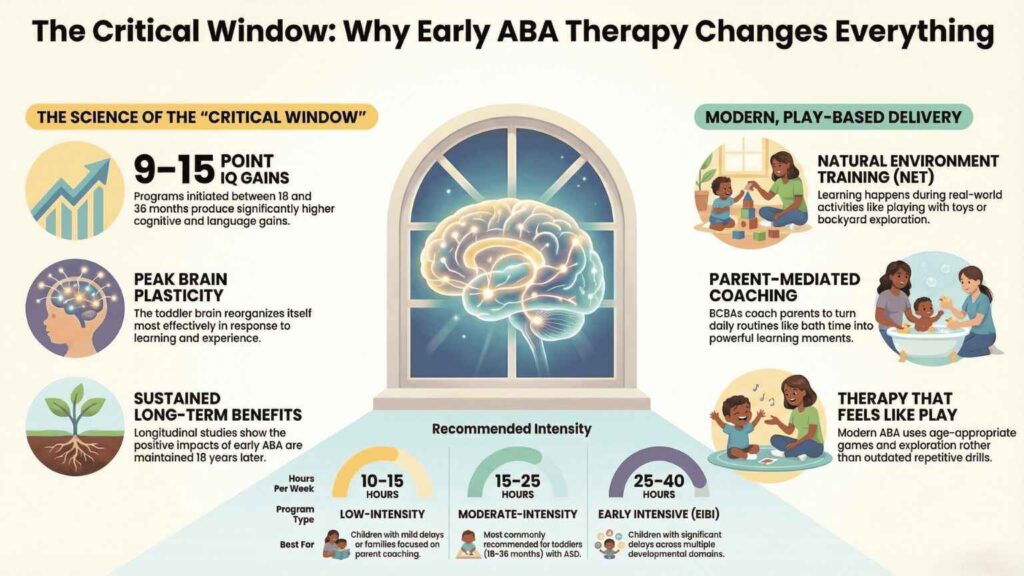
Between birth and age 5, the brain forms neural connections at a rate it will never match again. Scientists call this period of heightened brain plasticity the ability of the brain to reorganize itself in response to learning and experience. [2] For children with autism, this window is the most powerful opportunity to shape how the brain processes language, social information, and behavior.
When early intervention ABA therapy begins during this period, therapists are not just teaching skills they are actively helping the brain build pathways it might otherwise not develop on its own. The earlier intervention begins, the more time those pathways have to be reinforced. Every month of early therapy compounds over years. Waiting, even by 6 to 12 months, measurably narrows that window.
This is not a theory. A comprehensive PMC narrative review of early intensive interventions found that programs initiated between 18 and 36 months produced IQ gains of 9 to 15 points and significantly stronger outcomes in language, social communication, and adaptive behavior compared to later-starting groups. [1]
Your Child's Earliest Years Are Their Most Important. Don't Wait.
Fill in the form below to discuss how your child could start therapy quickly, without the stress:
What Does ABA Therapy Actually Look Like for a Toddler?
One of the most common misconceptions parents have is that ABA therapy for very young children means sitting at a table doing drills. That image is outdated. Modern ABA therapy for young children especially for toddlers is play-based, naturalistic, and designed to look and feel like fun. Here is what the three main delivery formats look like in practice:
Natural Environment Training (NET)
NET takes place in the child’s natural environment, home, backyard, or any familiar setting. The therapist follows the child’s lead, embedding language and social goals into whatever the child is already doing. If the child loves trains, every train becomes a teaching moment for requesting, labeling, turn-taking, and joint attention. Learning happens in context, which makes skills transfer faster to real life.
Play-Based ABA
In play-based sessions, structured learning goals are woven into age-appropriate activities building blocks, art, sensory play, or pretend games. The child does not experience the session as therapy. They experience it as play. [3] This approach is particularly effective with toddlers because it matches how young children naturally learn through exploration and interaction, not passive instruction.
Parent-Mediated Sessions
For children under age 3, parent-mediated ABA is one of the most powerful formats available. The BCBA coaches the parent directly during the session guiding them to implement naturalistic teaching strategies during everyday routines like meals, bath time, getting dressed, and bedtime. [4] Because parents interact with their child far more hours per day than any therapist can, parent-mediated delivery multiplies the total learning time dramatically.
Read More: Understanding Level 1 Autism: Early Signs, Challenges, and Support Strategies
What Can Early ABA Therapy Actually Accomplish? The Research
The evidence base for early intensive behavioral intervention is one of the strongest in all of autism science. Here is what high-quality research shows across the key outcome areas:
Outcome Area | What the Research Shows | Key Study |
IQ & Cognitive Development | IQ gains of 9–15 points reported in children who began EIBI before age 3 | PMC12514992 — Narrative Review, 2025 |
Language & Communication | Large effect size for receptive language; early ABA groups show significantly more word acquisition | PMC9458805 — ABA Scoping Review, 2022 |
Social Communication | Children starting ABA at 18–30 months showed 17.6-point developmental gain vs 7.0 in comparison group | PMC6034700 — ESDM Trial, 2018 |
Adaptive Behavior | More intervention hours at younger ages = greater gains in daily living skills and independence | JAMA Pediatrics, Sandbank et al. 2024 |
Autism Symptom Severity | Early ABA associated with measurable reduction in core ASD symptoms across multiple meta-analyses | PMC7265021 — Meta-Analysis Review |
Long-Term Outcomes | Benefits of early ABA sustained up to 18 years after intervention ends in longitudinal studies | Estes et al., JAACAP 2015 |
Note: Results vary by child, program intensity, and age at start. Individual outcomes are always assessed by a qualified BCBA.
Did You Know?
A 2025 PMC narrative review of early intensive interventions found that ABA programs initiated between 18 and 36 months produced IQ gains of 9 to 15 points and yielded significantly stronger outcomes in language, social communication, and adaptive behavior than those started after age 5. The gap in outcomes between early and late starters is measurable and consistent across studies. [1]
Signs Your Toddler May Benefit from ABA Therapy Right Now
You do not need to wait for a formal diagnosis to pursue an evaluation or early intervention services. If you notice any of the following in your child between 12 and 36 months, it is worth speaking with a BCBA or your pediatrician right away:
Early Signs That Warrant Immediate Action
- No babbling by 12 months or loss of babbling after it had started
- No single words by 16 months, even sounds used to point at objects
- No two-word combinations by 24 months such as ‘more milk’ or ‘daddy go’
- Not responding to their name consistently by 12 months
- Limited or no pointing to share interest in something with you by 14 months
- Loss of any previously learned language or social skills at any age, this is an urgent sign
- Unusual repetitive movements, hand flapping, spinning, rocking, that interrupt daily activities
- Rarely or never makes eye contact during interactions or play
Early action on these signs even before a formal diagnosis can make a significant difference. [5] A BCBA can begin a behavioral assessment and start parent coaching immediately while a formal evaluation is underway.
Notice Any of These Signs? Early Evaluation Is Free and Takes Only a Week to Schedule.
How Many Hours Per Week Does a Toddler Actually Need?
The research on intensity is clear, more early hours produce better early outcomes. A 2024 JAMA Pediatrics meta-analysis of 144 studies and 9,038 children found that both daily intensity and total cumulative hours were significantly associated with developmental gains across all domains. [6]
In practice, ABA programs for toddlers and young children typically fall into the following intensity ranges:
Hours Per Week | Program Type | Best For |
10–15 hours/week | Low-intensity / naturalistic | Children with mild delays or families who also want parent coaching |
15–25 hours/week | Moderate-intensity | Most commonly recommended for toddlers 18–36 months with confirmed ASD |
25–40 hours/week | Early Intensive Behavioral Intervention (EIBI) | Children with significant delays across multiple developmental domains |
The right intensity for your child depends on their unique profile, your family’s schedule, and insurance coverage. A BCBA will assess your child and recommend the appropriate level. ABA is never one-size-fits-all, it is always individualized.
Read More: Insurance vs Private Pay for ABA Therapy in New York: Pros & Cons
Can ABA Therapy Start at 18 Months? What If My Child Is Under 2?
Yes and in many cases, ABA therapy at 18 months or younger is not only possible but recommended when early signs are present. Children can be identified as showing developmental concerns as early as 12 to 18 months, and early intervention services in many U.S. states can begin before a formal autism diagnosis is issued. [5]
Under Part C of the Individuals with Disabilities Education Act (IDEA), children from birth to age 3 are entitled to early intervention services if they show developmental delays, regardless of whether they have a confirmed diagnosis. [7] This means your child does not need to have an official autism diagnosis to begin receiving support. If delays are present, services can and should start immediately.
For children under 2, parent-mediated ABA is the most commonly recommended format the BCBA coaches caregivers to embed learning strategies into daily routines. As the child approaches age 2 and 3, the program can expand to include direct therapist sessions and more structured components.
Did You Know?
Under IDEA Part C, all children from birth to age 3 who show developmental delays are entitled to early intervention services at no cost regardless of whether they have a formal autism diagnosis. Early evaluation and service connection should begin the moment developmental concerns are identified, not after months of waiting for a diagnosis. [7]
In-Home ABA vs. Center-Based ABA: Which Is Better for Young Children?
Both settings have strong evidence behind them, and the best choice depends on your child’s individual needs, age, and temperament. Here is how they compare for toddlers and very young children:
Factor | In-Home ABA | Center-Based ABA |
Best age range | All ages, especially 18 months–3 years | Typically 2.5 years and older |
Environment | Child’s natural home setting familiar and low-stress | Structured environment that prepares child for school |
Parent involvement | Very high, parents learn techniques in real time | Moderate, parent training provided separately |
Generalization of skills | Fastest, skills learned where they’ll be used | Requires intentional transfer to home setting |
Social exposure | Lower in-session; can be supplemented with social groups | Higher group activities, peer interaction built in |
ABS coverage | NY, NJ, CT, GA, NC fully in-home | Malverne, NY and Douglasville, GA centers |
Many families begin with in-home ABA to build comfort and foundational skills, then transition to center-based as the child grows. At Achievement Behavior Services, our BCBAs guide families through this decision based on the child’s profile, not a one-size-fits-all protocol.
ABS Serves Families Across NY, NJ, CT, GA & NC - Start the EI + ABA Conversation Today.
ABS Provides In-Home Early Intervention ABA Across NY, NJ, CT, GA & NC – Centers in Malverne, NY and Douglasville, GA.
- New York – In-home and center-based ABA therapy
- New Jersey – ASD evaluations and individualized ABA programs
- Connecticut – Evidence-based autism support for families
- Georgia – Personalized ABA therapy for lasting results
- North Carolina – Supporting your child’s development journey
- Douglasville, GA – Family-centered autism care
Frequently Asked Questions
Q: At what age should ABA therapy start for autism?
The earlier the better, ideally before age 3. Research consistently shows that children who begin ABA therapy for toddlers between 18 and 36 months achieve the greatest gains in language, cognition, and adaptive behavior. [1] However, ABA is effective at any age. If your child is older, do not wait, later is always better than never. If you have concerns about a very young child, request an evaluation even before a formal autism diagnosis is given.
Q: What does ABA therapy look like for a 2-year-old?
For a 2-year-old, ABA therapy is almost entirely play-based and naturalistic. Sessions look like structured play following the child’s interests, embedding communication and social goals into everyday activities. [3] There is no table drilling, no rote repetition, and no pressure. A BCBA designs each session around what motivates that specific child. Parent coaching is also central at this age. Caregivers learn how to extend learning throughout the day between sessions.
Q: Can a child start ABA therapy before being diagnosed with autism?
Yes. Under IDEA Part C, children from birth to age 3 who show developmental delays are entitled to early intervention services regardless of a formal diagnosis. [7] If your child shows signs of developmental delay, speech delays, limited eye contact, not responding to their name you can and should pursue an evaluation immediately. A BCBA can begin parent coaching and behavioral assessment while a formal diagnostic evaluation is underway.
Q: How many hours of ABA therapy does a toddler need per week?
Most toddlers with confirmed ASD benefit from 15 to 25 hours per week of structured ABA, though recommendations range from 10 to 40 hours depending on severity of delays. [6] A 2024 JAMA Pediatrics meta-analysis of 9,038 children confirmed that more intervention hours at younger ages are associated with significantly better developmental outcomes across all domains. Your BCBA will assess your child and recommend the appropriate intensity.
Q: Is in-home ABA or center-based ABA better for toddlers?
For very young children especially under age 3 in-home ABA is often the preferred starting point. Home-based therapy allows learning to happen in the environment where skills will actually be used, which accelerates generalization. [4] It also enables higher parent involvement. As children approach preschool age, center-based ABA adds valuable peer interaction and school-readiness preparation. Many families use both over time.
Q: What is the difference between ABA therapy and early intervention?
Early intervention (EI) is a broad term for services provided to children from birth to age 3 who have developmental delays and ABA is one of the most evidence-based types of early intervention available for autism. [7] EI services are often publicly funded under IDEA Part C, while ABA therapy beyond age 3 typically transitions to school-based services or insurance-funded private therapy. A BCBA can help families navigate which funding streams apply to their child’s age and needs.
References
[1] Supekar K, et al. The Impact of Early Intensive Behavioral and Developmental Interventions on Key Developmental Outcomes in Young Children With Autism Spectrum Disorder: A Narrative Review. PMC12514992. 2025.
https://pmc.ncbi.nlm.nih.gov/articles/PMC12514992/
[2] Dawson G, et al. Randomized, Controlled Trial of an Intervention for Toddlers With Autism: The Early Start Denver Model. Pediatrics. 2010;125(1).
https://www.tandfonline.com/doi/full/10.1080/09540261.2018.1432574
[3] Sandbank M, et al. Project AIM: Autism intervention meta-analysis for studies of young children. Psychological Bulletin. 2020;146(1):1. Referenced across CASP 2024 Practice Guidelines.
https://www.casproviders.org/evidence-intensive-early-aba
[4] French L, Kennedy EMM. Annual research review: Early intervention for infants and young children with, or at-risk of, autism spectrum disorder: A systematic review. Journal of Child Psychology and Psychiatry. 2018;59(4):444–456. PMC6034700.
https://pmc.ncbi.nlm.nih.gov/articles/PMC6034700/
[5] Shaw KA, et al. Prevalence and Early Identification of Autism Spectrum Disorder — ADDM Network, 2022. MMWR Surveillance Summaries. 2025;74(SS-2):1–22. https://www.cdc.gov/mmwr/volumes/74/ss/pdfs/ss7402a1-H.pdf
[6] Sandbank M, Pustejovsky JE, Bottema-Beutel K, et al. Determining Associations Between Intervention Amount and Outcomes for Young Autistic Children: A Meta-Analysis. JAMA Pediatrics. 2024;178(8):763–773.
https://pubmed.ncbi.nlm.nih.gov/38913359/
[7] U.S. Department of Education, OSEP. Individuals with Disabilities Education Act — Part C: Early Intervention Program for Infants and Toddlers with Disabilities.
https://sites.ed.gov/idea/regs/c
[8] Linstead E, et al. Applied Behavior Analysis in Children and Youth with Autism Spectrum Disorders: A Scoping Review. PMC9458805. 2022.
https://pmc.ncbi.nlm.nih.gov/articles/PMC9458805/
[9] Peterson T, Dodson J, Sherwin R, Strale F. The Effects of Age and Treatment Intensity on Behavioral Target Mastery With ABA Intervention. Cureus. 2024;16(8):e67179.
https://pubmed.ncbi.nlm.nih.gov/39295655/
[10] Estes A, Munson J, Rogers SJ, et al. Long-term outcomes of early intervention in 6-year-old children with autism spectrum disorder.
https://www.jaacap.org/article/S0890-8567(15)00256-7/abstract