

The ABA intake and assessment process typically takes 3 to 6 weeks from first contact to starting therapy. It includes insurance verification, a parent interview, direct observation of your child, a formal skills assessment, and treatment plan approval by your insurance carrier.
Before your child attends a single therapy session, there is a process. Forms, phone calls, an interview, an observation, an insurance decision. For most families this is the least understood part of ABA and the part where the waiting feels longest.
This guide walks through every step, with realistic timelines for each. Intake is the first stage of the ABA therapy journey, everything that follows is built on the plan created here.
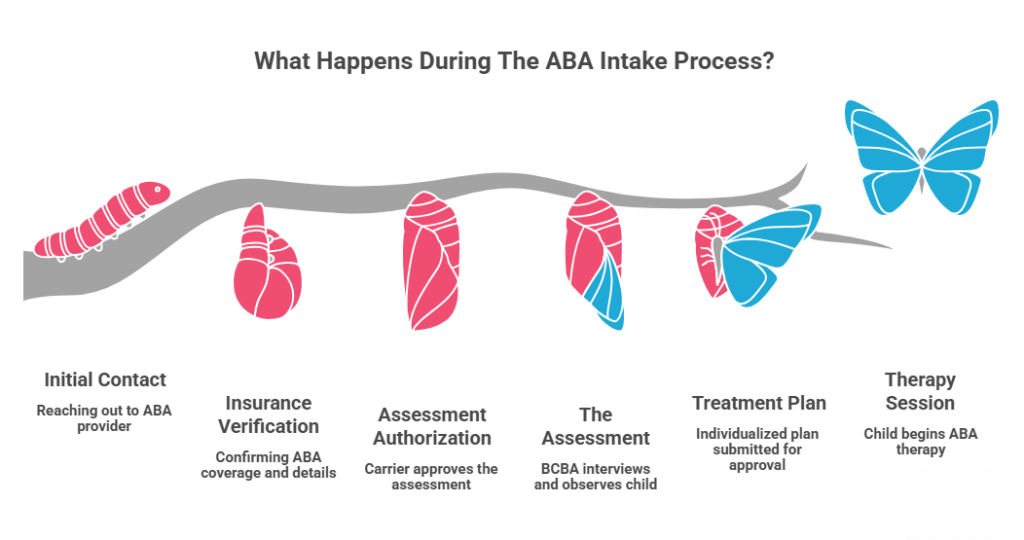
What Happens During The ABA Intake Process?
Intake is everything that happens between your first phone call and your child’s first therapy session. It breaks into six steps:
Step 1: Initial contact and forms. You reach out. The provider sends an intake form covering demographics, insurance details, your child’s diagnosis, and your availability.
Step 2: Insurance verification. The provider contacts your carrier to confirm ABA coverage, deductibles, copays, and prior authorization requirements. At ABS, our team handles this, you should not be calling your insurer yourself.
Step 3: Assessment authorization. Your carrier must approve the assessment before it happens. In our experience, this typically takes 3 to 10 business days, depending on the carrier.
Step 4: The assessment. A BCBA conducts a parent interview, observes your child, and administers a formal skills assessment. This may happen in one visit or across several.
Step 5: Treatment plan and authorization. The BCBA writes an individualized treatment plan and submits it to your carrier. Approval commonly takes 2 to 4 weeks.
Step 6: Scheduling and starting. Once approved, you are matched with a Registered Behavior Technician (RBT) and a schedule is built around your family’s routine.
Total realistic timeline: 3 to 6 weeks. Some families move faster. Complex insurance situations move slower.
Want us to handle the intake process for you?
Our team manages insurance verification and authorization so you don’t have to.
What Documents Do I Need For ABA Intake?
Gathering these before you start shortens the process considerably:
- The autism diagnosis report: from a psychologist, neurologist, or developmental pediatrician. Most carriers require a formal ASD diagnosis before authorizing ABA. If your child has not been evaluated yet, ABS offers ASD evaluations in New York and New Jersey.
- Insurance card and policy details
- Prescription or letter of medical necessity from your child’s physician, if your carrier requires one
- Prior evaluations: speech, occupational therapy, psychological, or educational
- Current IEP or IFSP, if your child has one
- Reports from any previous ABA provider, including past treatment plans and FBA results
The single most common cause of intake delay is a missing or outdated diagnosis report. Carriers often require the diagnostic evaluation to be recent, commonly within the last 6 to 12 months.
What is An ABA Assessment?
An ABA assessment is a clinical evaluation conducted by a Board Certified Behavior Analyst to identify your child’s current skills, skill gaps, and the function of any challenging behaviors. It produces the roadmap for the entire treatment program [1].
An ABA assessment is not a diagnosis. It cannot diagnose autism and is not used to determine whether your child is autistic. Diagnosis requires a separate evaluation by a qualified clinician such as a developmental pediatrician, psychologist, or neurologist [2]. The ABA assessment starts after diagnosis and answers a different question: what should we teach, and in what order?
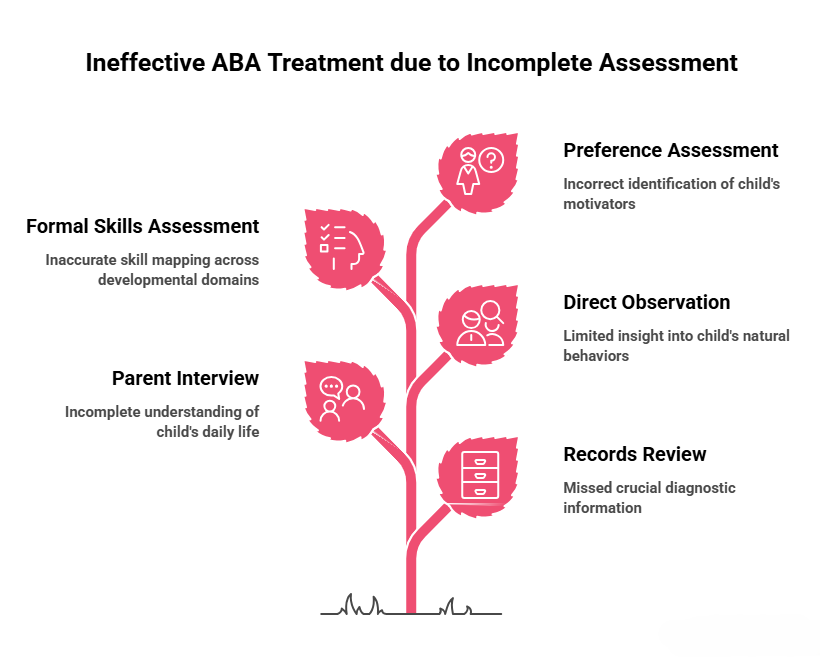
The assessment has four components:
- Records review: the BCBA reads the diagnostic report, prior evaluations, and school documents before meeting your child
- Parent interview: a structured conversation about your child’s daily life
- Direct observation: watching your child play, communicate, and move through routines in a natural setting
- Formal skills assessment: a standardized tool that maps skills across developmental domains
Some assessments also include a preference assessment, which identifies what actually motivates your child. This sounds minor. It is not. Reinforcement drives every hour of ABA that follows, and a program built around the wrong motivators will stall.
What Questions Will The BCBA Ask Me?
The parent interview is the part most families underestimate. Expect questions like:
- What does your child love? What holds their attention longest?
- Walk me through a typical day, morning, mealtimes, transitions, bedtime.
- How does your child let you know what they want?
- What are your child’s sensory sensitivities?
- Which behaviors are hardest for your family right now? When do they happen?
- What have you already tried?
- What would a good outcome look like to you in six months?
That last question shapes the whole program. ABA goals should reflect your family’s priorities. A plan that teaches your child to label 50 objects but does not help them get through a grocery trip has optimized for the wrong thing.
From our experience at ABS: A lot of parents arrive at the interview quietly braced to be judged, as if the BCBA is evaluating their parenting alongside their child’s skills. We understand why. Many families have spent years being told what they are doing wrong. But the interview is not an audit.
You are the only person in the room who has watched this child every day of their life, and nothing in the assessment file is worth as much as what you know. The families who tell us the messy, unflattering truth about hard mornings get better treatment plans than the families who tell us everything is fine.
Worried the assessment will feel like a test?
What Assessment Tools Are Used?
Your BCBA selects a standardized tool based on your child’s age and skill level. The most common are the VB-MAPP, ABLLS-R, AFLS, and Vineland-3.
The only part of that choice that affects your schedule is how long it takes. A VB-MAPP typically runs 30 minutes to 2 hours [3]. An ABLLS-R can run considerably longer and is usually split across visits.
What is a Functional Behavior Assessment (FBA)?
If challenging behavior is one of your concerns aggression, self-injury, elopement, severe tantrums, the BCBA adds a Functional Behavior Assessment to the process.
An FBA answers one question: what is this behavior accomplishing for my child? Behavior is communication. A child who screams at the dinner table may be escaping a demand, requesting attention, or trying to access something they cannot ask for. The same behavior serves different functions in different children, which is why two children who scream need entirely different plans [4].
For you, an FBA means additional interview time and more observation, and it adds a Behavior Intervention Plan to your child’s treatment plan. That plan teaches a replacement behavior serving the same function more appropriately because you cannot remove a behavior without giving your child another way to meet the same need.
Our guide to types of ABA assessments covers how an FBA is conducted in detail.
How Long Does the ABA Assessment Take?
The assessment itself typically runs 2 to 4 hours of direct contact, though this varies significantly.
Some BCBAs complete everything in a single session. Others split it across two or three shorter visits, which usually produces better data, a child who is unfamiliar with the assessor and tired by hour three will not show their real skills.
Assessment length depends on:
- Your child’s age and skill level: some tools take far longer than others
- Whether an FBA is needed: behavioral concerns add observation time
- Your child’s tolerance: a distressed child produces unusable data, so a good BCBA stops
- Setting: home, center, school, or a combination
Add the insurance timelines around it and the full assessment phase usually spans 2 to 4 weeks from authorization to treatment plan submission.
What Happens After The Assessment?
The BCBA analyzes everything gathered and builds your child’s treatment plan. It includes:
- Baseline skill levels across each domain
- Specific, measurable goals prioritized by what matters most to your family
- Recommended intensity: comprehensive programs run 25 to 40 hours per week, focused programs run 10 to 25. See our guide on focused versus comprehensive ABA for how that call gets made.
- Teaching methods: which blend of DTT, NET, PRT, and VB-based instruction fits your child
- Parent training plan
- Data collection plan — how progress will be measured
You should review this plan with your BCBA before it goes to insurance. Ask questions. Push back on goals that do not match your priorities. It is your child’s plan.
Once submitted, carriers typically respond within 2 to 4 weeks. Authorization periods commonly run 3 to 6 months, after which the BCBA submits progress data to continue services. Reassessment is generally required annually.
Then therapy begins. For what that looks like day to day, see our guide to what a typical ABA session looks like.
Ready to start the intake process?
Frequently Asked Questions
Is the ABA assessment covered by insurance?
In most cases, yes. New York State law requires state-regulated health plans to cover the screening, diagnosis, and treatment of autism spectrum disorder [5]. Our team verifies your specific coverage and handles authorization before anything is scheduled. See our ABA insurance guide for New York.
Can the assessment happen at home?
Yes. Assessments can be conducted at home, at a center, at school, or in the community. Home assessments often produce the most realistic picture for young children, because that is where their actual routines happen.
What if my child refuses to participate?
That is not a failure and it is information. A skilled BCBA works around refusal, gathers data through observation and parent report, and does not force participation. Assessments are frequently split across multiple visits for exactly this reason.
Do I need an autism diagnosis before the assessment?
For insurance-funded ABA, almost always yes. If your child has not been evaluated, that is the first step. ABS offers ASD evaluations and can usually schedule faster than the regional average.
Why does insurance authorization take so long?
Carriers review the treatment plan for medical necessity, which involves clinical review, not just paperwork processing. A complete, well-documented submission moves faster than an incomplete one, which is why choosing a provider with an experienced intake team materially affects your start date.
Can I switch providers after an assessment?
Yes. Your assessment results and treatment plan belong to your child’s record. If you are considering changing providers, see our guide to choosing an ABA provider in NYC.
Start The Intake Process With ABS
Our intake team handles insurance verification, prior authorization, and BCBA matching, so you are not navigating the system alone.
If your child is under 5, starting sooner matters. See our early intervention program for why the first years produce the strongest outcomes.
Sources
[1] Behavior Analyst Certification Board (BACB). “About Behavior Analysis.” https://www.bacb.com/about-behavior-analysis/
[2] Hyman, S. L., Levy, S. E., Myers, S. M., & AAP Council on Children with Disabilities. (2020). “Identification, Evaluation, and Management of Children With Autism Spectrum Disorder.” Pediatrics, 145(1).
https://publications.aap.org/pediatrics/article/145/1/e20193447/36917/Identification-Evaluation-and-Management-of
[3] Sundberg, M. L. (2014). The Verbal Behavior Milestones Assessment and Placement Program: The VB-MAPP (2nd ed.). Concord, CA: AVB Press.
https://marksundberg.com/vb-mapp/
[4] Cooper, J. O., Heron, T. E., & Heward, W. L. (2020). Applied Behavior Analysis (3rd ed.). Hoboken, NJ: Pearson Education.
https://www.pearson.com/en-us/subject-catalog/p/applied-behavior-analysis/P200000000905/9780137477210
[5] New York State Department of Financial Services. “Autism Spectrum Disorder Insurance Requirements.”
https://www.dfs.ny.gov/industry_guidance/circular_letters/cl2014_06