
A typical ABA therapy session blends structured teaching with play-based learning, following a predictable rhythm: pairing, skill building, natural practice, and breaks. Sessions usually run 1 to 3 hours and are delivered one-on-one by a Registered Behavior Technician under BCBA supervision.
Most parents have the same question after their child starts ABA therapy: what actually happens there? You drop your child off, or you step into another room, and two hours later someone tells you it went well. But what did they do?
This guide walks through a typical ABA session from start to finish, the structure, the settings, the techniques, and who does what. If you have not started therapy yet, see our guide on your child’s first ABA therapy session, which covers what makes session one different from every session after it.
What Does A Typical ABA Therapy Session Look Like?
The honest answer surprises most parents: it mostly looks like play.
A well-run ABA session is full of movement, games, snacks, and toys. Therapists sit on the floor, chase children around the yard, build block towers, blow bubbles, and eat crackers at the kitchen table. What looks casual from the outside is highly structured underneath, every activity has a target, and every target is being tracked.
The rigid image many parents carry, a child at a desk doing drills for hours, describes 1980s ABA, not modern practice. Contemporary ABA is play-based, uses only positive reinforcement, and follows the child’s interests wherever possible [1].
From our experience at ABS: The single most common thing we hear from parents observing a session for the first time is some version of “wait, that’s it?” They expected something clinical and saw someone playing trains on the floor. What they cannot see is the structure underneath, the RBT is running specific targets, prompting at a specific level, and recording data on every trial. Good ABA is supposed to look easy. That is the skill.
Want to know what your child's sessions would look like with us?
Every ABS program is built from your child’s own assessment,, the setting, the methods, the intensity.
What Is The Structure of An ABA Therapy Session?
Sessions follow a predictable rhythm. Predictability matters: when a child knows what comes next, anxiety drops and they are more available to learn.
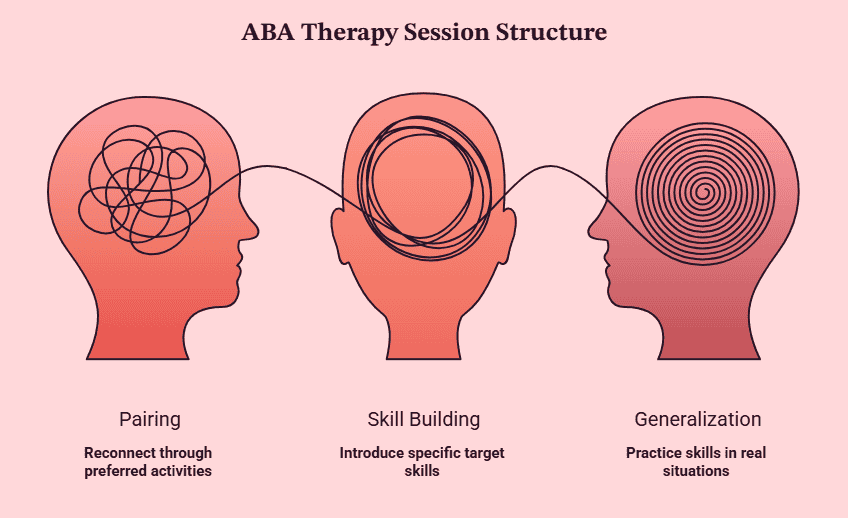
Most sessions move through four phases:
1. Pairing and Warm-up (first 10–20 minutes)
The therapist reconnects with your child through preferred activities before asking anything of them. This is the same pairing process used in the first session, repeated briefly at the start of every session. Research supports pre-session pairing as a way to reduce interfering behavior during the teaching that follows [2].
2. Targeted Skill Building (the core of the session)
The therapist introduces the specific goals your child’s BCBA has written into the treatment plan. These might be requesting a snack, imitating a clap, identifying colors, washing hands, or answering a simple question. Each target is taught in short trials with immediate reinforcement for success.
3. Natural Practice and Generalization
The therapist moves the same skills into real situations, the kitchen, the yard, the hallway. A child who can request “juice” at a table has learned a skill. A child who requests juice at the actual refrigerator when they are actually thirsty has learned to use it.
4. Breaks and Free Play
Children get regular, genuine breaks. These are not a reward the child has to earn, they are built into the session structure because attention is finite and forcing a tired child to continue produces nothing but resistance.
These phases are not rigid blocks. A skilled RBT moves between them fluidly based on your child’s energy, focus, and mood on that particular day.
Where Do ABA Therapy Sessions Take Place?
ABA sessions happen wherever the skills need to be used. Common settings include:
- Your home: the living room floor, the kitchen table, the bathroom during a handwashing routine, the bedroom during a bedtime routine
- A therapy center: a structured clinical space with play areas, teaching tables, and opportunities for peer interaction
- Community settings: a playground, a store, a library
- School: through school-based consultation, coordinated with your child’s teachers and IEP team
Many families use more than one setting over time. In-home ABA works especially well for younger children and for skills tied to daily routines. Center-based sessions at our Malverne location suit children ready for peer-based social work or families who prefer a clear separation between home and therapy.
Neither setting is inherently better. The right choice depends on your child’s age, goals, and your family’s logistics.
Is ABA Therapy Play-Based or Table-Based?
Both and the ratio depends on your child.
Table time is useful for skills that need many clean repetitions in a low-distraction environment: letter sounds, number sequences, precise motor imitation. Floor and community time is essential for skills that depend on motivation and real context: requesting, conversation, play, transitions.
A well-designed program uses both. A session for a 3-year-old might be 80% floor play and 20% table. A session for a 7-year-old working on academic readiness might flip that ratio. If a provider tells you they only do table work, or only do floor play, that rigidity is a warning sign, it means the program is built around the provider’s preference rather than your child’s needs.
What Techniques Are Used in An ABA Session?
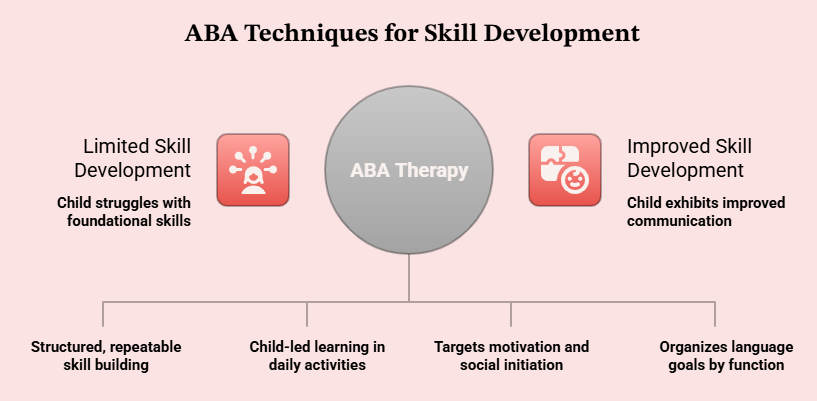
Within a single session, your child’s therapist may use several ABA teaching methods, often switching between them within minutes. The four most common are:
- Discrete Trial Training (DTT): structured, repeatable trials with a clear instruction, response, and reward. Best for building new foundational skills that benefit from repetition.
- Natural Environment Teaching (NET): child-led teaching during everyday activities, with natural rewards. A child who asks for a bubble gets a bubble. Best for generalization and spontaneous communication [3].
- Pivotal Response Treatment (PRT): targets four pivotal areas including motivation and social initiation, using child choice and natural reinforcement. Best for engagement and social communication.
- The Verbal Behavior (VB) approach: a framework for organizing language goals by function: requesting, labeling, repeating, and conversing. It runs through the other three methods rather than competing with them.
Naturalistic methods like NET and PRT are classified as Naturalistic Developmental Behavioral Interventions (NDBIs), a research-supported category of autism intervention [4].
For a full comparison of how these methods differ and which blend fits which child, see our guide to types of ABA therapy methods.
What Does The RBT Do VS The BCBA in A Session?
This is one of the most useful things a parent can understand about ABA.
The Registered Behavior Technician (RBT) delivers the session. They are the person your child sees most usually every session, several times a week. RBTs run the targets, deliver reinforcement, manage prompts, and collect data. RBT certification requires a 40-hour training course, a competency assessment, and a background check.
The Board Certified Behavior Analyst (BCBA) designs the program. They conduct the assessment, write the goals, choose the teaching methods, review session data, and adjust the plan. BCBAs hold a master’s degree and are certified by the Behavior Analyst Certification Board [5].
The BACB requires that RBTs receive ongoing supervision covering at least 5% of the hours they provide services each month, with a minimum of two face-to-face contacts per month, at least one of which must include the supervisor directly observing the RBT with a client [6].
Note what that means in practice: 5% is a floor, not a target. An RBT working 100 service hours in a month needs 5 supervised hours to meet the minimum. Quality agencies exceed this considerably, because a program only adapts as fast as the BCBA actually sees what is happening.
A question worth asking any provider: “How many hours per month will my child’s BCBA directly observe their sessions?” If the answer is exactly the minimum, the program is being managed to a compliance standard rather than a clinical one.
For a fuller breakdown of the two roles, see our guide on BCBA vs RBT.
Not sure how much BCBA supervision your child actually gets?
How Long Is A Typical ABA Therapy Session?
Individual sessions typically run 1 to 3 hours, though some center-based programs run half-day or full-day blocks for older children.
Session length depends on your child’s age, attention span, and total weekly hours. A 2-year-old may do best with two 90-minute sessions per day rather than one three-hour block. A 9-year-old may handle a longer block comfortably.
Total weekly intensity is a separate question from session length:
- Comprehensive programs run 25 to 40 hours per week across multiple sessions
- Focused programs run 10 to 25 hours per week targeting specific skill areas
Your BCBA recommends intensity based on your child’s assessment, not on a standard package. See our guide on focused vs comprehensive ABA for how that decision gets made.
How is Data Collected During a Session?
Every session produces data. This is what separates ABA from interventions that rely on impression and memory.
Throughout the session, the therapist records whether each trial was correct, incorrect, or prompted and at what prompt level. They may also track frequency of specific behaviors, duration of activities, or independence on multi-step routines [7].
That data goes to the BCBA, who reviews it and adjusts the program. If a target is mastered, it moves to maintenance and a new one is introduced. If a target is stalling, the BCBA changes the teaching approach rather than repeating a method that is not working.
Data collection is also why you should never feel awkward asking to see it. A provider who cannot show you your child’s data, or explain what it means, is not running a data-driven program.
What Happens At The End Of A Session?
Most sessions end with a brief parent debrief. Depending on the provider, this happens after every session or at set intervals.
In that debrief you should hear:
- What skills the therapist worked on
- How your child responded, including anything difficult
- One or two things you can reinforce at home this week
That last part matters more than parents expect. Your child spends 20 to 40 hours a week in therapy and roughly 130 hours a week with you. Skills that only appear in session are not skills yet. Parent carryover is how progress becomes real, which is why parent training is embedded in every ABA program worth paying for [8].
Ready to see what your child's program would look like?
Frequently Asked Questions
Can I watch my child’s ABA session?
Yes. You should never be told you cannot observe your own child’s therapy. Some therapists will ask you to observe from a distance initially, because a young child may struggle to engage with the therapist while a parent is in reach but that is a clinical adjustment, not a restriction on your access.
What if my child has a meltdown during a session?
Experienced therapists expect this and are trained to respond by reducing demands, giving space, and helping your child regulate. A meltdown also generates useful information about triggers and recovery. It is not a failed session.
Do sessions look the same every day?
The structure stays consistent, but the content changes. Targets rotate, activities vary, and difficulty scales as your child progresses. Consistency in rhythm, variety in content.
Will my child ever get bored?
A good therapist mixes mastered easy targets with newer harder ones specifically to prevent this. If your child is consistently disengaged, tell the BCBA, it usually means reinforcement or difficulty needs adjusting.
Is ABA covered by insurance?
Yes. ABA therapy is covered by most major carriers including Aetna, Cigna, UnitedHealthcare, and Anthem BCBS, plus Medicaid in eligible states. See our ABA insurance guide for New York for how to verify your benefits.
Talk To a BCBA About What Your Child's Sessions Would Look Like
Every child’s sessions look different, because every program is built from that child’s own assessment. If you would like to understand what a session would actually look like for your child, the setting, the methods, the intensity, that conversation starts with a BCBA.
Our team has designed individualized ABA programs for families across New York, New Jersey, Connecticut, Georgia, and North Carolina since 2015.
Sources
[1] Hyman, S. L., Levy, S. E., Myers, S. M., & AAP Council on Children with Disabilities. (2020). “Identification, Evaluation, and Management of Children With Autism Spectrum Disorder.” Pediatrics, 145(1).
https://publications.aap.org/pediatrics/article/145/1/e20193447/36917/Identification-Evaluation-and-Management-of
[2] Ensor, C., Feeley, K., & Jones, E. (2024). “Evaluation of a rapport-building intervention for early interventionists working with children on the autism spectrum.” Behavioral Interventions, 39(1).
https://onlinelibrary.wiley.com/doi/10.1002/bin.1983
[3] Hart, B., & Risley, T. R. (1975). “Incidental teaching of language in the preschool.” Journal of Applied Behavior Analysis, 8(4), 411–420.
https://pmc.ncbi.nlm.nih.gov/articles/PMC1311874/
[4] Schreibman, L., Dawson, G., Stahmer, A. C., Landa, R., Rogers, S. J., McGee, G. G., et al. (2015). “Naturalistic Developmental Behavioral Interventions: Empirically Validated Treatments for Autism Spectrum Disorder.” Journal of Autism and Developmental Disorders, 45(8), 2411–2428.
https://pubmed.ncbi.nlm.nih.gov/25737021/
[5] Behavior Analyst Certification Board (BACB). “About Behavior Analysis.”
https://www.bacb.com/about-behavior-analysis/
[6] Behavior Analyst Certification Board (BACB). “RBT Ongoing Supervision Fact Sheet.”
https://www.bacb.com/rbt-ongoing-supervision-fact-sheet/
[7] Cooper, J. O., Heron, T. E., & Heward, W. L. (2020). Applied Behavior Analysis (3rd ed.). Hoboken, NJ: Pearson Education.
https://pmc.ncbi.nlm.nih.gov/articles/PMC2831449/
[8] Strauss, K., Vicari, S., Valeri, G., D’Elia, L., Arima, S., & Fava, L. (2012). “Parent inclusion in early intensive behavioral intervention: The influence of parental stress, parent treatment fidelity and child outcome.” Psychotherapy and Psychosomatics, 81(3), 166–168.
https://pubmed.ncbi.nlm.nih.gov/22188793/