

ADHD is not a form of autism, and it is not on the autism spectrum. They are two separate conditions that overlap in behavior and often occur together. A child can have both, which people often call AuDHD.
Key takeaways
- ADHD and autism are separate diagnoses, but about 3 in 10 autistic people also have ADHD.
- The same behavior can have different causes, so only an evaluation can tell them apart.
- One condition can hide the other, so ask for both to be checked.
- The best plans cover both: school supports, home routines, and therapy.
Worried About Autism or ADHD in Your Child?
Tell us what you’re seeing. We’ll call you within one business day to talk through next steps.
Is ADHD a Form of Autism? Is ADHD on the Autism Spectrum?
No. ADHD is not a form of autism, and it does not sit on the autism spectrum. NIMH and CDC describe them as separate conditions with different defining features [1][2]. The word spectrum describes wide variation in autism symptoms and in the support people need [3].
The confusion is understandable. The two conditions share traits and often occur together. Traits alone do not make a diagnosis, so a child with ADHD can show some autistic traits without being autistic.
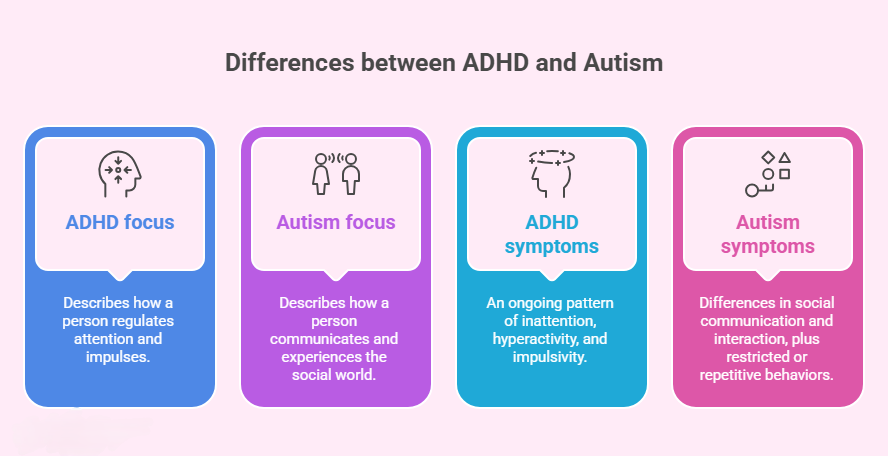
ADHD describes how a person regulates attention and impulses. Autism describes how a person communicates and experiences the social world. Clinicians can diagnose both in the same person [4].
What is the Difference Between ADHD and Autism?
ADHD is an ongoing pattern of inattention, hyperactivity, and impulsivity that interferes with daily life. Symptoms begin in childhood and usually continue into the teen years and adulthood.
Autism involves differences in social communication and interaction, plus restricted or repetitive behaviors or interests [2]. Symptoms generally appear in the first two years of life. In short, ADHD is mainly about attention and impulse control, while autism is mainly about social communication and a need for sameness.
ADHD vs Autism: Same Behavior, Different Reason
Two children can act the same way for different reasons. Use this table as a guide, not a test.
|
What you see |
Possible ADHD reason |
Possible autism reason |
|
Interrupts or blurts out |
Cannot wait for a turn |
Misses turn-taking cues, or is eager to share a favorite topic |
|
Cannot sit through circle time |
The body needs to move |
Noise or a sudden activity switch overwhelms |
|
Melts down at transitions |
Hard to stop a fun activity |
The plan changed or the routine broke |
|
Struggles with friends |
Acts before thinking, or drifts off mid-play |
Has trouble reading unwritten social rules |
|
Big emotional reaction |
Frustration and impulsivity make anger flare fast |
Sensory overload or an unexpected change builds to a meltdown |
|
Intense focus on one thing |
Hyperfocus, then moves on fast |
Deep, long-lasting interest with set rituals |
A child with both can have both reasons at once.
How do ADHD and Autism Overlap?
Both conditions begin in childhood and can affect daily life in similar ways. NIMH notes that some autism symptoms can overlap with ADHD [3]. Shared struggles often include:
- Trouble planning, starting, and switching tasks
- Strong reactions to noise, light, or textures
- Big emotional reactions when overwhelmed
- Difficulty with friendships
- Sleep problems
Overlap explains why a wrong or missing diagnosis is common. A clinician has to look at why a behavior happens, not only what it looks like.
Autism and ADHD Together in Children: What are the AuDHD Symptoms?
AuDHD is an informal name for having both autism and ADHD, and it is not a separate diagnosis [4]. You may also see it written as AuADHD or AuHD.
In AuDHD vs ADHD, ADHD alone involves inattention, hyperactivity, and impulsivity, while AuDHD adds autism’s differences in social communication and routines. Many children with both feel pulled in two directions: ADHD pushes toward novelty and movement, and autism pushes toward sameness and predictability.
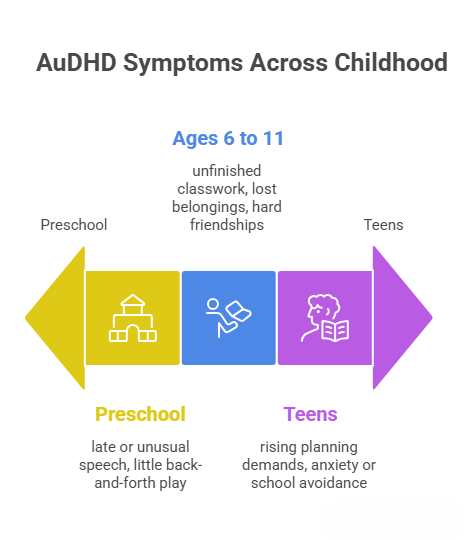
- Preschool: late or unusual speech, little back-and-forth play, strong sensory reactions, and nonstop motion.
- Ages 6 to 11: unfinished classwork, lost belongings, hard friendships, and blowups after school.
- Teens: rising planning demands, with anxiety or school avoidance when support is missing.
Autism signs can appear in the first year, such as not responding to their name by 9 months [2]. ADHD is often noticed later, when school demands rise.
Seeing These Signs in Your Child?
How Common are Autism and ADHD Together?
Rates vary because studies count diagnoses, checklist scores, and clinic or community samples differently. A 2019 meta-analysis of 96 studies found ADHD in 28% of autistic people [5]. In the other direction, about 1 in 8 children with ADHD also had an autism diagnosis in CDC survey data [6].
Children with both diagnoses had greater treatment needs and more co-occurring conditions [6]. These are group averages, not predictions for your child.
High Functioning Autism and ADHD in Children: What Parents Should Know
High-functioning autism is not an official diagnosis. The DSM-5 describes autism by support needs: Level 1 needs support, Level 2 substantial support, and Level 3 very substantial support. Clinicians often avoid the term because it can lead schools to offer less help than a child needs [7].
With ADHD added, strong grades can hide how hard the day feels. The child may hold it together at school and fall apart at home.
Describe daily struggles in specific terms instead of using a label. For example: my child cannot start homework without a reminder and melts down when the room is loud.
How are Autism and ADHD Diagnosed Together?
No single test diagnoses either one. A good evaluation combines a parent interview, developmental history, observation, and rating scales from parents and teachers. ADHD symptoms must appear in more than one setting, so teacher input matters.
Developmental-behavioral pediatricians, child psychologists, child psychiatrists, and neuropsychologists can evaluate for both. A board-certified behavior analyst (BCBA) can assess behavior but does not diagnose. Ask directly: Can you check for both?
At Achievement Behavior Services (ABS), we offer ASD evaluations and behavior assessments, and we can point you to the right next step if ADHD is also a concern.
Each condition can hide the other. In a school-based study, only 16% of children who had both conditions had been diagnosed with both before the study, yet parents and teachers noticed traits of both in almost all of them [4].
What Treatments and Supports Help Children with Autism and ADHD?
For ADHD, the American Academy of Pediatrics (AAP) recommends parent training in behavior management as first-line treatment for ages 4 to 5. For ages 6 to 11, it recommends medication plus parent training, classroom interventions, or both [8]. Medication can help ADHD symptoms but does not treat autism’s social communication differences.
For autism, common options include speech therapy, occupational therapy, and applied behavior analysis (ABA). ABA research centers on autism, and parent training is the best-studied behavioral option for ADHD. Some autistic adults criticize older, rigid ABA, so ask any provider how goals are chosen and how they respect your child’s assent. ABS provides in-home and center-based ABA therapy and parent training for families.
In the U.S., your child may qualify for an IEP or 504 plan, which the AAP calls a necessary part of ADHD treatment [8]. At home, use a visual schedule with small choices, give timer warnings before transitions, and break tasks into steps with quick rewards.
What Should I Do First If I Think My Child Has Both?
- Track what you see for two weeks, at home and at school.
- Ask the teacher what they see and whether the school can evaluate.
- Book an evaluation for both conditions, and join waitlists early.
- Start support now: routines, sleep, movement, and any recommended speech or OT.
- Review the plan at least once each school year.
Call your pediatrician right away if your child loses skills they once had, runs into danger, or hurts themselves. If you live in New York, New Jersey, Connecticut, Georgia, or North Carolina, the ABS team can talk through your child’s needs and help you plan next steps.
Ready for the Next Step?
Frequently Asked Questions
Is AuDHD an official diagnosis?
No. It is an informal term. Doctors diagnose autism and ADHD, and a child can receive both.
Can ADHD be mistaken for autism?
Yes. Some people without autism show a few of the same characteristics. A thorough evaluation with input from home and school lowers the risk of a wrong label.
Does ABA help ADHD?
ABA was developed for autism and is studied mostly there. Evidence that it reduces core ADHD symptoms is limited. Parent training has the strongest evidence for ADHD.
Sources
- NIMH, Attention-Deficit/Hyperactivity Disorder
- CDC, Signs and Symptoms of Autism Spectrum Disorder
- NIMH, Autism Spectrum Disorder fact sheet
- American Psychiatric Association, When Autism and ADHD Occur Together
- Lai et al., Lancet Psychiatry, 2019
- CDC, Zablotsky et al., Co-occurrence of ASD in children with ADHD
- Cleveland Clinic, High-functioning autism
- AAP 2019 ADHD guideline, treatment by age