Disclaimer:The content in this blog is for informational and educational purposes only. We do not offer speech therapy services.
Speech therapy for autism is one of the most important interventions a child on the spectrum can receive. Around 25 to 30 percent of autistic children are minimally verbal or do not develop functional speech and many more struggle with expressive language, social communication, or conversation skills. [1] The good news: evidence-based autism speech therapy techniques have advanced significantly. This guide covers the most effective methods available in 2026, broken down by approach, age, and need.
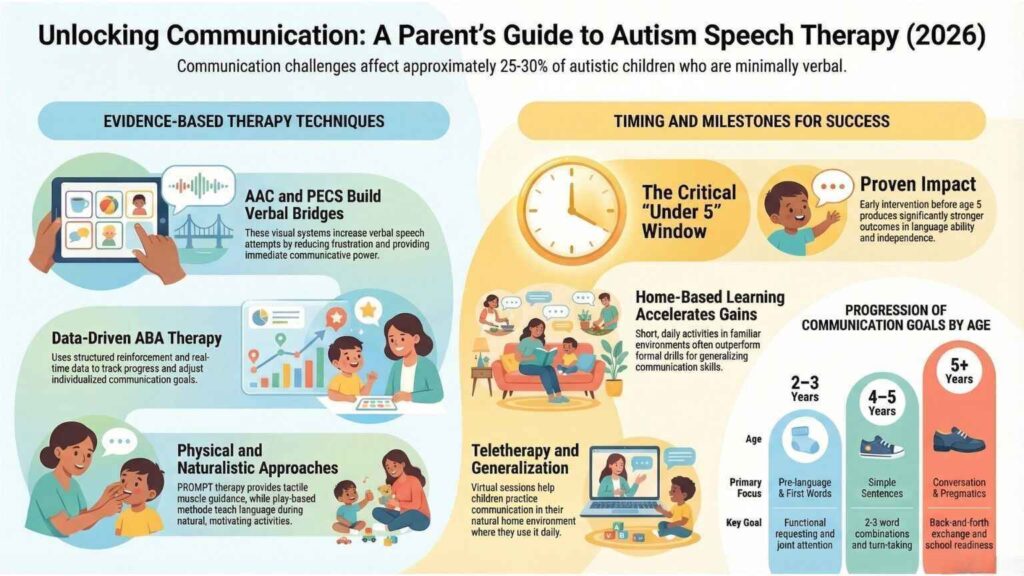
Why Speech Therapy Is So Important for Children with Autism
Communication is not just about talking. For autistic children, autism language therapy targets a wide range of skills including making requests, understanding what others say, using gestures, maintaining eye contact, and building back-and-forth conversation. When these skills are underdeveloped, frustration grows on both sides.
Research consistently shows that early speech intervention for autism produces the strongest and longest-lasting outcomes. [2] Children who receive structured communication support before age 5 show significantly greater gains in language ability, social interaction, and independence compared to those who begin later. The window is real and early action makes a measurable difference.
Speech therapy for autistic children typically targets:
- Expressive language: forming words, phrases, and sentences to express wants and feelings
- Receptive language: understanding spoken instructions, questions, and conversation
- Pragmatic language: knowing when, how, and why to communicate in social situations
- Nonverbal communication: eye contact, gestures, facial expressions, and pointing
- Articulation: producing speech sounds clearly and accurately
Is Your Child Struggling to Communicate? ABA Therapy Can Help.
Fill in the form below to discuss how your child could start therapy quickly, without the stress:
Why Speech Therapy Is So Important for Children with Autism
Communication is not just about talking. For autistic children, autism language therapy targets a wide range of skills including making requests, understanding what others say, using gestures, maintaining eye contact, and building back-and-forth conversation. When these skills are underdeveloped, frustration grows on both sides.
Research consistently shows that early speech intervention for autism produces the strongest and longest-lasting outcomes. [2] Children who receive structured communication support before age 5 show significantly greater gains in language ability, social interaction, and independence compared to those who begin later. The window is real and early action makes a measurable difference.
Speech therapy for autistic children typically targets:
- Expressive language: forming words, phrases, and sentences to express wants and feelings
- Receptive language: understanding spoken instructions, questions, and conversation
- Pragmatic language: knowing when, how, and why to communicate in social situations
- Nonverbal communication: eye contact, gestures, facial expressions, and pointing
- Articulation: producing speech sounds clearly and accurately
The Most Effective Autism Speech Therapy Techniques in 2026
No single method works for every child. The best outcomes come from combining approaches, guided by a speech-language pathologist (SLP) and supported by a BCBA when behavioral goals overlap with communication. Below are the most evidence-backed autism speech therapy methods available today.
1. ABA Therapy for Speech Development
ABA therapy for speech is one of the most widely used and rigorously studied approaches in autism communication support. ABA uses structured reinforcement strategies to build communication skills step-by-step. [3] Techniques include Discrete Trial Training (DTT), which breaks language goals into small teachable units, and Natural Environment Training (NET), which practices communication in real-life settings such as mealtimes, play, and daily routines.
A key strength of ABA-based speech therapy techniques for autism is the ongoing data collection. Every session is measured, so progress is tracked precisely and programs are adjusted quickly when a strategy is not working. This makes it highly individualized and accountable.
2. AAC Devices and Systems
AAC devices for autism Augmentative and Alternative Communication give children who are minimally verbal or nonverbal a way to communicate meaningfully. AAC includes speech-generating devices (SGDs), communication apps on tablets, picture boards, and sign language. A 2021 systematic review found that AAC interventions consistently improve functional communication outcomes for autistic children across all age groups. [4]
A common parent concern is that AAC will stop their child from trying to speak verbally. Research says the opposite is true AAC use often increases verbal speech attempts, because it reduces frustration and gives children a bridge to communication while verbal skills develop. The two reinforce each other rather than compete.
3. PECS – Picture Exchange Communication System
PECS autism communication is one of the most researched and widely implemented tools for nonverbal and minimally verbal autistic children. Developed by Bondy and Frost, PECS teaches children to exchange a picture card representing a desired item with a communication partner to make a request. It progresses through six structured phases, building from basic requests to forming short sentences.
In a 2014 study by Schreibman and Stahmer, children with autism who had fewer than 10 spoken words acquired approximately 90 spoken words after 6 months of PECS-based intervention and around 120 words after 9 months. [5] A meta-analysis by Hart and Banda found that nearly all participants showed an increase in functional communication when taught PECS making it one of the most reliably effective tools for speech therapy for nonverbal autistic children.
Did You Know?
A comprehensive review of AAC research found that augmentative communication systems consistently increase not decrease verbal speech attempts in autistic children. Providing a bridge to communication reduces frustration and creates more opportunities for meaningful interaction. [4]
4. PROMPT Therapy
PROMPT therapy autism Prompts for Restructuring Oral Muscular Phonetic Targets is a specialized, hands-on approach used by trained SLPs to directly support the physical production of speech sounds. The therapist uses tactile cues on the child’s face and jaw to guide the correct muscle movements needed to form specific sounds and words.
PROMPT is particularly effective for autistic children who have strong language comprehension but struggle with speech motor planning meaning they understand language but cannot consistently produce it physically. [6] It works well alongside ABA and AAC, and is often used with children aged 2 to 6 when early speech sound patterns are being established.
5. Play-Based and Naturalistic Speech Therapy
Play-based speech exercises for autistic children embed language practice into natural, motivating activities rather than structured drills. Approaches such as Pivotal Response Treatment (PRT) and the Early Start Denver Model (ESDM) teach communication in the flow of play, following the child’s lead and using their interests to create genuine communication moments.
For speech therapy for autistic toddlers specifically, naturalistic methods often outperform structured drills because they match how young children naturally acquire language. [7] The child is not pulled out of context, the learning happens in the environment where the child actually lives and communicates.
Read More: Understanding Hand Flapping in Autism
Speech Therapy by Age: What to Expect
The goals of autism speech therapy techniques shift as your child grows. Here is what evidence-based intervention looks like at each key stage:
Child’s Age | Primary Focus | Common Techniques Used | Key Goal |
2–3 years (toddlers) | Pre-language & first words | PECS Phases 1–2, ABA-NET, play-based therapy | Functional requesting, joint attention |
3–4 years | Expanding vocabulary | PECS Phases 3–4, AAC devices, naturalistic ABA | 50+ words, basic phrases |
4–5 years | Simple sentences & social language | PECS Phases 5–6, PRT, AAC + verbal modeling | 2–3 word combinations, turn-taking |
5+ years | Conversation & pragmatics | Social skills groups, ABA, PROMPT, teletherapy | Back-and-forth exchange, school readiness |
Note: These are general frameworks. A certified BCBA and SLP will assess your child individually and build a tailored program. For autism speech therapy for 3 year olds, autism speech therapy for 4 year olds, and autism speech therapy for 5 year old children, early and consistent intervention is the single most important factor in outcomes.
Not Sure Which Approach Is Right for Your Child? Let Our BCBAs Guide You.
Speech Therapy for Nonverbal Autistic Children: Where to Start
If your child has not yet developed speech, the goal is not to wait for verbal language to appear, it is to build communication now through whatever channel is available. Speech therapy for nonverbal autistic children begins with establishing joint attention (the ability to share focus with another person) and a reliable way to make requests.
PECS and AAC devices are the two most-used starting points. Both give your child immediate communicative power and a sense of agency which is critical for motivation and engagement. [5] Even a child who cannot speak can learn to make choices, express needs, and engage socially using these systems and many go on to develop verbal speech in parallel.
Key milestones to target before verbal speech:
- Eye contact and joint attention: looking toward a person or object of shared interest
- Intentional reaching and pointing: using the body to signal wants
- Requesting a preferred item: the first true communicative act in PECS
- Responding to name: foundation of all future social communication
Did You Know?
Children who receive evidence-based speech and communication intervention before age 5 show dramatically stronger language outcomes including higher rates of verbal speech development compared to those whose intervention begins in elementary school years. [2]
How to Help Your Autistic Child Speak: Exercises You Can Do at Home
Parents play an essential role in reinforcing speech exercises for autistic children between therapy sessions. You do not need a clinical setup. Consistent, short daily activities in familiar environments mealtimes, bath time, play are often more effective than formal drills. [7]
Here are five practical, evidence-informed strategies for home practice:
- Use ‘say it before they get it.’ Pause before handing over a desired item and model the word or sign. Give your child a 5-second window to attempt communication before providing the item.
- Follow their lead. Comment on what your child is already looking at or doing. ‘You have the red car!’ This is the foundation of naturalistic language modeling.
- Repeat and expand. If your child says ‘ball,’ you respond: ‘Yes! Throw the ball!’ Expanding on their output teaches the next language step without pressure.
- Create communication opportunities. Put a favorite toy in sight but out of reach. Give them only part of their snack. These gaps motivate communication attempts naturally.
- Practice choice-making. Hold up two items ‘Do you want the apple or the crackers?’ and wait. This builds requesting skills and expressive vocabulary simultaneously.
Teletherapy for Autistic Children - Does It Work in 2026?
Teletherapy for autistic children has grown significantly since 2020, and the research supporting it has strengthened. Virtual speech therapy sessions allow children to receive consistent, high-quality autism language therapy from their home in an environment where generalization of skills often happens faster than in a clinic. [8]
Teletherapy works especially well for school-age children who can maintain attention on a screen and for parent-coaching models, where the therapist guides the parent to deliver activities during the session. For toddlers, parent-mediated teletherapy has shown strong evidence the parent becomes the delivery agent with live guidance from the SLP or BCBA.
Benefits of teletherapy for autism speech therapy:
- No travel or scheduling barriers consistency is easier to maintain
- Parents learn techniques in real time reinforcement continues between sessions
- Child is already in their natural, familiar environment
- Expanding access in underserved areas of NY, NJ, GA, CT, and NC
Ready to Take the Next Step?
ABS Offers In-Home and Teletherapy-Compatible ABA for Speech – Available Across NY, NJ, CT, GA & NC.:
- New York – In-home and center-based ABA therapy
- New Jersey – ASD evaluations and individualized ABA programs
- Connecticut – Evidence-based autism support for families
- Georgia – Personalized ABA therapy for lasting results
- North Carolina – Supporting your child’s development journey
- Douglasville, GA – Family-centered autism care
Frequently Asked Questions
Q: What is the most effective speech therapy technique for autism?
No single technique is universally best, the most effective approach is individualized. However, research consistently supports ABA-based communication therapy, PECS, and AAC as the most evidence-backed starting points for most autistic children. A BCBA and SLP working together can determine which combination best fits your child’s profile and age.
Q: When should speech therapy for autism start?
As early as possible ideally before age 3. The brain’s neuroplasticity is highest in the first few years of life, and early speech intervention for autism during this window consistently produces stronger long-term outcomes. If you have concerns about your child’s communication development, request a developmental screening from your pediatrician right away. Do not wait for a formal diagnosis to seek support.
Q: What speech therapy is available for nonverbal autistic children?
PECS and AAC devices are the primary evidence-based options for speech therapy for nonverbal autistic children. Both give nonverbal children an immediate, reliable way to communicate. Many children who begin with these tools go on to develop verbal speech alongside their AAC system. PROMPT therapy can also be used when the barrier is motor planning rather than language comprehension.
Q: Can I do speech therapy exercises at home with my autistic child?
Yes and it is strongly encouraged. Parents who actively practice speech exercises for autistic children at home between professional sessions see faster progress. Strategies like creating communication opportunities, modeling words before providing items, and following your child’s lead during play are effective, research-backed tools any parent can use daily.
Q: Does ABA therapy help with speech for autistic children?
Yes. ABA therapy for speech is one of the most researched and widely used approaches. ABA uses structured reinforcement and data-driven programming to build communication skills. It is often delivered in coordination with a speech-language pathologist for children with significant communication goals. Achievement Behavior Services provides ABA programs that incorporate communication skill-building into every child’s individualized plan.
Q: Is teletherapy effective for autistic children’s speech development?
Teletherapy for autistic children has strong research support, particularly for school-age children and for parent-coaching models with toddlers. Delivering therapy in the home environment can actually accelerate generalization of skills because the child practices communication in the same setting where they will use it day-to-day.
References
[1] Baio J, et al. Prevalence of Autism Spectrum Disorder Among Children Aged 8 Years — Autism and Developmental Disabilities Monitoring Network, 11 Sites, United States, 2018. MMWR Surveillance Summaries.
https://www.cdc.gov/mmwr/volumes/67/ss/ss6706a1.htm
[2] Estes A, Munson J, Rogers SJ, et al. Long-term outcomes of early intervention in 6-year-old children with autism spectrum disorder. Journal of the American Academy of Child & Adolescent Psychiatry.
https://www.jaacap.org/article/S0890-8567(15)00256-7/abstract
[3] Lovaas OI. Behavioral treatment and normal educational and intellectual functioning in young autistic children. Journal of Consulting and Clinical Psychology.
https://pmc.ncbi.nlm.nih.gov/articles/PMC10422951/
[4] Sievers S, Trembath D, Westerveld M. The role of augmentative and alternative communication for children with autism: current status and future trends. Neuropsychiatric Disease and Treatment.
https://www.dovepress.com/the-role-of-augmentative-and-alternative-communication-for-children-wi-peer-reviewed-fulltext-article-NDT
[5] Schreibman L, Stahmer AC. A randomized trial comparison of the effects of verbal and pictorial naturalistic communication strategies on phrase speech in preschoolers with ASD. Journal of Autism and Developmental Disorders.
https://pmc.ncbi.nlm.nih.gov/articles/PMC4005390/
[6] Rogers SJ, Hayden D, Hepburn S, et al. Teaching young nonverbal children with autism useful speech: A pilot study of the Denver Model and PROMPT interventions. Journal of Autism and Developmental Disorders.
https://link.springer.com/article/10.1007/s10803-006-0142-x
[7] Kasari C, Kaiser A, Goods K, et al. Communication interventions for minimally verbal children with autism: A sequential multiple assignment randomized trial. Journal of the American Academy of Child & Adolescent Psychiatry.
https://pmc.ncbi.nlm.nih.gov/articles/PMC4030683/
[8] Sutherland R, Trembath D, Roberts J. Telehealth and autism: A systematic search and review of the literature. International Journal of Speech-Language Pathology.
https://www.tandfonline.com/doi/full/10.1080/17549507.2018.1465123
[9] Therrien MCS, et al. A systematic review of AAC interventions using speech generating devices for autistic preschoolers. Augmentative and Alternative Communication.
https://pubmed.ncbi.nlm.nih.gov/40164143/
[10] National Institutes of Health (NIH), National Institute on Deafness and Other Communication Disorders. Autism Spectrum Disorder: Communication Problems in Children.
https://www.nidcd.nih.gov/health/autism-spectrum-disorder-communication-problems-children