

ABA therapy follows a clear path: an intake and assessment, a first session focused on building trust, ongoing play-based sessions that teach skills, regular progress reviews, and a gradual wind-down as your child meets their goals. A BCBA guides every step, and data tracks progress throughout.
What Happens in ABA Therapy?
If your child was recently diagnosed with autism and ABA has been recommended, you are probably trying to picture what you are signing up for. What happens on day one? What does a session look like? When does it end?
This guide walks you through the entire ABA journey, stage by stage, so you know what to expect. For the bigger picture of the therapy itself, our overview of Applied Behavior Analysis explains the method behind the process.
The ABA Therapy Process, Step By Step
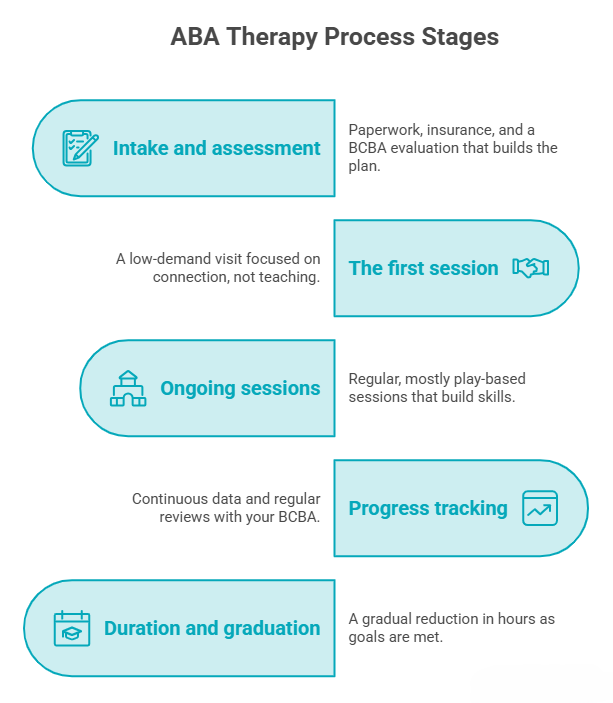
Most families move through five stages, in the same order every time:
- Intake and assessment: paperwork, insurance, and a BCBA evaluation that builds the plan
- The first session: a low-demand visit focused on connection, not teaching
- Ongoing sessions: regular, mostly play-based sessions that build skills
- Progress tracking: continuous data and regular reviews with your BCBA
- Duration and graduation: a gradual reduction in hours as goals are met
No two children follow the same timeline, but the sequence stays consistent. Here is what each stage involves.
Feeling overwhelmed? A BCBA can walk you through it.
Tell us about your child and we’ll explain exactly what the journey would look like for them.
Stage 1: Intake and Assessment
Everything starts before your child attends a single session. This stage covers the practical setup, intake forms, insurance verification, and authorization, followed by a clinical evaluation.
During the evaluation, a BCBA reviews records, interviews you, observes your child, and runs a formal skills assessment such as the VB-MAPP. Everything gathered becomes your child’s individualized treatment plan. Understanding the ABA intake and assessment process helps you prepare the right documents and avoid the delays that most often hold families up.
One thing to know: the goals your BCBA writes should reflect your family’s real priorities, not just clinical targets. This is the stage where those priorities get built in.
Stage 2: Your First Session
The first session surprises most parents. There is no table, no drills, and no demands. Instead, the therapist spends the visit “pairing” joining your child’s play to become a source of good experiences and build trust.
This is deliberate and backed by research. A child who links their therapist with fun will engage; a child who links them with demands will avoid them. Knowing what to expect during your child’s first ABA therapy session takes most of the anxiety out of day one.
First sessions are often shorter than parents expect. If the therapist ends early because your child has had enough, that is good clinical judgment.
Stage 3: Ongoing Sessions
Once the program begins, your child settles into a regular schedule. This is where most of the work happens and it is far more play-based than parents imagine. A good session can look like a therapist on the floor building blocks and blowing bubbles, all while running targets and recording data underneath the play.
Sessions follow a rhythm: a brief warm-up, focused skill building, natural practice, and genuine breaks. Seeing exactly what happens in an ABA session gives you a clear window into the hours your child spends in therapy.
Program intensity varies by child:
- Comprehensive programs: 25 to 40 hours per week
- Focused programs: 10 to 25 hours per week
Stage 4: Tracking Progress
ABA is data-driven, and this is what sets it apart from therapies that rely on impression. Every session produces data on your child’s goals, and the BCBA reviews it continuously, formally at least once a month.
That data drives every decision. A met goal moves to maintenance and a harder one replaces it; a stalled goal prompts a change in approach. Learning how ABA progress is measured means you never have to guess whether therapy is working, you can always ask to see the graphs.
Progress is rarely a straight line. Skills often plateau before a jump, so reviewing the data with your BCBA matters more than a verbal “things are going well.”
Stage 5: Duration and Graduation
ABA is not meant to last forever. It ends when your child consistently meets their goals and uses key skills independently, not at a fixed age or after a set number of years.
Duration varies widely. The honest answer to how long ABA therapy lasts is that it depends on your child’s needs, goals, and pace of progress, which is why the plan is reassessed regularly.
Graduation is gradual, not a single final session. As your child gains independence, weekly hours taper while skills are maintained across home, school, and community. The goal was never to keep your child in therapy, it was to help them need less of it.
Now that you know the path, ready to take the first step?
How the Stages Connect?
The five stages form a loop, not a straight line. The assessment sets goals, sessions work toward them, progress tracking measures them, and that measurement feeds back into the plan, adjusting goals and eventually reducing hours.
Your BCBA is the throughline, coordinating each stage and keeping the program aligned with your child’s data and your family’s priorities. This is also why choosing a strong provider matters: a good one like Achievement Behaviour Services runs this loop tightly, with real supervision and honest data.
Frequently Asked Questions
How soon after diagnosis can ABA therapy start?
Once you have a diagnosis and insurance in place, intake and assessment usually take a few weeks before regular sessions begin. Starting sooner matters most for children under 5.
Does my child need an autism diagnosis before starting?
For insurance-funded ABA, almost always yes. Most carriers require a formal diagnosis from a qualified clinician before authorizing therapy.
Where does ABA therapy take place?
Wherever your child needs to use the skills, at home, in a center, at school, or in the community. In-home programs suit young children well.
How involved will I be as a parent?
Very. Parent training is built into quality programs, because what you reinforce at home is where progress becomes real.
Is ABA therapy covered by insurance?
Yes. Most major carriers and Medicaid in eligible states cover ABA based on medical necessity, and coverage continues as long as therapy remains clinically appropriate.
Talk To A BCBA About Your Child's ABA Journey
Understanding the process is the first step. The next is a conversation about what it would look like for your child, the goals, the intensity, and the plan.
Our team has guided families through every stage of the ABA journey across New York, New Jersey, Connecticut, Georgia, and North Carolina since 2015. Request a free consultation to talk through where your child would begin.
Sources
[1] Behavior Analyst Certification Board (BACB). “About Behavior Analysis.” https://www.bacb.com/about-behavior-analysis/
[2] Hyman, S. L., Levy, S. E., Myers, S. M., & AAP Council on Children with Disabilities. (2020). “Identification, Evaluation, and Management of Children With Autism Spectrum Disorder.” Pediatrics, 145(1).
https://publications.aap.org/pediatrics/article/145/1/e20193447/
[3] Cooper, J. O., Heron, T. E., & Heward, W. L. (2020). Applied Behavior Analysis (3rd ed.). Hoboken, NJ: Pearson Education.
https://books.google.com/books/about/Applied_Behavior_Analysis.html?id=jeksEAAAQBAJ