

ABA therapy progress is measured through continuous data collection. Therapists record data on your child’s specific goals during every session, and the supervising BCBA reviews that data regularly at least monthly to confirm what’s working and adjust what isn’t.
If your child is in ABA, you’ve probably watched a therapist jotting notes or tapping a tablet during a session and wondered what exactly they’re tracking and how you’d know if it’s working. This guide answers both questions: what data gets collected, how goals are set, and how you as a parent actually see the progress. Progress tracking is the stage of what happens during ABA therapy that ties all the others together.
How is Progress Measured in ABA Therapy?
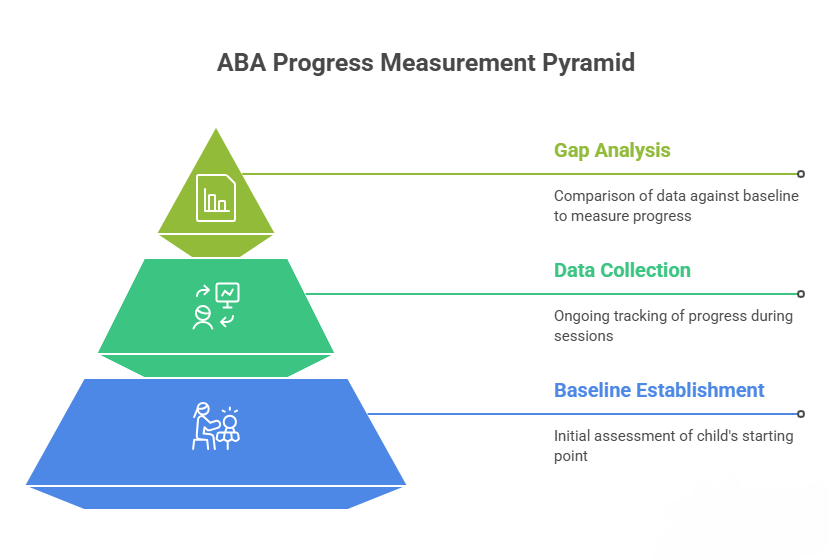
Progress in ABA is measured against your child’s individual goals, using objective data rather than general impressions. This is the core of what makes ABA different from many other therapies, every claim of progress is backed by numbers, not just a therapist’s sense that things are going well [1].
It works in three layers. First, the BCBA establishes a baseline, where your child starts on each goal before teaching begins. Second, the therapist collects session data on those same goals every visit. Third, the BCBA compares the ongoing data against the baseline to see whether the gap is closing.
A goal like “requests items independently” isn’t measured by whether it feels like your child is asking for more. It’s measured by counting: your child made independent requests 2 times per session at baseline, and 14 times per session three months in. That’s progress you can see on a graph.
What Data Do ABA Therapists Collect?
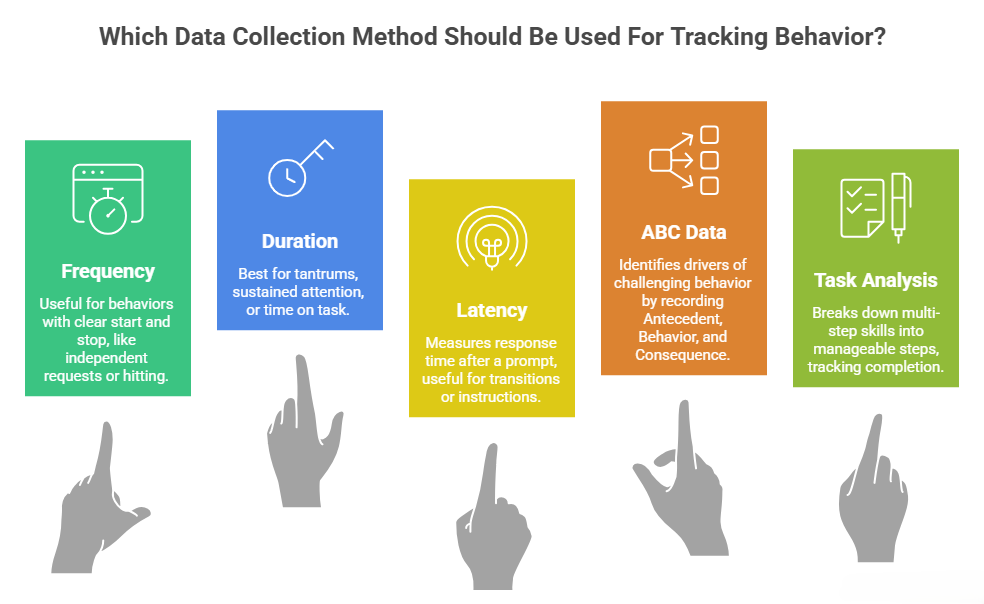
Therapists choose a data collection method that matches the specific behavior being tracked. A few show up in almost every program [2]:
- Frequency: how often a behavior happens. Used for things with a clear start and stop, like independent requests or hitting.
- Duration: how long a behavior lasts. Used for tantrums, sustained attention, or time on task.
- Latency: how long it takes your child to respond after a prompt. Useful for measuring how well transitions or instructions are working.
- ABC data: recording the Antecedent (what happened before), the Behavior, and the Consequence (what happened after). This is how the team identifies what’s driving challenging behavior.
- Task analysis: breaking a multi-step skill like handwashing into steps and tracking which ones your child completes independently.
Most programs blend several methods, because a single one rarely captures the full picture. The ABC method in particular does double duty: it’s also central to the Functional Behavior Assessment that shapes the original plan, which our guide to the ABA intake and assessment process walks through in detail.
Increasingly, this data is collected on tablets rather than paper, which lets the BCBA see trends in near real time and graph them automatically.
Want to know if your child is really making progress?
A BCBA can review where your child stands and show you exactly how progress is measured.
What Are ABA Therapy Goals?
Everything measured in ABA traces back to goals and good goals share three traits. They’re specific (not “improve communication” but “request 10 preferred items independently”), measurable (so progress can be counted), and individualized (built from your child’s own assessment, not a template).
Goals fall into two broad types. Skill acquisition goals build something new, communication, play, social interaction, daily living skills. Behavior reduction goals decrease something that’s interfering aggression, self-injury, elopement, always by teaching a replacement behavior that meets the same need, never by suppression alone.
Those goals come directly out of the initial assessment, where the BCBA maps your child’s current skills and priorities. If you haven’t reached that stage yet, our guide to your child’s first ABA therapy session shows how the process begins, and the intake and assessment guide explains how goals are chosen.
One thing worth asking your BCBA: whether your family’s priorities are reflected in the goals. A plan full of clinical targets that doesn’t help your child get through a morning routine has measured the wrong things.
How Often is the Treatment Plan Reviewed?
The BCBA reviews your child’s data continuously, but formal reviews happen on a regular cycle, typically at least monthly, and comprehensively every six months when insurance reauthorization comes up.
Between formal reviews, the BCBA is watching the data for two signals. If a goal is being met consistently, it moves to maintenance and a new, harder goal takes its place. If a goal is stalling, the BCBA changes the teaching approach rather than repeating a method that isn’t working. This is the engine of ABA, the plan is meant to change constantly based on what the data shows.
The six-month comprehensive review is also when the BCBA reassesses overall direction, often re-running parts of the original assessment to measure progress against the starting baseline. That reassessment ties directly to how long therapy continues, which our guide on how long ABA therapy lasts covers in full.
How Will I Know if My Child is Making Progress?
You’ll know in two ways: through the data your BCBA shares, and through changes you see at home.
The data is the objective measure. Your BCBA should be able to show you graphs for each goal, the line moving in the right direction is progress, plain and visible. Ask to see them.
But the changes you notice at home matter just as much. Progress often shows up as your child asking for something instead of melting down, following a two-step instruction, playing near another child, or getting through a transition that used to trigger a tantrum. These everyday shifts are the real point of the graphs.
From our experience at ABS: Progress in ABA is rarely a straight line, and that trips up a lot of parents. Skills often plateau for weeks before a jump, and challenging behaviors sometimes briefly increase before they improve. When a family tells us “nothing’s changing,” the data usually shows movement they couldn’t feel day to day, which is exactly why we review the graphs with parents rather than just reporting a verbal summary. Seeing the line is different from being told about it.
How Do Parents See Progress Data?
You should never have to guess whether therapy is working. Quality providers share progress data with families in a few standard ways:
- Regular progress meetings with the BCBA to review graphs and discuss what’s next
- Written progress reports, usually every six months for insurance, summarizing goals met and goals in progress
- Parent-facing dashboards on many digital data platforms, where you can see your child’s trends between meetings
- Session notes from the therapist, often shared after each visit
If a provider can’t or won’t show you your child’s data, treat that as a warning sign, it’s your right to see it, and a genuinely data-driven program has nothing to hide. This is one of the things worth checking when you’re choosing an ABA provider in the first place.
Not seeing real progress data from your current provider?
What Happens if My Child isn't Progressing?
If the data shows a goal has stalled, that’s not a failure, it’s information, and it triggers a specific response from the BCBA. This is exactly what the constant data collection is for.
The BCBA works through a sequence: first checking whether the goal was set at the right level, then whether the teaching method fits your child, then whether the reinforcement is actually motivating, then whether the skill needs to be broken into smaller steps. Often the fix is a change in approach, moving a skill from structured teaching to natural play, or switching which ABA method is being used. Our guide to the four main ABA methods explains how BCBAs match technique to the child.
Genuine lack of progress over time also prompts bigger questions, whether the intensity is right, whether another service like speech or occupational therapy should be added, or whether the goals themselves need rethinking. What should not happen is the same plan running unchanged month after month while the data stays flat. If that’s what you’re seeing, raise it directly with your BCBA.
Frequently Asked Questions
How often should I get progress updates?
Most families meet with the BCBA regularly for informal updates and receive a formal written report every six months. If you’d like more frequent updates, ask, a good provider will accommodate it.
Can I see the actual graphs, not just a summary?
Yes. You’re entitled to see your child’s data, and many providers now offer parent dashboards for between-meeting access. Seeing the graphs directly is more useful than a verbal summary.
What if I disagree with how progress is being measured?
Raise it with your BCBA. Goals and measurements should reflect your family’s priorities, and a good BCBA will explain their reasoning and adjust where it makes sense.
Does slow progress mean ABA isn’t working?
Not necessarily. Progress often plateaus before a jump, and some skills take longer than others. The data usually reveals movement that’s hard to feel day to day but persistent flat data does warrant a change in approach.
Is progress data used for insurance?
Yes. Carriers require progress data to reauthorize continued therapy, which is why consistent measurement matters. Our ABA insurance guide for New York explains how reauthorization works.
Talk to a BCBA About Tracking Your Child's Progress
Clear, honest progress tracking is one of the biggest differences between a strong ABA program and a weak one. If you’d like to understand how your child’s goals would be set, measured, and shared with you, that conversation starts with a BCBA.
Our team has designed and tracked individualized ABA programs for families across New York, New Jersey, Connecticut, Georgia, and North Carolina since 2015.
Sources
[1] Cooper, J. O., Heron, T. E., & Heward, W. L. (2020). Applied Behavior Analysis (3rd ed.). Hoboken, NJ: Pearson Education.
https://books.google.com/books/about/Applied_Behavior_Analysis.html?id=jeksEAAAQBAJ
[2] Behavior Analyst Certification Board (BACB). “RBT Task List (2nd ed.).”
https://www.bacb.com/rbt-task-list/
[3] Hyman, S. L., Levy, S. E., Myers, S. M., & AAP Council on Children with Disabilities. (2020). “Identification, Evaluation, and Management of Children With Autism Spectrum Disorder.” Pediatrics, 145(1).
https://publications.aap.org/pediatrics/article/145/1/e20193447/36917/Identification-Evaluation-and-Management-of